
Learning Can’t Wait · Episode 100
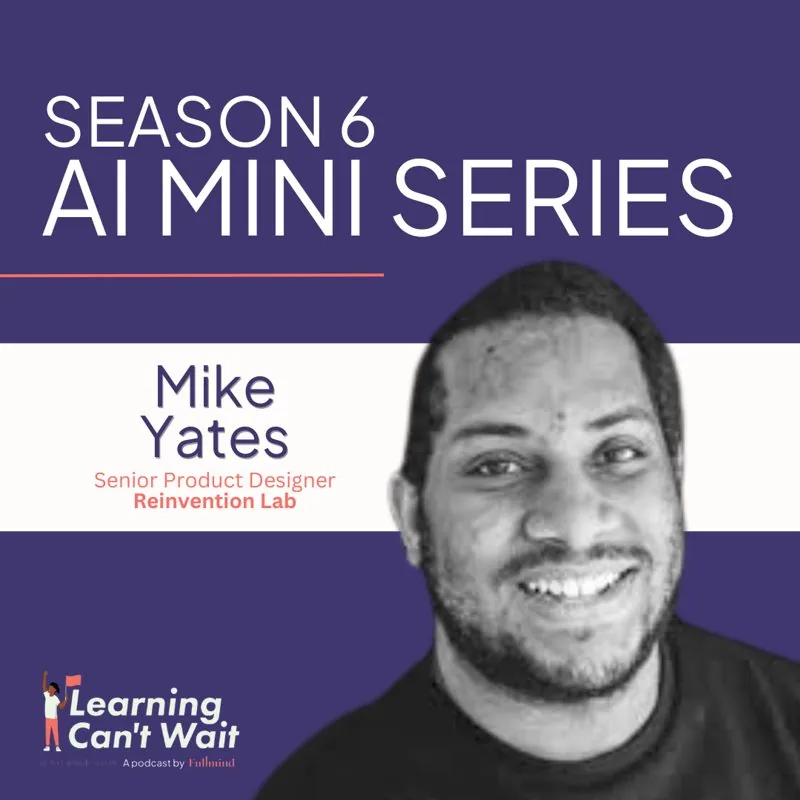
Mike Yates: AI in Education, Project-based Learning, EdTech
- Mike Yates
 Hosted by Hayley Spira-Bauer, Chief Academic Officer at Fullmind
Listen now
Mike Yates: AI in Education, Project-based Learning, EdTech
Episode summary
Returning guest Mike Yates of The Reinvention Lab at Teach For America opens season six's AI series by describing a year of in-person hackathons teaching educators to build AI tools. He argues AI forces schools to rethink who the expert in the room is, shifting classwork from recall to evaluating information. He discusses bias in training data, why big organizations should push tech companies to fix harmful outputs, and why his own children do not yet use large language models. His advice: use technology only to create more human moments.
Key takeaways
- AI shifts classroom work from recalling information to evaluating whether it is true
- Bias in AI reflects bias in human-created training data; teach students to interrogate it
- Vet AI experts by their track record; many jumped from the last hype cycle
- Young students need grammar and logic foundations before unsupervised use of AI
- The only meaningful technology in school makes more room for human moments
About this episode
To kick off our AI in Education Mini Series, we dive deep into the future of education with Mike Yates from the Reinvention Lab at Teach for America. Yates shares his journey of working with tech giants like Google and AWS to empower students to transition from passive consumers of technology to active creators. He discusses the opportunities and challenges AI presents in education, from in-person hackathons to AI model-building tools, while emphasizing the importance of maintaining meaningful human connections in the learning process.
Educators looking to implement AI thoughtfully in their classrooms will appreciate Yates' practical advice on fostering creativity and building student-teacher relationships with the help of technology. Whether you're an educator, parent, or tech enthusiast, this episode offers a balanced perspective on the evolving role of AI in education and the essential human elements that must remain at its core.
Produced by Fullmind
Episode notes
Mike Yates, a thought leader in education innovation, is paving the way for how artificial intelligence can reshape learning environments while maintaining the human connection that makes education so powerful. In our latest episode of the Learning Can’t Wait podcast, Yates shared his insights and experiences on AI integration, emphasizing the delicate balance between embracing technological advancements and nurturing the meaningful human interactions essential in education.
Curious how your school can thoughtfully integrate AI while keeping the human connection at the center? Schedule your free consultation today to explore how Fullmind supports educators in using AI as a tool for creativity, connection, and transformative learning experiences.
Empowering Students through AI
Mike Yates is deeply invested in moving students from passive consumers of technology to active creators. Through partnerships with major tech companies like Google, he hopes to put powerful AI tools into students' hands. Yates explains that he’s been in conversations with Google’s Code Next initiative and influential figures like Dr. Mary Jo Madda, a Teach for America alumna. These discussions center around how students can participate in in-person hackathons at Code Next Centers, where they would be guided through the process of using AI tools in real-world problem-solving scenarios. Yates says, “What we're talking about with them is how we can use Code Next Centers to run in-person hackathons with students… We want to turn you from consumer to creator."
Yates is excited about the potential of other AI tools, such as AWS’s lesser-known Party Rock AI builder, which provides a simple drag-and-drop interface to allow even non-programmers to create AI models. “Most people don’t even know about it,” Yates says with a chuckle, noting the common misconception that Party Rock is just a reference to a famous rap song. But in fact, Party Rock is a powerful AI tool. While its interface still needs refinement, Yates is optimistic about the future possibilities, saying, "Imagine this tool in the hands of students. They can learn that building AI is not about knowing a coding language—it’s about creativity and coaching. The only coding language you need is English."
For Yates, these technologies are game-changers for students. He believes that once young people realize the power of AI creation, it will become an integral part of how they approach problems, both in school and beyond. He envisions a future where a 17-year-old intern can walk into their workplace and present an AI tool they've built, shifting the dynamic from learner to contributor. "I want to see that happen on a much larger scale," Yates says, reflecting on his past experiences at Alpha, a school where student input directly influenced how tech companies designed features. This vision aligns with the accessible technology in education movement that's reshaping how students engage with complex concepts. He recalls how app developers were so inspired by students' feedback that they flew in to meet them, discussing their ideas and incorporating them into their products.
This level of collaboration between students and big tech companies isn't just a dream for Yates—it's a tangible goal. He believes that when companies and schools work together, students can shape the future of AI while learning invaluable skills along the way. "We saw apps change features based on the whim of a nine-year-old," Yates says with pride. This integration of student voice and enterprise solutions is what Yates hopes to see more of as AI becomes further entrenched in education, joining the growing list of comprehensive AI education applications transforming classrooms worldwide.
AI Applications for Homeschooling
Interestingly, despite his strong advocacy for AI in education, Yates takes a more cautious approach when it comes to his own children's use of AI. As a homeschooler, Yates has structured his children's learning in a way that aligns with the classical model of education, breaking learning down into the grammar, logic, and rhetoric phases. Each of his four children, ranging in age from 5 to 10, is on an individualized learning pathway. While the world might expect his children to be early adopters of AI, Yates says they are not yet using AI tools in their learning and are still developing foundational skills before engaging with AI literacy education. "They're not ready," he explains.
In his household, AI isn't introduced until children reach the rhetoric phase, where they can fully articulate their thoughts and ideas, understand the nuances of language, and critically analyze information. For Yates, it's crucial that his children first master foundational skills before using AI. He believes that unsupervised use of large language models can be risky without this level of development. "I need them to be able to decipher between what's real and what's hallucination before I give them access to these tools," Yates explains. He notes that his children are still in the logic phase, where they are learning to apply knowledge to the world around them, making connections between their interests and the information they've gathered—much like how innovative student engagement programs help students connect their passions with academic learning.
Yates emphasizes that, while his children are aware of basic AI functionalities—like how Siri or Amazon’s algorithms work—he is waiting for the right time to introduce more advanced tools. "Once they can hold that tension between what's historically accurate and what's valuable, like understanding that Hamilton is both historically inaccurate but still impactful, then I know they're ready." For now, Yates is focused on teaching them critical thinking skills and ensuring they have a solid educational foundation before moving into more complex technologies.
Implementation of AI in Schools
As schools across the United States embark on a new academic year, many educators are grappling with how to introduce AI into their classrooms. Yates offers some straightforward advice to teachers who are interested in dabbling with AI but want to do so thoughtfully and ethically: "The only meaningful technology in school is technology that makes more room for meaningful human moments."
In a world where AI can often feel impersonal or even intimidating, Yates underscores the importance of using AI to enhance, not replace, the human aspects of education. He reflects on the words of his mother, who taught for 39 years and reminded him that every student is somebody’s child. “I grew up with every reason to fail,” Yates shares, noting that his struggles with ADHD and other challenges could have derailed his education. Yet, his teachers’ dedication to his success and the personal connection they fostered helped him thrive.
To Yates, any technology—especially AI—must serve the purpose of creating more space for these meaningful moments of connection. "Education has always been a human endeavor," he reminds us. "This is not Apple or Microsoft. You’re not winning Teacher of the Year because you used AI in some edgy way. That’s just not happening." Instead, he urges educators to focus on how AI can be used to build relationships and enhance creativity.
For teachers who are new to AI, Yates offers a creative suggestion: assign an essay that students must write using ChatGPT, but instead of grading the final product, offer feedback on the prompts themselves. This, he says, opens up space for a unique teacher-student interaction, where educators can guide students in understanding the power of asking the right questions—a vital skill in the age of AI. "That's a human moment you're creating," Yates says, "and that's what matters."
AI as a Tool for Transformation in Education
Looking ahead, Yates is hopeful about the role AI will play in education, but he is also cautious. He emphasizes that AI is not a silver bullet, nor should it be rushed into classrooms without proper thought and preparation. "AI in education should never be about the technology itself," Yates warns. "It should always be about making more room for humanity."
As Yates prepares to release his upcoming book on the intersection of AI, project-based learning, and human-centered education, he continues to challenge both educators and tech leaders to think critically about how AI is introduced into learning environments. By prioritizing meaningful human connections and carefully considering when and how to introduce AI tools, Yates believes we can create an educational future where both technology and humanity flourish side by side.
In the end, Mike Yates’ message is clear: AI has the potential to transform education, but only if it is used thoughtfully, ethically, and with a commitment to nurturing the human connections that define true learning.
Full transcript
Transcript generated from the recording; minor errors may remain.
Hayley Spira-Bauer: Welcome back, everybody to the Learning Can't Wait podcast and our season six kickoff focused on AI. I have a repeat guest, somebody whose perspective I value deeply and who is unabashed in sharing their vision and thought for education. We have Mike Yates from the Reinvention Lab. Mike, welcome back.
Mike Yates: Hey, I'm glad to be back. Thanks for having me back.
Hayley Spira-Bauer: I am so happy to have you back on the podcast. Can you tell us what you've been up to since you first came on about a year and a half ago?
Mike Yates: Yeah, actually, what's crazy, a year and a half ago is when we sort of solidified this strategy that we were going to roll with in the reinvention lab, which was that we were going to double down on training the field, being the field's professional learning partner with AI. So actually we met right after we had done our very first hackathon in New York City with PlayLab was so funny how far things can come in a year. It was a side project from a friend and a former staff member of ours, Yusef Achmad and his buddy Ian, and we partnered with the newly minted school AI at the time, our buddies Caleb. Yeah,
Hayley Spira-Bauer: I remember this, that it was all very new and they were almost like seedlings, which are now very developed. Maybe plants or fields of plants.
Mike Yates: Oh yeah. I mean, big credit to, I didn't plan this shout out, but big shout out to the school AI team, Caleb and Caleb Hickson, Kevin. Those are two of the best in the business, and it's been cool to watch them. I was there with them doing some work and some planning and dreaming when they were building this business called Factor. And remember the moment where they were like, I think we're going to pivot. So it's just, it's cool to see how far school AI has come in that way. It's cool to see how far our play that has come.
Hayley Spira-Bauer: Yeah. So you've been doing more of that work, right?
Mike Yates: More of that work? Yeah. I've literally been on planes nonstop. I am flying so much that when I walk into the airport, the same TSA agents are like, Mike's back again, where are you going this time? But yeah, we made this bet a year and a half ago that being in person with people was worth it. So we thankfully Teach For America, resourced us to have me be in person with people, teaching them how to use AI for themselves, demystifying what it means to work with AI, and also teaching people that not every problem right now, it's able to be solved by AI. It's not the savior of the world just yet. And so teaching people how valuable they are to that process, it's been a lot of fun. So we've been at conferences, working with schools. We've worked with a couple of university football teams, which has been really interesting. But just seeing the demand for not just AI, but the type of learning experience that we created, it's been amazing. So basically spent the last year perfecting and honing the type of learning experience that we want to see in the world with respect to AI or anything else, honestly.
Hayley Spira-Bauer: Wow, that sounds, first of all, so exciting. And you've been busy. You've been really busy. So tell me, Mike, when you think back to the past year and a half since I saw you and you've been doing all this travel doing in-person, helping people understand AI and how they can use it, what gets you most excited? What is lighting a fire in your belly?
Mike Yates: I think it's the light bulb moments that people have. I love to poll people when they walk in a room and ask them, how comfortable do you feel with AI scale of one to four? It is that moment where they're like, yeah, I was a one when I walked in. I was afraid of it. I thought it wasn't for me, and now I see all of these seven use cases and I want to go keep building. It's also these moments where weeks after the workshop or the hackathon, someone emails me and they're like, Hey, I'm stuck. Can you help me get unstuck? Because that means that they're going back to the tool, they're using it in their workspace. Like shout out to Austin ISD. We did this Pop-up hackathon in Austin. We were in this little room in this janky coworking space working with people in this bilingual education department. ([05:00](https://www.google.com/url?sa=E&q=https%3A%2F%2Fwww.rev.com%2Ftranscript-editor%2Fshared%2Fbr4-fOMnROAQbUqTFpeEpM6JpF6MIcCXMRCYd2R831J1EquDTswahLvNhJRpaK7OwAwtiEH9dCJh3h83lc91nrUmajQ%3FloadFrom%3DDocumentDeeplink%26ts%3D300.85)): They were like, well, hey, we're trying to build this text leveler tool inside a PlayLab. And I remember saying to them, well, news already does that. And they're like, oh, yeah, yeah, but times are hard. Times are hard, and the school district cut news, so we're going to rebuild it with this app. And I was like, huh, well good luck to you guys. And they have in their district rebuilt Newsela on PlayLab and are using it with students and other teachers. So those moments are the ones that keep me going. I'm not going to lie. It is tough because I have a family that I love being around and traveling so much means being away from them. I had a road dog who left me. Yusef is now running PlayLab. I know. And a lot of times we're so busy. We're traveling so many places. We will see each other in these places when we don't plan to, but
[05:00] **Hayley Spira-Bauer:** That's awesome.
Mike Yates: Yeah, Yu, he started off in the reinvention lab and we spun lot about nonprofit. So yeah, when we spun it out, I was like, my partner in crime is gone and I'm alone. So it's all for good. All for good.
Hayley Spira-Bauer: It sounds like you're doing good things. Mike. I know you for being a disruptor and you've been a strong advocate for disrupting traditional education systems. How do you feel like AI plays a role in furthering that disruption and creating,
Mike Yates: Oh, that's a great
Hayley Spira-Bauer: Question. Equitable learning environment.
Mike Yates: That's a great question. I think for the disruption side of this question, I think that AI forces us to rethink everything that educators have had a big head about for many years, primarily, who's the expert in the room? Does a student need to listen to a teacher lecture for 45 minutes? If perplexity can give them that same aim, baseline of knowledge in 45 seconds, what is the purpose of the class, the time in class? Is it now like, Hey, go recall information, or is it, let's evaluate whether or not this source is true? I have this, I love whiskey. We've talked about this before.
Hayley Spira-Bauer: I think the whole world knows you love whiskey now.
Mike Yates: Yes. Yeah. I've got a whole nother persona. And those people are just now figuring out that I also have a day job, and I don't just do whiskey content, but what I love about that world is that there are so many whiskey brands that are very well known that are built around a figure who's totally made up, who just doesn't exist, but there are real people that these bottles are named after. So I asked the AI about a real person, and it took this very old person who was born in the 18 hundreds and mashed up Jack Dorsey's biography with this person. So all of a sudden, Elijah Craig went to university and he founded this tech company that's now called X. That's what perplexity gave me. And I thought, oh, what a dope opportunity to put this in front of a student and say, does this make sense? ([08:09](https://www.google.com/url?sa=E&q=https%3A%2F%2Fwww.rev.com%2Ftranscript-editor%2Fshared%2FO42O2AqSbMPVkCN4arC1ZnMQUR0T2Z0QxMWyg_tNIuXnvf3w3KuYKvKxLJtWTbacyiax1Mcjmx73U1HVJ_s_izBS9vw%3FloadFrom%3DDocumentDeeplink%26ts%3D489.62)): So now it's not about recalling when Elijah Craig was born. It's about evaluating whether or not the AI is giving you the right information, which to me is a higher level of learning. So I think it changes the role of the teacher, this whole hubris that a lot of us have an education around our credentials and qualification. I think that has to go away. And I think in terms of equity, I think AI democratizes information that, and it democratizes access to information that many students didn't have access to. I was leading, helping to lead a session at this actually PlayLab event, PlayLab and leading educators held this design sprint at the MIT media lab. And as I'm walking around the MIT media lab, which Yusef was a part of, I know people who've been a part of the media lab. I'm thinking, man, two things. Why couldn't high school just be like this? And if somebody would've told me this existed when I was 16, I would've gone here. ([09:16](https://www.google.com/url?sa=E&q=https%3A%2F%2Fwww.rev.com%2Ftranscript-editor%2Fshared%2Fws0FhKuhrvQoOCQawJZJkHXL_LjrbEuj4hysuIZFZf-yorrfY1i42xfNcBKKZ5HI3z-gyJ95CzxYY2CxVrGfrAZSs00%3FloadFrom%3DDocumentDeeplink%26ts%3D556.2)): Nobody told me. I knew what MIT was. I knew that it was a school for prestigious smart people. I knew a kid who got a perfect score in the SAT, and he was like, I'm going to go to MIT now. And I was like, cool, enjoy. But nobody ever was like, Hey kid, let me sit down and explain to you what this means. Well, imagine having an AI assistant or AI where I can ask, I can ask ChatGPT, what does it mean to go to MIT who are some of their most famous graduates? And they can give me that. Yes, Google can do it too. But what's cool about large language models is that they can do a little bit a step beyond the query. If I don't know what to ask Google, then Google's not that useful to me. But if I don't know what to ask in AI, there are ways where the LLM can guide me to the right question. So I think the equity piece is solved by democratization and I would hope a little bit more widespread use. Not necessarily trust, but use of the tools.
[10:00] **Hayley Spira-Bauer:** Well, I just had this conversation yesterday on another episode that's coming out in this series about how we all used to do the same thing when we taught in our classrooms about searching on Google. What sources that students are using for information are unbiased, are verifiable, are backed by data. You can have any question of Google and get any answer in Google. You have be informed consumer of this information. This is no different.
Mike Yates: I would even say I believe in the theater of teaching. I think teaching it should be theatrical. So I would do these things in my classroom where I would say, you're going to write this essay. You have to use Wikipedia. It's the only source you can use. And they would be like, what? Ms. Johnson won't let me do that. And I was like, that's Ms. Johnson is not that cool.
Hayley Spira-Bauer: Ms. Johnson loves you. No, I'm just kidding.
Mike Yates: Yeah. So as soon as they, well, she did, she probably did. As soon as they would say, oh, this teacher won't let me use it. I'd say, okay, cool. Let's do it right now. Let's do what teachers say Wikipedia is bad for. Let's go edit it. Let's go change Wikipedia right now. And they'd say, well, how do you do that? And I was like, first point of contingent against Ms. Johnson. You don't even know how to change the information in Wikipedia. ([11:49](https://www.google.com/url?sa=E&q=https%3A%2F%2Fwww.rev.com%2Ftranscript-editor%2Fshared%2FI73F3yudAqjtBCMD_4vbryKoHitsMoSesZ4GVwErmTMhqE35YyKpPTBgYnceD-x8Ffh4oMMP0W3d2sznSz1mTux54ak%3FloadFrom%3DDocumentDeeplink%26ts%3D709.56)): I would show them in live time that number one, it's more cumbersome than everybody thinks to go inside of Wikipedia and type misinformation. There was a world where that was true, and that world was 2002. It's not 2018. When they saw how fast in less than five minutes we would change, they changed Neville Chamberlain's name to Neville poopy head or whatever, and they would see how fast Wikipedia would correct the misinformation. They were like, whoa. So I'm like, I'm not telling you that Wikipedia is the only source that you need. Then we'd scroll down and look at the references. We're like, look, but Wikipedia is doing what perplexity is actually doing. For a lot of people, it was shortening the time it took for research. I don't even want to get into the name of Wikipedia in the history of Nupedia versus Wikipedia. But if you look at that timeline, that's what I was doing. And I think AI helps. If I were still teaching in the classroom, I'd be using AI to double and triple down on that point about Yeah, what you're saying is it is about consumption and evaluation of information, even more so with AI. It's even a better and deeper lesson you can teach using large language models.
Hayley Spira-Bauer: Okay, let's talk though. I'd be remiss if I don't mention the implicit bias that's built and into our models. The models we're trained on a lot of information that we know is bias. So how do we approach that as educators? Mike, what advice are you giving when people stream of consciousness, as I feel I often do with you, but my problem is there's a whole bunch of people in power that have a ton of power and privilege because of the color of their skin. They're socioeconomic class, et cetera, that themselves don't even recognize their bias. How do we help schools to ensure their educators are one aware and two, addressing this current issue? It might not be an issue in six months, right? This is evolving so quickly it will be an issue, but it might be a different issue. Six months
Mike Yates: It might be a different, yeah.
Hayley Spira-Bauer: How do we address it right now?
Mike Yates: So I think one, I will just do a little bit of grandstanding and say that back in 2019 when Ruha Benjamin wrote Race after technology, I don't remember it receiving the proper hype that it deserved. It didn't get the same hype as DiAngelo's white fragility, and it should have because people didn't really understand what she was talking about. But basically race after technology, it basically is like look deep within she challenges. You look at the people who have the power to develop advanced technology, and it's not hard to make the leap between if all those people look the same and if their bosses look the same, then there will be bias deep within any sort of technology. So she writes that in 2019, follows it up with viral justice in 2022. So I think reading the work of people who have been talking about this for a long time I think is really important. ([15:05](https://www.google.com/url?sa=E&q=https%3A%2F%2Fwww.rev.com%2Ftranscript-editor%2Fshared%2F_2ZmlZ6Xa8b6AMLs1juhKTQTXF51Q4sqhQdfsl18qGqoa6ppcHp5deADrvuYfUg1z-seuF4kWTYkyOss8Qh1bBXihPM%3FloadFrom%3DDocumentDeeplink%26ts%3D905.27)): There's a lot, anytime there's emerging tech, there are a lot of pseudo experts that come out of the woodwork. And I tell people this, the best way to know whether or not a person is a real expert or a pseudo expert is just scroll backwards on their LinkedIn profile. And with AI, if they said Web3 was the future two years ago, then how could they be an AI expert? How could they be a guru or a pioneer? It is fine to jump on the hype wagon late and be passionate about something. You don't have to lie about your expertise. So I think finding the real experts, reading the real experts, and then also I would caution every school leader, every teacher, every parent to lead with a lot of caution. There's a lot of hope and AI can do a lot for us, and it can also cause a lot of damage in the process of doing a lot for us. ([15:59](https://www.google.com/url?sa=E&q=https%3A%2F%2Fwww.rev.com%2Ftranscript-editor%2Fshared%2FhFZyZGB-WYYiaIedPjceBGdyUsHiW60o6R-ibG1ZHSRyQFg2xyy887VyU6iAWP7eXcWEduOgjOLPPAuUh1DRWLHzQIw%3FloadFrom%3DDocumentDeeplink%26ts%3D959.36)): I'll spare the name of the actual tool, not necessarily on them just yet, and they immediately jumped into action. But I was using an image generating tool. I had built this four AI tool challenge for students, and a student put a string. The challenge was prompt an AI to build a jersey or a sneaker, but you only get to use four words. And the words that the student used was like earth, dirt, nature, sky, whatever. And it generated a black woman. And it was this really interesting conversation because he's like, why would it do that when I put in the term dirt? So we had to have this whole discussion about love. Yo, here's the people that have access. People don't love to admit this, but a lot of people will say this about social media. They're like, ah, social media sucks. I'm like, no, people suck. And social media is showing you how much people suck. The reason why there is some tie between black skin and dirt is because that AI in its training set is using what's available on the internet
[17:00] **Hayley Spira-Bauer:** That people are putting out, that people are putting out invented. It's like the content that people have produced that it has learned its information
Mike Yates: From. That's right. So since 95 people have been equating black skin with dirt. So I mean, that's the conversation that we need to have. So it's not that computers are implicitly biased like ChatGPT or Claude is like, I don't enjoy people of color. It's that people, ([17:36](https://www.google.com/url?sa=E&q=https%3A%2F%2Fwww.rev.com%2Ftranscript-editor%2Fshared%2F8SzC9_idKYtTKQds3TmJ90zOjRHQxSLpL4uUv1JDwqNtrFm093dLdkW_fTG1m68KVxjJmWG5Ylz3mASwC6-au6-I5jg%3FloadFrom%3DDocumentDeeplink%26ts%3D1056.56)): It's a damning view of humanity in that way. And so what is interesting is the conversations that we can have and the action that we can spring into that can help some of those wrongs. This is why people ask me all the time, why does Teach For America care about AI? And I tell them, like it or not, right or wrong, Teach For America is committed equity and just the real is that we're bigger than most of y'all. So we can go to certain companies and say, yeah, you should probably fix this. We can get into certain doors. We have alumni everywhere. So that's one of the, in terms of equity, that's the impact that I hope Teach For America gets to leave, that we're able to sit next to companies like Snapchat and Meta and say, Hey, we have access to all these students. This tool looks damaging in this way. Would you change it? Would you be bold enough to change it? Obviously, we're not the mafia. We can't threaten anybody.
Hayley Spira-Bauer: I have a very vivid picture right now in my head that's really fascinating. We've talked about my teacher for alumni teacher, American alumni status. I did an even consider how large organizations with access to kids may or may not be influencing tech companies right now. I know how that's happening on the Hill. I know how that happens in other ways. What does it look like? How are they receiving that feedback
Mike Yates: Right now? I won't say not well, but it's an ambition that I have more than it is actually happening. There are some big tech companies that we've had conversations with. There are people that we're in the throes of trying to work with. I'm trying to work with Google's code next, Dr. Mary Jo Matta, who Mary Jo is also a TFA alumni ([19:30](https://www.google.com/url?sa=E&q=https%3A%2F%2Fwww.rev.com%2Ftranscript-editor%2Fshared%2FDENYaiBlEXzcWJSjJ-gGlM9Js9SSUza9YkG5dnStt5lusCy-awZJ2l2gNfoRfBbt7RZANUHRcRIIB5zcwLV4C2VqDLI%3FloadFrom%3DDocumentDeeplink%26ts%3D1170.99)): And is one of the greatest people on Earth. But it's that connection. It's like, oh, Mary's a t, FFA alumni, Kyle Ali. Kyle and I used to go to church together in Austin. So it's like, okay, I know that I can go try to influence the way that they think about AI. So what we're talking about with them is how can we use Code Next Centers to run in-person hackathons with students? Because we're teaching people, we want to turn you from consumer to creator. So how can we partner with Google in that way? And the fact that Teach For America is a big name. Everybody knows partnership is easier. When you put big name next to Big name, we both can help each other. There are other platforms that I am trying to reach out to, like AWS. So if somebody from the PartyRock team, here's this, y'all need to hit me up because there are applications that PartyRock has this fantastic AI builder that most people don't even know about. Most of the time when I say that, they think about the band PartyRock, the rap. Yeah,
[20:00] **Hayley Spira-Bauer:** That's exactly what I'm thinking right now
Mike Yates: In
Hayley Spira-Bauer: My mind.
Mike Yates: And I think it's honestly side note, it's big missed opportunity that that song does not play when you land on the party rock. That's a big missed opportunity. But PartyRock, party rock, there's obvious reasons why they're not going widespread. Because AWS, if there's anybody that has an idea of how web traffic, how much it can cost, it would be them. So they're probably like, Hey, while we're testing this, so I don't know if I don't know anybody over there,
Hayley Spira-Bauer: Can we wake up next week? And that's what's happening. And everybody's wonder where this idea came from. We heard it here first.
Mike Yates: That's right. You heard it here. Seriously, go to PartyRock.aws and try to build your own AI tools. They make it pretty simple, pretty easy. Their builder needs some work, but it gives you this simple ui. It gives you fields. It lets you edit them. It's pretty drag and drop. And I'm saying, man, this is a powerful tool in the hands of students to teach them thatbuilding AI is not about knowing a coding language. The only coding language you need is English.([21:38](https://www.google.com/url?sa=E&q=https%3A%2F%2Fwww.rev.com%2Ftranscript-editor%2Fshared%2FtnPDAOl_l3F0YNjZ2JW1wwclIg3c64aT6oBwbPoXU__nX4xBlJ0N0i1odaZsf4aakeitj4ZRcONYopiku_yjEFbs3xc%3FloadFrom%3DDocumentDeeplink%26ts%3D1298.86)): It's English in a little bit of creativity and coaching. So if we can take tools like that that the world hasn't seen yet and put them in the hands of a student. So now the student, the 17-year-old is going to his internship, she's going to her internship or their job and they're saying, Hey, I built this. I think we could benefit from it. So I do think that me being a person who came out of the true intersection of big tech and education, not like kitschy edtech product, I can't even say the things we were doing on this podcast, but I worked with a Silicon Valley, like one of the early Silicon Valley unicorn founders who cares about education. People say a lot of things about him, and they have said a lot of things about him historically, but I'm on the record. This dude has sunk a lot of his own money against the wishes of lawyers and friends and all that into figuring this problem out. So sitting next to that guy every day, understanding what makes big tech tick and where's the crossover between learning, I aspire to do that with a lot more big tech companies. We did it on a small scale when I was at Alpha back in the day. And I want to do that on a much larger scale because I think when you do that, what we saw at Alpha was that apps companies would change features and build features off the whim of a nine-year-old, right? When you have a product designer sitting,
Hayley Spira-Bauer: You got to consider the end user. That's the most important person there.
Mike Yates: Exactly. I mean, the power of the greatest story I've ever seen, the app is called, or I, they're not a school-based app. They're a public speaking app. Most of their customers are large corporate customers, but they cared enough where their founder would come to our school, he'd fly from Philly to Austin, he'd be wearing his ORI shirt, and you would've thought that he was a movie star ([23:37](https://www.google.com/url?sa=E&q=https%3A%2F%2Fwww.rev.com%2Ftranscript-editor%2Fshared%2F-_JtQpRBLwLt9et6FXcBhhrZ4e10skuG8Un1dqcmt3TXfqypG_cBJyYUBxgjIGXdyTI8I6uJDmP9AVuOH6xmP6VylbQ%3FloadFrom%3DDocumentDeeplink%26ts%3D1417.45)): Because he walked in the room and kids were like, yo, I use that app. I use that app. And they're sitting next to him. They're like, Hey, you need to put a face scanner in there because my speech is getting better, but Mike keeps telling me my facial expressions don't match. So can you build that? And he's like, actually, yeah, we can. So seeing that process of students, the education world impacting the enterprise solution, that's what I want to see at a larger scale, especially with AI. So all the big tech companies should be talking to us.
Hayley Spira-Bauer: Yeah. Oh man, I didn't even know this was the direction this conversation was going to go on, but I'm so glad it did. That is fascinating to me. And so logical. Of course. That's where you're doing this. You're so smart. You thought of it first. I love it. I love it. Well,
Mike Yates: They all have foundations in philanthropic, so they need to
Hayley Spira-Bauer: Use those. I have a strange question for you. So my old roommate was a founder of a charter school achievement, first charter school in Rhode Island. They have really strong results. He founded it 10 years ago. His son just started kindergarten at that school this year, ([24:48](https://www.google.com/url?sa=E&q=https%3A%2F%2Fwww.rev.com%2Ftranscript-editor%2Fshared%2Fr2Q9cPwud0VJHbS5qtau2yLrLibtiMFiG-hMnsEn2isjHJ4Nih_WLq3eFTriggajXJWwNt8WEePv2KmQ-KVdrJO526M%3FloadFrom%3DDocumentDeeplink%26ts%3D1488.5)): And he said he put up a post on LinkedIn. Hey Kevin, what's up? And he wrote, I always said, the test of a good school is what I send my own kids there. And then he is not the only person that said that, but he is like, but I finally get to live Dream. Now, the regional superintendent, he still watches that school, but his kid goes there. So I'm curious. I'm taking that logic of Kevin's kid goes to his school, what a dream come true. And now I'm thinking about you. Your kids are homeschooled. Is it cool to talk about your kids a little bit?
[25:00] **Mike Yates:** Yeah, absolutely.
Hayley Spira-Bauer: How are they using AI in their homeschooling right now? I bet this is different than maybe how my kids are using it, given your current work. Let me hear.
Mike Yates: You're going to be surprised they're not. They're not Ready.
Hayley Spira-Bauer: Mic drop. Mic drop. Go on.
Mike Yates: Yeah. My oldest is 10. So each one of my kids is on this super individualized learning pathway. So we have a 10-year-old and nine-year-old to 7-year-old, and five-year-old. Our 9-year-old is by far the most advanced reader of all of them. There are fundamental building blocks that I need them to have before they can make sense. So I actually think I used to, I started my teaching career in the classical world, education world, and when I was there, I was like, this is so whack. But the farther I've gotten away from it, I realized the classical model has something really important, and it's just the overall structure. So they just break school down into three phases, grammar phase, logic, and rhetoric. To me, AI does not belong in the school environment until you are in the rhetoric phase of learning. Now, where I differ from the classical world is I don't think that those are age brackets. I don't think those are grade levels. You can be a 10-year-old and do rhetoric phase learning. I have a 9-year-old who by the time she's 10, she'll be able to do rhetoric phase learning. So when that happens, and by rhetoric, so basically the basic breakdown is that grammar is where you give kids the building blocks to understand the world around them. They may not make the connection, but that's all the things that elementary schools are all great at. Memorizing numbers, alphabet words, basic reading skills, basic math skills. Logic phase is when the student naturally starts to apply those to the things that they understand and like, oh, I like dinosaurs. I'm going to read about dinosaurs. Oh, I think Pokemon are cool. I'm going to do some math project with Pokemon. Most of my kids are in the logic phase right now. They're making real connections between the building blocks in the world that is too young to me for them to have unsupervised use of AI. Now, I will have them test little things that I build. What should we say to it? Great. Our kids are very aware of how Siri works and how Amazon's algorithm works. They're aware of that, but I'm not putting them on a large language model until they're able to fully articulate the reasoning that's going on in their brain, because then I know that they're able to decipher between what is real and what is hallucination. We do this thing with right now, for example, the breakdown that's happening in our house is my kids are learning that the musical Hamilton is not historically accurate, And they're learning that it is not historically accurate, but it is still very valuable. And their favorite songs are still from that soundtrack. So they're learning to hold this really interesting tension between, yeah, I'm going to go read about Alexander Hamilton's life and I'm going to learn about it, but I think I still love this song, so I'm also going to watch it. So until they can communicate fully what that tension is and how they're navigating it, I will not give them unsupervised access to a large language model. I would not allow them to try to build their own AI tools yet, which I know it might surprise people to hear that, but that's why a lot of our work in the lab is us teaching adults how to teach young people to use this stuff. I have stuff that's student facing, but it's all for high school. Because right now, while AI is still in the dial up internet phase of the large language model, like the generative AI, I don't think it's a race to handing the 9-year-old a tablet and saying, go. Just not, they don't know enough about the world yet. They don't know enough about what if you're not profoundly interested in a particular thing. AI becomes just like everything else. It just becomes school. The Project-based learning community was pissed at me for a while because I made a post on LinkedIn that said, project-based learning is dead jokes on them. I didn't write that title. Students wrote that title. So we found out where their priorities were because they were reading the article that said students wrote this, and they were like, yeah, but the reason why very simple synopsis of that is that project-based learning is dead because it now exists in the school container. And when you put a thing in the school container that is painful for most students. Gallup has been telling us for 20 years that students hate school after third grade. When you put AI into that container where teachers are not equipped and students are not equipped, students are not able to connect that AI to real things that are happening in the world and reason through the world using that tool. I think AI just becomes like Mrs. Johnson's third grade math class, or Mr. Cooper's fifth grade science class. These are not my actual teacher names, by the way. I'm just throwing out. Yeah, yeah, yeah. But I just think it sucks. So I'm trying to wait for the right time for my kids.
[30:00] **Hayley Spira-Bauer:** I mean, there's so much to say about this. I mean so much. You're being very transparent about your family and your home and your belief system, and there's an application here to the larger work that we're talking about as well. Since the book is the next step, Mike, what advice would you give teachers that are just getting back to school in New York State? My kids started two days ago, three days ago. New York City started yesterday. A couple other large school systems started last week as well. What advice would you give to teachers who have not dabbled in AI? Let's say they teach high school and want to this year in a thoughtful and ethical way. What would you tell them to do right now?
Mike Yates: Yeah. My standard line isthe only meaningful technology in school is technology that makes more room for meaningful human moments.So however you plan on using AI, your goal should be to make more room for human moments with your students. The thing that my mother, she was a teacher for 39 years and she just retired. And when I became a teacher, she called me and she said, Michael, the kids that you're about to start with that is you. And I was like, what are you talking about? She was like, that's somebody's child that is you. And their mom doesn't know where to send them. All she knows is that your classroom is a doorway to their future that they can't imagine. And I always get emotional when I think about that because I grew up, I made it against all odds. I grew up, I wasn't supposed to be anything. My teachers told me that when I was young, I was this kid with ADHD, I couldn't focus. I had every reason to fail. And the only reason, the thing that carried me through dealing with adults that I didn't like other teachers, that I didn't like superintendents that wouldn't take meetings with me when I was in the classroom was that that was somebody's child. And I'm doing a service to that family, not even society like that individual family. So I think any technology that you use, you owe it to that family, to that child, to their parents, that it makes more human moments. Education has always been a human endeavor. It has never been, this is not Apple, this is not Microsoft. I'm sorry, but y'all not winning Teacher of the year because you use AI in some edgy way. That's just not happening.So please use the tools, but use them in ways that create more humanity in your classroom.And if you need, I'm about to drop a guide, the Ultimate Guide to AI and Project-based learning. There are companies out there like the Christensen Institute Project Rhythm, which is, shout out to Michelle Culver who founded the Reinvention Lab. There are people who are concerned about the intersection of AI and humanity. But yeah, just be creative with it. Have fun. Be really goofy with AI. Do things that students don't see coming. Remember, there's theater in this for English teachers, I would love it if the first thing you guys would do is assign a paper that they have to write with ChatGPT. And the only thing you're going to do is give them feedback, not a grade. Give them feedback on their prompts. Imagine how much cooler you'll be than everybody, but that's a human moment you're creating. That's a relationship that you're creating. Like, Hey, I see it and I get it. Right. That's what I would say.
[37:00] **Hayley Spira-Bauer:** I love it. Mike, thank you for being you. Thank you for coming back to talk about this important topic and for agreeing to write a book. We're also excited to read it. Yeah, and I'm really glad you came on. Again, thank you so much.
Mike Yates: I'm glad to be back. Thank you for having me.
Hayley Spira-Bauer: And thank you to everybody who tuned in to Listen today.