
Learning Can’t Wait · Episode 116
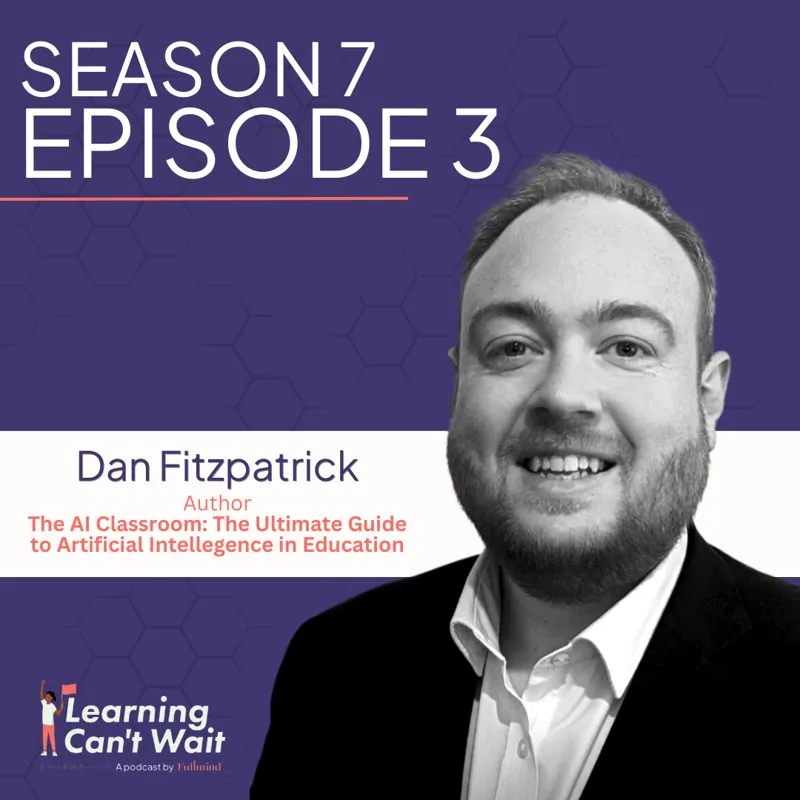
Dan Fitzpatrick: AI Educator, AI in Education, Education Innovation
- Dan Fitzpatrick, Educator and author
 Hosted by Hayley Spira-Bauer, Chief Academic Officer at Fullmind
Listen now
Dan Fitzpatrick: AI Educator, AI in Education, Education Innovation
Episode summary
Dan Fitzpatrick, UK-based education strategist and author of Infinite Education, explains how he moved from teaching and college leadership into advising schools worldwide on AI. He argues that strategy is not a step-by-step plan but the act of throwing your hat over the wall, that schools need heretical and connector leaders alongside managers, and that competition from online and alternative schools will force innovation. He warns that AI could widen gaps between families who can pay and those who cannot, and urges schools to teach entrepreneurial problem-solving.
Key takeaways
- Strategy is leadership in the future, not a plan; commit first, then figure out how
- Schools need a cycle of managerial, heretical, connector, and entrepreneurial leaders
- Online and alternative schools will bring real competition that forces innovation
- AI-powered education risks widening gaps unless access is deliberately equitable
- Students need entrepreneurial skills: identifying problems and delivering solutions
About this episode
On our newest episode of the Learning Can’t Wait podcast, our host Hayley Spira-Bauer speaks with educator and author Dan Fitzpatrick about how competition and AI are driving innovation in education. They explore the potential of technologies like AI tutors to reshape learning models, referencing groundbreaking examples like Synthesis, an online school fostering creativity and problem-solving. The discussion highlights the urgent need to rethink traditional systems and ensure equitable access to innovative tools, especially for underserved communities.
Dan and Hayley also reflect on the post-pandemic education landscape and the importance of equipping students with entrepreneurial skills for the future. Dan shares advice for new teachers, encouraging them to embrace creativity, innovation, and a willingness to challenge the status quo. This episode offers thought-provoking insights for educators and anyone invested in the future of learning.
Read Dan’s books here -
Episode notes
Education stands at the cusp of a revolutionary shift, driven by the rapid advancements in artificial intelligence (AI) and a growing demand for innovative approaches to learning. As highlighted in a recent episode of the Learning Can't Wait podcast, educators and thought leaders like Dan Fitzpatrick are calling for bold changes to reimagine how we teach, learn, and prepare students for the future. In this post, we explore key insights from the discussion on AI in education, the necessity for innovation, and the critical importance of equitable access.
To help schools stay ahead of these rapid changes, Fullmind provides state-certified, online-trained educators who are skilled at integrating technology, including AI tools, into everyday instruction. With Fullmind’s flexible virtual staffing solutions, districts can ensure every student—regardless of location or background—benefits from high-quality, innovative teaching that bridges the gap between traditional classrooms and the future of learning.
AI in Education: Transforming Learning Experiences
Artificial intelligence has already begun reshaping education by introducing tools like AI tutors, personalized learning platforms, and advanced problem-solving simulations. Dan Fitzpatrick pointed to innovative schools like Synthesis, which uses AI to guide students through collaborative problem-solving activities rather than traditional rote learning. These groundbreaking models challenge conventional schooling structures and prepare students for careers in evolving fields. Understanding the impact of AI in education reveals how AI-driven learning not only enhances educational outcomes but also personalizes the experience to meet the unique needs of every student.
While AI offers exciting possibilities, it also raises critical questions. Fitzpatrick and podcast host Hayley Spira-Bauer discussed the urgent need for public education systems to adopt these technologies proactively. As Fitzpatrick noted, competition from alternative education models will likely force innovation. However, he urged schools not to wait for external pressures to innovate, as doing so risks widening the gap between public education and more privileged alternatives.
Driving Educational Innovation: A Call to Action
The COVID-19 pandemic provided a glimpse of how education systems can adapt quickly, but Fitzpatrick emphasized that this shift fell short of meaningful transformation. "We took what we were doing in classrooms and stuck it on a Google Meet," he remarked, stressing the missed opportunity to restructure schooling entirely. Today, AI disruptions offer a new chance to innovate in the future of education with emerging technologies—but this time, the stakes are higher.
The podcast highlighted the importance of fostering entrepreneurial skills in students. Fitzpatrick argued that the means of production have shifted in the digital age. With just a laptop and internet access, students can create, problem-solve, and collaborate—essential skills for the modern workforce. By incorporating design thinking and real-world problem-solving into curricula, including innovative approaches like AI-powered teaching environments, schools can better equip students to succeed in a world where adaptability and innovation are paramount.
Ensuring Equitable Access to Education
One of the most pressing challenges in integrating AI and innovative practices into education is ensuring equitable access to educational technology for all students. Fitzpatrick warned of the risks associated with allowing only affluent families to benefit from cutting-edge educational models. As he explained, alternative education options, such as those powered by AI, could inadvertently deepen inequities if they remain exclusive to those with resources.
To counteract this potential divide, schools and policymakers must prioritize distributing these tools and opportunities broadly. Equitable access ensures that students from all backgrounds can benefit from advancements in education, leveling the playing field for future generations.
Redefining the Role of Educators
For educators entering the field today, Fitzpatrick’s advice was clear: “Take what you think being a teacher is and throw it out the window.” Teachers have an unprecedented opportunity to become innovators within their schools. By embracing AI and fostering a spirit of experimentation, educators can drive meaningful change from within the system. Fitzpatrick also encouraged teachers to share their insights publicly, becoming influencers who advocate for change and inspire others.
Conclusion
The future of education lies in our ability to innovate, embrace technology, and ensure equitable opportunities for all students. As AI continues to disrupt traditional schooling models, educators, policymakers, and communities must work together to harness its potential responsibly. By fostering entrepreneurial skills, redesigning outdated systems, and prioritizing access, we can create an educational landscape that truly prepares students for a dynamic future.
As Fitzpatrick eloquently put it, “The future is here already; it’s just unevenly distributed.” Now is the time to ensure that future is accessible to everyone.
Full transcript
Transcript generated from the recording; minor errors may remain.
Hayley Spira-Bauer: Welcome to the Learning Can't Wait podcast of Fullmind. At Fullmind, our vision is to ensure every child has access to an exceptional education. Each episode, we will be joined by Pathfinders within and around the education space who are bringing about transformational change. On behalf of deserving students, I'm your host, Hayley Spira-Bauer. Welcome back everybody to the Learning Can't Wait podcast. I am amazed I was able to get the next guest for this episode in one place as his busy travel schedule has been very busy. If you follow him, you'll know what I mean. In just a second. We have the incredible, Dan Fitzpatrick, the education strategist and author of the recent bestseller, infinite Education. Welcome, Dan.
Dan Fitzpatrick: Thank you so much for having me. It's amazing to be with you. And yeah, I've been looking forward to chatting with you for a while now, so hopefully we can have a great conversation.
Hayley Spira-Bauer: I'm really eager to talk to you as well, not just because your book is receiving a ton of buzz for its vision of education and the crossover between AI and education, but also because you really are considered one of the world's foremost experts on this very topic. And as we talk about the global influence of artificial intelligence development, I want to hear not just the United States perspective, but one for the whole world, and who better to do that than you?
Dan Fitzpatrick: Yeah, as you can probably tell from my accent, I'm from the northeast of England, which is where I am now. So as you can see, the listeners probably won't be able to see, but it's dark outside, so it's late at night here. So yeah, I'm really privileged. I get to travel around and around the uk, Europe, around the United States and Latin America as well, which is really cool. Yeah, so it's all going great. And like you said, the book seems to be going down well, which is all I can hope for really, because I suppose when you put out ideas, when you're kind of alone at your laptop right away, you don't know how it's going to be received, I guess. So it's always a bit nerve wracking, but thankfully people are getting it, at least that seems very true. Yeah.
Hayley Spira-Bauer: Well, let's do this. Let's jump into you and your vision and how we got here, and then we'll talk a little bit about the book. So Dan, how did you come to be the professional and personal version of yourself?
Dan Fitzpatrick: Yeah, I mean, it's taken a while. I'm 38. I keep wanting to say 39, but I'm 38, so I had lots of different jobs when I was younger, lots of, at one point I was a standup comedian, did that for a few years. And yeah, it took me a while to figure out really what I wanted to do. And I suppose I still don't fully know if I'm honest, but I always had a passion for wanting to see if there was something more, wanting to see how can we improve things, how can we do things better? No matter what field I was in, I always pushed for that. And yeah, my late twenties, I trained to be a teacher, a high school teacher in a place called Manchester in the north of England, and then moved back to Newcastle where I'm from, got into leadership with education. ([03:54](https://www.google.com/url?sa=E&q=https%3A%2F%2Fwww.rev.com%2Ftranscript-editor%2Fshared%2FdEoVxSOI3z9TS1xzvv-2OcdcZgoQAS2chlPbxqKeFdtOuJrcEO1cvZ_0hG4U7NSyfQQeNSCXZzDMkFAjmSmixV3csno%3FloadFrom%3DDocumentDeeplink%26ts%3D234.73)): I was always fascinated by EdTech, educational technology. It always blew my mind what was available out there, but how little of it was being used, especially in the uk, I feel like the United States has always been a bit ahead of us, but in the uk, education is very traditional, and we had all of these tools at our fingertips, but nobody really knew how to use them and how to make the most of them. So I always kind of had a passion for wanting to share these with fellow educators and try and change the learning experience for our young people. ([04:36](https://www.google.com/url?sa=E&q=https%3A%2F%2Fwww.rev.com%2Ftranscript-editor%2Fshared%2F32vmtipFunnDY7iPdUfVQi3sIRNZQloK6O0v5lUKhD0UzdzVnYFakIqoI_CYpYIYWOc7V1qkkE-FYywjjhuedVFB6o8%3FloadFrom%3DDocumentDeeplink%26ts%3D276.97)): So I got very into artificial intelligence, educational technology, and then moved into leadership within college education. It was high school education in the uk as it is in the United States, there's not enough budget really to really take things that far. So as somebody who was passionate and wanted to lead strategy and change in education, it made sense for me at a certain point to move to college education where there was more scope to make an impact. So I spent some time in industries, actually, I was writing an innovation strategy, a five year innovation strategy for the college, spent a lot of time in local industries, and that's why I first came across a tool that was first described to me as a calculator for words, and this really fascinated me because I was like, well, this could be really helpful for our teachers just on the most basic level of helping them save a bit of time. ([05:35](https://www.google.com/url?sa=E&q=https%3A%2F%2Fwww.rev.com%2Ftranscript-editor%2Fshared%2Fa-20SmV0fbhVjNd9ryQuwqBBxlEnvmEC0FYPGVuV5U5_nrzLUkP-ntRHdTlJ60XK5G_0y-7PR7LJlz996Yyby78s2rk%3FloadFrom%3DDocumentDeeplink%26ts%3D335.98)): And so we started to play around with early versions of this. And then in November, 2022, a company called OpenAI released ChatGPT, which was the tools we'd been playing with, but a lot more advanced. And I suppose the capabilities that I thought might be way down the line, five, 10 years down the line, we suddenly at our fingertips and suddenly realized that this could be another moment where education needs to grapple with something new. And I knew from my own experience that education was never particularly good at that and always took innovation and tried to fit it in with how to support what they were already doing, not take innovation and look at, well, how do we improve what we're doing necessarily? And I recognized that AI was actually going to be probably one of the most disruptive things to happen to education for a long time, if not forever, really. ([06:40](https://www.google.com/url?sa=E&q=https%3A%2F%2Fwww.rev.com%2Ftranscript-editor%2Fshared%2FTmuKU-iHVtbAHYyc0vaXWhyy1UmCB6ivWWkRCQ0T2tflRmNGO2uoxQzcD5BnjtoPodOxam0eKVJu3cZnIaovSpo7Zqc%3FloadFrom%3DDocumentDeeplink%26ts%3D400.04)): So sat out on this journey, really start writing, started helping other schools, other educators, businesses around the world, and how to use AI to rethink education, I guess. And I always joke, AI is kind of like the Trojan horse into schools, so I get invited in to talk about AI into, but actually once I'm in there, I think the main message is more the kind of transformational piece of, well, how do we improve education going forward? So yeah. Yeah, it's been a crazy few years as anyone who works in AI can probably attest to. But yeah, I wouldn't want to be doing anything else at the moment. And like you said and pointed out, my new book, infinite Education has just come out and it's geared towards the strategic side of things.
[07:00] **Hayley Spira-Bauer:** That is so interesting how you landed in this particular phase of your journey, which I know the journey is still going, but it is really fascinating to hear you speak about your nascent introduction to AI and then the rapid acceleration of basically its possibilities due to the introduction of ChatGPT. Can you talk a little bit about, if you can remember back before OpenAI released chat, GBT, where did you think this was going in, as you said, five to 10 years?
Dan Fitzpatrick: Yeah, I thought, I mean, I don't fully know. It's always a bit when you're trying to think back how you would think it's trying to piece it together. And I guess I think I thought maybe where we were at on the launch of OpenAI's ChatGPT that was probably going to be maybe 10 years down the line and didn't quite envisage it being as smooth as it is and how the back and forth with a tool like ChatGPT for example, how easy that would be. So yeah, I think even before when we first started looking at it, I was just kind of thinking if it could pick out keywords, if it could pick out the essence of how certain key terminology had been used within an essay or a piece of work like that, and then could give an indication to the lecturer or to the teacher of some metrics of the right, and that would be amazing, and that's what we were kind of looking at at the time. But yeah, I suppose what we got in the end was blew my mind.
Hayley Spira-Bauer: Right. I've talked to a few different technologists who say they were using AI before OpenAI gained popularity, and yet the proliferation and pace that we're seeing right now, particularly over the past year and a half, two years, is well beyond expectation. So obviously no one was fully anticipating maybe beside the engineers over AI what was to come. And now we're living in a world in which, as I said, it's rapidly changing. So let's talk about amidst this rapid change, you still have a blueprint for the future of what it can and should be, which is what you've laid out in your book, infinite Education. For those that haven't read it yet, can you talk us through what is that vision you've laid out and why do you think people are resonating with it?
[10:00] **Dan Fitzpatrick:** Well, what I tried to do in the book is I tried, I've, I'm really clear that I think we kind of misunderstand strategy a lot, and I think what we think of as strategy usually is a plan. So I think it's very, we see a lot of resources out there where it's like, right, the strategic approach to whatever it is might be AI. And it's like, right, well first of all, you need to speak to the parents, bring the community, and then you need to do some AI literacy within the school. You need to make sure that your IT department have security input and it's all really good stuff. I'm not saying this isn't good, of course it is good and it needs to happen, but I think that's almost after the strategy, that's the plan that flows from a strategy. So what I try to do in the book is I try to step back from that and say, right, well, even before we get into that, so this, and I'm probably detracting people away from the book by saying this, but when you get the book, it's not going to be a step-by-step process of what you should do to change your school. ([11:36](https://www.google.com/url?sa=E&q=https%3A%2F%2Fwww.rev.com%2Ftranscript-editor%2Fshared%2FBwgGF9hflaUJx19BMfKvjOaUaxXBrSZkYEXFc-5lLemcpvnMbbM388lWG_5nI7chpSexTg1woAafwUcF5Oc8h4A1T3c%3FloadFrom%3DDocumentDeeplink%26ts%3D696.63)): That's because I think that's impossible and for the reason that we don't know what this technology is going to be like in six months, nevermind five years. ([11:51](https://www.google.com/url?sa=E&q=https%3A%2F%2Fwww.rev.com%2Ftranscript-editor%2Fshared%2FxmCBXKsTTnZ8bayI8GlH0EKZP8FM0ouP6kpc12MikISwavHsr9M55NxI7I1chacyG8ZCNgcaIt247foF6N_fsAXMJSw%3FloadFrom%3DDocumentDeeplink%26ts%3D711.74)): And I see it a lot, and I kind of know why people do it, but it kind of infuriates me sometimes. And that is, I think, let it out, let it out. Here we go. But I think just thinking we know everything about how this is going to unfold just based off what we've got access to right now. And I think that's really dangerous because that is changing at such a fast pace, and there's so much happening behind the scenes that I don't think we realize the advanced robotics that's happening right now, it's predicted that within five years, many of us are going to have humanoid robots living with us that we can have an intellectual conversation with that can do chores around the house. These exist, this is not like a sci-fi prediction. You go onto YouTube and look up the Tesla Optimus or the figure two, they're already working in factories. ([12:46](https://www.google.com/url?sa=E&q=https%3A%2F%2Fwww.rev.com%2Ftranscript-editor%2Fshared%2FdXelsf1Jd3aoqRDOLU6rvzoh_EKQ45HsvUDm-stJ7eaps0cTzgqqjqjZ5vnTqimOxYSvxM7el0jabbhC8VMgVDyCCgI%3FloadFrom%3DDocumentDeeplink%26ts%3D766.96)): The figure two is already working at BMW factory, the optimist is already working in Tesla factories. Then you go over to the medical side or the more invasive side in terms of how places are linking AI with medical treatment, with breed and brain signals, and it starts to get really crazy. So just thinking AI is like ChatGPT or is an educational platform, and it is really kind of scratching the surface. So what I do is I try to give people the tools in this book that lets them continue to innovate. And for me, strategy is innovation because strategy is my definition for strategy, which I kind of got from a guy called Vijay Govindarajan, who's a business strategist, who I studied under when I did a postgraduate diploma at MIT. And he pretty much says that strategy is leadership in the future. It's all about how do we ensure that we are leading tomorrow, five years, 10 years down the line, and you've got to act now to be able to do that. ([14:02](https://www.google.com/url?sa=E&q=https%3A%2F%2Fwww.rev.com%2Ftranscript-editor%2Fshared%2FHNM39xEXvlmO8qyt6eExWw7zqNcSgN-McVbgIrEWgQgEDelY1BQ6evBOotOw6hzIduLw4dmpSsIUskEfsqgMPn5BuJ0%3FloadFrom%3DDocumentDeeplink%26ts%3D842.98)): So the strategy is kind of, and I use the analogy and I started using this analogy a while ago and realized nobody knew what it meant. And I think it might just be something like my dad said to me when I was younger, which I thought everybody knew, but they don't. But my dad used to say to me when I was younger, if you come up against a challenge, if you come up, let's say you come up against a wall and you need to climb over it and it's too high, you throw your hat over it. So you take your hat off, you throw your hat over it, then you've got no choice but to find a way over the wall.So for me, strategy is about throwing your hat over the wall, then you figure out how to get over it.Whereas going back to what we were saying before, I think we've confused strategy with how you get over the wall. ([14:52](https://www.google.com/url?sa=E&q=https%3A%2F%2Fwww.rev.com%2Ftranscript-editor%2Fshared%2FlvsIYAInne03ovpAA0kjhMi4LnouuU3hZBX3GT4mOU4kYZVpPFot5zEYUzyEYlfCkvSdBpL9Z3zp63PiCy2DMxr1Sq0%3FloadFrom%3DDocumentDeeplink%26ts%3D892.82)): I think strategy is the throwing of the hat over the wall, and then you figure out how to get over it. So the book is essentially how do you within an organization like a school, like a college, like a university that are very entrenched in tradition, a very entrenched as an orthodox approach that's been done a certain way for so long, how do we begin to envisage, I suppose, how far we can throw our hat over that wall? I think to take the analogy analogy even further and continue to do that because after we get over that wall, there'll be another wall and then there'll be another wall. So how do we have the skills and the know-how to be organizations that can continue to do this and takes a multifaceted approach, one of them being the type of people we have at our skills, the experience, the expertise we have or the vision that we have. ([16:04](https://www.google.com/url?sa=E&q=https%3A%2F%2Fwww.rev.com%2Ftranscript-editor%2Fshared%2FLNrD4UTkmodn1u9dxX3e1PFF93JIgDv_gl4-vgWmHa8I1JA9y7amKBvgsMDmeDCqDlgyvoYdfZwX3_DWxsIPUU7Il1Y%3FloadFrom%3DDocumentDeeplink%26ts%3D964.34)): And I kind of make the argument as well that within schools, we've always prioritized the managerial type of leader. So someone who can come in, take it over, keep it taken over, maybe incrementally improve it over time and then pass it on to another leader and so on. It's a managerial style of leadership. Whereas actually there's a whole spectrum of types of leaders, and I argue that we need, and I take these styles of leaders from a framework called Liberating Structures, which is a great builds on design thinking, and it's about making change in organizations. And after we have managerial leadership, which kind of happens within maturity of an organization, then we need to continue the cycle and move into what it calls creative destruction. So we have to then start to not recklessly, we need to do it with empathy, compassion, but we need to start unpicking. ([17:12](https://www.google.com/url?sa=E&q=https%3A%2F%2Fwww.rev.com%2Ftranscript-editor%2Fshared%2FP6TEIuLfgyamOIe55Oihz-U5ZY4vvl_tSDlT_-iZ5xMM44toDPTlnycfAgBNm9Pfg-1dmU77hzMtlgscuYxwnB1F6j4%3FloadFrom%3DDocumentDeeplink%26ts%3D1032.89)): We need to start deconstructing where we're at. And that type of manager, sorry, that type of leader, we need what's called a heretical leader. A leader who's going to say, actually, is there another way? Here is what we've got all there is, or is there more here? Can we unpick this and try and figure it out? And then it goes to leaders who are connectors, because once you've passed that point, you then need leaders who can bring ideas together, bring people together, and then it goes into an entrepreneurial style leader who can then build something, and then it goes to maturity. But the idea is that you keep moving and you have these different types of leaders in your organization. So I mean, that's just one approach that I mentioned in the book. And yeah, I guess it's probably just to give you one other insight into it, I explain it a bit of how do we create almost like a startup company within an ancient company. So because one of the things I argue is that I think we're on the brink of lots of new styles of education and not just on the brink, it's happening. The fastest growing school in the UK at the moment is an online school. And I know from my work in the United States, there's a lot of hybrid and online schooling now and has been for a few years, and not just a replication of what's going on in the classroom online, but there's a lot of innovation going on with that.
[18:00] **Hayley Spira-Bauer:** And that's what I love what you said about creative destruction, right? That speaks volumes right there because status quo isn't doing what it needs to do for all kids. So we already know. So you and I are very aligned here. Sorry to interrupt. No, it's, you're very aligned. I love that you infuse the word empathy because when I rabble rouse, I want people to know that I do it with equity and care and empathy, but rabblerousing is necessary. We have a world ahead of us that we have never experienced, lived or known.
Dan Fitzpatrick: Yeah, exactly. Yeah, no, and I think how we get through that is through choice. We have to lay everything out, and I think we have to do that for our students and their parents as well. And that's what quite, I suppose my career at the moment is I go into established schools and colleges and universities and help them to do that process that you just spoke about. But also, I'm also quite excited that there are these new types of school popping up and being created because the more choice we can give to parents, to families, to students, that the better I think. And I think we're on the brink. I don't think we're fully there yet, but I think we could be on the brink of a phenomena that's happened in other sectors, which is decentralization. So we are seeing within finance, we have been for the last 15 years or so, a real kind of march towards decentralized finance. ([20:21](https://www.google.com/url?sa=E&q=https%3A%2F%2Fwww.rev.com%2Ftranscript-editor%2Fshared%2FlAwvRwAj9T2T_3ybkrkJCfOPil2HzGz9kbRvyYh5oVVcJBZhHwAm29p6CA_ryEp6ADngWgEA5S3IAcQXaismwSXFhpU%3FloadFrom%3DDocumentDeeplink%26ts%3D1221.27)): And it's really challenging economies all over the world at the moment. And those centralized financial systems, same with ownership, same with, I mean art to a certain extent, healthcare, I know a few people who are working in healthcare, and there's a big push at the moment on the innovation side of healthcare for it to become more decentralized away from the centralized hospital in a city, more to how can healthcare be brought to the person and be continuous, so, so I think education is kind of on that journey of that phenomena as well. And I think this is the crux of it here. And that because of that, I think we are going to start to get competition in education where we have never really had proper competition in education. Now you might get independent schools where they might be competing against another independent school, but you look under the hood and a lot of it's very similar. ([21:27](https://www.google.com/url?sa=E&q=https%3A%2F%2Fwww.rev.com%2Ftranscript-editor%2Fshared%2FBTMyC4e9bdZuTWo7epGs-s1nCBqQ7G_3O-nhjxnwkDiH2mcTrLllYFp8tKJlbkwzWdOHgw3wPFbJb7ealId0I3BpJH0%3FloadFrom%3DDocumentDeeplink%26ts%3D1287.43)): 99% of it is very, very similar, but I think we will start to see competition that varies drastically to what we might call school. And I think when that happens, just like it does in the business world, it forces innovation to happen. Innovation happens in the business world because of competition. And I think education has almost had a special dispensation from that for a long, long time. And I think that's probably coming to an end. So I think we innovate or we put ourselves in a really tricky position over the coming years based on the offerings that we're providing for our students and for their families. I think it's exciting. We get to be part of almost a generation who gets to do that creative destruction and start to think about how we forge forward. But yeah, it's an interesting time, and I think we're going to be shocked by some of the AI that's going to come coming in the next few years, and that will kind of make us think
[22:00] **Hayley Spira-Bauer:** How do
Dan Fitzpatrick: This,
Hayley Spira-Bauer: And I want to get to that in a second. I know you just wrote a great Forbes piece about AGI, artificial general
Dan Fitzpatrick: Intelligence. Okay. Yes.
Hayley Spira-Bauer: But I'm going to get to that in just a second. I think one interesting comment that I've heard a couple times from school superintendents in the United, for those listening in the uk, school superintendents in the US oversee districts. So I have some superintendents on the podcast
Dan Fitzpatrick: Don't have that superintendent in the uk,
Hayley Spira-Bauer: Right? Right, right.
Dan Fitzpatrick: So I was giving anyone in the UK who hears the word superintendent just thinks the superintendent charmers from the Simpsons. That's literally the only link to that word we
Hayley Spira-Bauer: Have. So different, very, very different. Some really brilliant people who do incredibly hard work for context for our UK listeners that incredibly high turnover rates because the role is so challenging, but so important here. But my point here being I interviewed one today, and unfortunately the episode is not going to go live till March. So a little bit of a time warp here because Dan, your episode is going live in January, and this episode won't go live in March. But this leader used the words malpractice as it refers to what was possible after the pandemic, what amount of change we really should have seen in terms of restructuring schooling, but it never happened, right? We had this opportunity, and this is somewhat divorced of the concept of introducing AI, but really to your point about rethinking education, she said she thought the pandemic would bring a complete restructuring of schooling to benefit children. ([24:22](https://www.google.com/url?sa=E&q=https%3A%2F%2Fwww.rev.com%2Ftranscript-editor%2Fshared%2FDeUGC5SyS_KpoOBEUSPg65L4nu_TUgXZarH6Wy5kgiQBjkWPEBppC-Mvm50NyYxUOyQizah4DAgTnYlLff_GCizSF9U%3FloadFrom%3DDocumentDeeplink%26ts%3D1462.97)): And it never happened to the point so far that she thinks it's malpractice, that we just went back to our old systems and our old ways and maybe tweaked a couple things here or there. And like you and like me, we all are looking for bigger change than that. We think it's possible. In your book, you talk about this, we think it's possible to disrupt more holistically than we are right now. So I find it really fascinating. Your concept of the competition is going to lead to you believe that competition is going to lead to that change.
Dan Fitzpatrick: I think it will eventually. I almost don't want us to wait till that moment because it could mean that what we call here state education, I think you guys call it public education. I guess it could really lead to a sticky situation for when parents have choice. And I think we need to start innovating now. In fact, we should have been innovating for the last 20 years, I think probably since the dawn of the internet, really, ([25:29](https://www.google.com/url?sa=E&q=https%3A%2F%2Fwww.rev.com%2Ftranscript-editor%2Fshared%2F-04kd9ik-C4vwXjkqHPrbEJArkBGUWfFiSHS_JDrAgjYr7F8AUlkWM1x9H8Fu3N8RfncW_tVOSQ8N7jmeNSmeWeePv8%3FloadFrom%3DDocumentDeeplink%26ts%3D1529.63)): Because it's been on the card since then. But yeah, COVID is interesting. I do mention Covid a few times in the book can, I think Covid had an end, that's why. So we always knew it was going to come to an end at some point. And so no matter what we did, we knew it didn't have to be long-term. AI disruptions doesn't have an end. And I think that's the main difference there. Plus we didn't know how to innovate.Covid came along and we took what we were doing in the classroom and stuck it on a Google meet, right?
[25:00] **Hayley Spira-Bauer:** Yeah, no, that's, you two should meet the woman I'm talking to. Her name is Shannon Cox. She's the head of not just a district, but an entire county in Ohio that's incredibly innovative, and it's called Montgomery County ESC. I talk about them constantly. I even brought them up to some political figures I had on the podcast, Arne Duncan, the former US Education secretary, just to share the stories of what's happening in this county in Ohio because it's so incredible. That's really cool. But I say this because the level of change that you and Shannon advocating for and that you think is coming with the right level of conditions is important. I'm a big believer in education opportunities that are innovative and exciting and make a difference in children's lives should be equitably distributed. And I do believe you talk about this in your book, that AI has the potential to do that.
Dan Fitzpatrick: Yeah, yeah, I think so. And it's interesting you just said that. I was on a panel the other day and there was a great guy called Guy Claxton. He's a British psychologist who talks about innovating education. And he quote, I forget who he quoted now, but the court was essentially, the future is here already. It's just unevenly distributed. And I think we can see that we can't. There's a school out of California, an online school called Synthesis, where it has the highest number of billionaire parents who send their kids to this online school. It was born out of SpaceX. They have AI tutors who teach the children, and then they work on problem solving and communication with the students in these. And you wouldn't recognize it as a school. It would probably, I think if most teachers looked at it, they'd probably see it to be almost like an extracurricular club style. That's what they would recognize it as. But actually it's a school and some of these students are being year marked by top companies for when they graduate. And I think once we get to that point and people start going, actually, these students are going into amazing opportunities from this type of education, that's when I think people all start to think, actually, there are other routes here
Hayley Spira-Bauer: And how can we distribute it? To your point, how can we distribute it to all, not just the billionaires kids.
Dan Fitzpatrick: Exactly. Yeah, exactly. And I think that will likely come in terms of competition drives price down as well. And I think we will get big companies, whether it be Google, Microsoft Khan Academy or whoever it is, who will offer, I think we'll get to a point where full curriculums, full education programs will be offered for free online as well. I do worry though, and I don't want to give the impression that I think this is all going to be kind rosy and amazing, because I think there's a huge possibility that a gap will continue to divide those who have and those who don't have. And I kind of compare it to, I spent some time about 15 years ago in Kenya, in Africa, I was there for about six months. And the education system there is, the state education system is very, very poor. ([29:41](https://www.google.com/url?sa=E&q=https%3A%2F%2Fwww.rev.com%2Ftranscript-editor%2Fshared%2FH4Xg3qOT9naKST0aDcA0qHc3HUDDg8FeqDRiZreYWb3J-4RBRoigTuqKdfD_jTTPz64_ksmxrcZvIDpIEAu35LpeQtI%3FloadFrom%3DDocumentDeeplink%26ts%3D1781.05)): It's very, very basic. They might be in a mud hut with a blackboard and anybody who has money, which is not many people at all, but even if you've got a little bit of money, you can afford some kind of higher up education. And what that means is that the money in the state education is non-existent. They don't have much at all. And so I do worry that if we do start to get these alternative forms of education and the parents who are more, for want of a better term, switched on and realize that these are the forms and maybe have a little bit of money to spend on it, it could drive a real wedge between those who even just, I mean, look at our economies at the moment, even those who just have a little bit of disposable income, which is not many people in this economy, just a small extra bit at the end of the month. And those who don't. And I suppose a bit like what happens in the United States, it doesn't happen in the uk, but education through voucher schemes and parents being able to choose where they spend those vouchers and so on. And that could really be a disadvantage to state education that a lot of people who don't have as much will rely on, but could start to become really underfunded more and more. I mean, there was some things. I think that's
[30:00] **Hayley Spira-Bauer:** Why we have to talk about it, constantly talk about it every time we have the opportunity to think about, yes, we have access to these great tools, these great resources, these great schooling opportunities, but who is we have access? Is it everyone? Is it a subpopulation who can afford it or has the means and resources to know where it is? It's important.
Dan Fitzpatrick: And also I think we're talking about innovation of schools, but actually given our students the tools for them to be innovative. And I mentioned, I think it's in the introduction of my book, I talk about how the means of production has changed over the centuries. So you go back to the post-industrial era, somebody who could produce more wealth was likely somebody who had wealth already. They had land, they were go back to feudal times. Then we get into the industrial revolution and actually the key marker. Now, land and wealth was still important, but one of the key marker for being able to produce wealth became labor. So could you bring people together to work for you and so on. We're now kind of in that post industrial times where actually it's entrepreneurial skills because you don't need wealth already. I mean, you need a laptop, you don't need land, you need a table in a Starbucks, you don't necessarily need labor. ([32:46](https://www.google.com/url?sa=E&q=https%3A%2F%2Fwww.rev.com%2Ftranscript-editor%2Fshared%2FxnFV2vwSByZFozJc5tHKLr9kNw9bBhsIvCCOjqk-mYIBQ8Av6RZcrMN0HXH-mWZo8iTY4MqjCL9NyN_7Dy-IR33gdLM%3FloadFrom%3DDocumentDeeplink%26ts%3D1966.13)): You can work with AI. You can literally do the job of 10 people with AI now. And what that leaves is, I suppose the individual vision, the individual ability to solve problems, to discover solutions, to then to act, to bring something to market. It's entrepreneurial skills. And I make the argument in the book that when I talk about that, I'm not saying everyone has to become a business person or start a business, but it's the skills behind that. It's the ability to be able to identify gaps, to identify problems and deliver solutions. And I think that's going to be the key marker. And our schooling, and I paint in very broad strokes here because I know not all schools are like this, but our schooling doesn't really do that. It's all about, we're going to give you some information that you need to learn. It's not about, here's a problem, let's spend some time on figuring something out here. Let's spend a term on working with a local water company who are having droughts and are about to go out of business, and can we help them? Can we put our brains together and can we teach our students some design thinking skills to work with the, do you know what I mean?
Hayley Spira-Bauer: Oh, yes. And think about the level of motivation, how it increases for kids that historically aren't finding connection at school and aren't motivated by their current learning environment. I often think about my CEO and I, our two very different types of learners. We actually went to the same college but didn't know each other. And he was the type of student that just wanted to think outside the box and wanted to create and wanted to learn by doing. And I didn't think I was that. I thought, I was like, oh, well, I receive information, I memorized it, I output it. But I know now that actually I would've excelled even more had I had a type of learning environment where I could build and I could try and I could experiment and ask questions. So I've seen models where that happens. I've seen schools where that occurs. ([34:58](https://www.google.com/url?sa=E&q=https%3A%2F%2Fwww.rev.com%2Ftranscript-editor%2Fshared%2FqSpu2VGcdE2zArXuuzDLytuNSOpdZ33efp0Oz4L-AE-fVmWer9tznfycNU51-nqkxEqnvoXGMYIvFaCD-vmiYxpsoCM%3FloadFrom%3DDocumentDeeplink%26ts%3D2098.43)): It is not widespread here in the us. And imagine if it were, I mean, Dan, I could talk four days with you on this topic and the topic of education in general. We're not going to get to the article, or excuse me, the piece you just published in Forbes, but I will link it with this episode in my newsletter when it goes out in just about a week so they can all read it and see what we need to do to prepare for AGI, which is coming this year in 2025. But I will direct us to our final question here with the hope that you'll come back and we'll talk some more about more topics in the, and that question is what advice would you give an educator who's starting their career today?
[35:00] **Dan Fitzpatrick:** Take what you think being a teacher is and throw it out the windowand really, really try to think, what do these students need me to be and who can I be to innovate wherever I'm going to be teaching? And this is purely from my own experience. Again, it's hard to give advice to lots of different people who have lots of different ideas, but I think, I know from my teacher training years, a lot of us kind of had that romantic idea of being a teacher, of buying the food jacket that has the patches on the elbows. And really, I was a philosophy teacher as well, so I was very like, I want to explore philosophy, helps my students discover the question of the big questions of life and so on. ([36:42](https://www.google.com/url?sa=E&q=https%3A%2F%2Fwww.rev.com%2Ftranscript-editor%2Fshared%2F5IocvDCS3pRCAds4yLNM3zssuDBSXnz8EYfbETXZ5nIPPqHQwMiLm5s6M1iRznbAhQKU3dFpAPStjo_AMd-j6JTEnNY%3FloadFrom%3DDocumentDeeplink%26ts%3D2202.59)): I think going into it thinking, how can I change it from within as well? What could I do? And I wrote an article actually for Forbes last year where I talked about how we need influencer teachers not just to be influencers, but to teachers who aren't afraid to go, you know what? I'm going to start speaking my mind and saying what I think needs to happen, and I'm going to promote myself. I'm going to write a book. I'm going to work with teachers and help them. And I think we need more of that. I think we need more teachers to stand up and say, you know what? There's got to be a better way here. There's got to be a better way. Yeah, I'm not sure if that's,
Hayley Spira-Bauer: I love it. Take what you know about a teacher and throw it out the window. Be different. Be creative, be innovative. I love that, Dan. Yeah, I love what you've shared here today. I adore your book. Congratulations.
Dan Fitzpatrick: Thank you. Thanks
Hayley Spira-Bauer: On all the well-deserved accolades. And I just want to say thank you again for making time in your busy schedule to come join us and share your wisdom. I will link access to some of your writing as well as access to the book in our newsletter. And thank you for joining us, Dan.
Dan Fitzpatrick: Oh, Hayley. Honestly, it's been my pleasure. Thanks for having me.
Hayley Spira-Bauer: And thank you to everybody who tuned into this episode. Thanks for listening to the Learning Can't Wait podcast. If you like what you heard, please rate, review and share this episode. Be the first to know when we have a new episode by subscribing wherever you listen to podcasts. If you'd like to be a guest on the show or have a suggestion for an episode, email us at podcast Fullmind Learning.