
Learning Can’t Wait · Episode 121
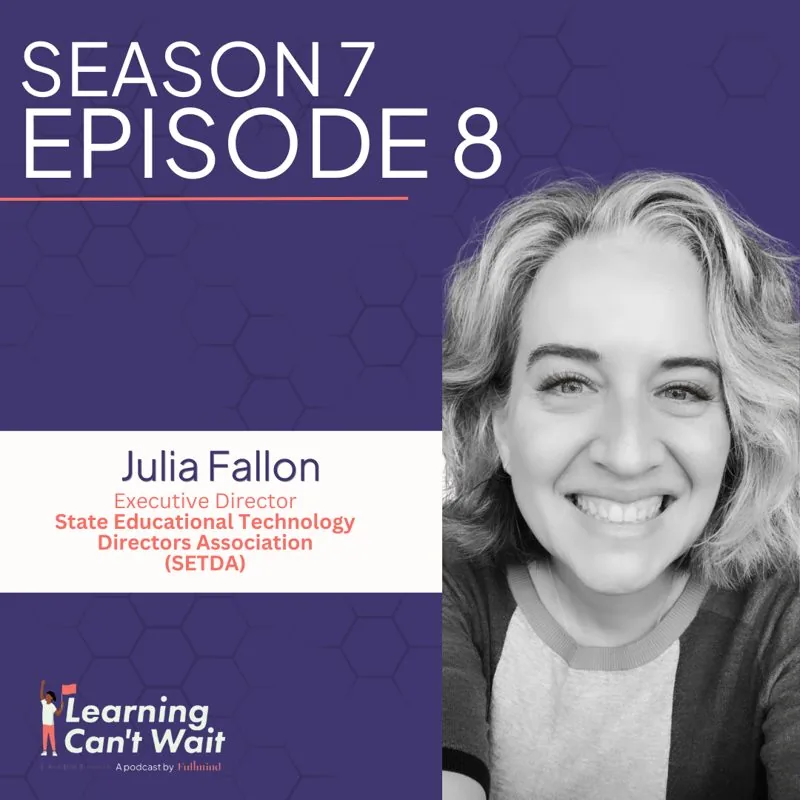
Julia Fallon: SETDA, EdTech, Education Policy
- Julia Fallon
 Hosted by Hayley Spira-Bauer, Chief Academic Officer at Fullmind
Listen now
Julia Fallon: SETDA, EdTech, Education Policy
Episode summary
Julia Fallon, executive director of SETDA, traces a career from campus computer labs and IRC communities to Washington's state education agency and now the association of state edtech directors. She argues schools must modernize beyond the 1950s classroom while keeping ritual and community, that technology should free people to be more human, and that a good school reflects its community's values. She describes how SETDA helped states learn from each other on generative AI policy, why policy is a slow chess game, and what advice she gives new state superintendents.
Key takeaways
- Nobody missed the bell schedule during the pandemic; they missed ritual and community, which can survive redesign
- A good school reflects its community's values; UDL lets students show learning in the ways that motivate them
- Technology should free people to be more human, handling the boring work so teachers spend time with kids
- States are methodical by design; SETDA convened early-mover states so others could borrow AI policy lessons
- New state chiefs should play the long game, anchor work to a portrait of a learner, and trust career staff
About this episode
How can technology drive systemic change in education? In this episode of Learning Can’t Wait, we sit down with Julia Fallon, Executive Director of the State Educational Technology Directors Association (SETDA), to explore the evolving role of technology in modernizing schools. Julia shares insights on how policy, infrastructure, and leadership play a critical role in shaping the future of education. From digital equity to innovative learning environments, this conversation dives into the challenges and opportunities of integrating technology effectively in K-12 education.
Tune in for an insightful discussion on what it takes to create lasting change in our schools—and why we can’t afford to wait.
Episode notes
The education landscape is evolving at an unprecedented pace. School leaders and administrators are at the forefront of ensuring that systemic change is not only embraced but also effectively implemented. In a recent episode of the Learning Can’t Wait podcast, Julia Fallon, Executive Director of SETDA, shared invaluable insights on how technology, policy, and modernization efforts are shaping the future of K-12 education.
If your district is ready to modernize but struggling to find the qualified teachers needed to implement new technology and teaching models, Fullmind can help. Our virtual staffing services connect schools with state-certified, online-trained K–12 educators in all subjects—so you can drive real change without missing a beat. Contact us today to learn more.
The Imperative for Systemic Change in Education
Systemic change in education requires more than just incremental improvements; it demands a shift in how schools operate, how educators teach, and how students learn. Fallon emphasizes that technology is a key driver in this transformation. However, it’s not just about adopting new tools—it’s about creating a sustainable digital ecosystem that enhances learning outcomes and closes equity gaps.
Many districts have already begun integrating digital solutions, but the challenge lies in aligning these efforts with long-term strategic goals. Fallon urges education leaders to focus on scalability, accessibility, and adaptability to ensure that modernization efforts meet the evolving needs of students and educators alike.
Leveraging Educational Technology for Meaningful Impact
The pandemic accelerated the adoption of educational technology, but its long-term effectiveness depends on intentional implementation. Fallon discusses the importance of K-12 digital transformation in fostering innovation and personalized learning.
For administrators, this means:
- Investing in Infrastructure: Reliable broadband access and updated hardware are foundational to successful technology integration.
- Supporting Professional Development: Teachers must be equipped with the knowledge and skills to utilize digital tools effectively.
- Prioritizing Equity: Ensuring all students, regardless of socioeconomic status, have access to high-quality learning experiences.
- Encouraging Data-Driven Decision-Making: Using analytics to track student progress and refine instructional strategies.
The Role of Policy in School Modernization
Policy plays a crucial role in driving systemic change. Fallon highlights how state and federal initiatives can either accelerate or hinder digital transformation efforts. School leaders must stay informed about funding opportunities, compliance regulations, and best practices in school modernization.
Engaging with policymakers and advocating for resources ensures that districts receive the necessary support to implement technology-driven reforms. Collaboration between educators, administrators, and government officials fosters a cohesive approach to improving student outcomes through modernization.
Moving Forward: What School Leaders Can Do Today
To drive meaningful systemic change, school leaders should:
- Conduct a Tech Audit: Assess current digital resources and identify gaps in accessibility and effectiveness.
- Develop a Long-Term Vision: Create a roadmap for integrating technology in a way that supports educational equity and innovation.
- Engage Stakeholders: Collaborate with teachers, parents, and students to ensure that modernization efforts meet the community’s needs.
- Stay Agile: Education is continuously evolving—leaders must remain adaptable to emerging technologies and instructional methodologies.
Conclusion
The future of education hinges on the ability of school leaders to embrace educational technology and systemic modernization. Julia Fallon’s insights underscore the need for intentional, equity-focused approaches to digital transformation. By leveraging technology, advocating for policy changes, and fostering collaborative environments, school administrators can pave the way for a more inclusive and effective education system.
As schools navigate this shift, one thing is clear—systemic change is not a one-time initiative but an ongoing journey. Are you ready to lead the charge?
Full transcript
Transcript generated from the recording; minor errors may remain.
Hayley Spira-Bauer: Welcome back, everybody to the Learning Can't Wait podcast. I am so eager to introduce today's guest. We have Julia Fallon, the executive director of SETDA on the podcast. Julia, welcome.
Julia Fallon: Thank you for having me. I'm excited to be here.
Hayley Spira-Bauer: You're one of those people that I follow your work. I've met you a few times and I'm also just a huge, huge fan of the kind of systemic work. We talked about this before, systemic work that you're doing at SETDA and very eager to dive into your work, how you got here, what you are excited about, and what you think about the future. So should we do it? Should we jump in?
Julia Fallon: Yes, let's do it. Let's do it.
Hayley Spira-Bauer: All right. Julia, tell the audience and me, how did you come to be the personal and professional version of yourself?
Julia Fallon: Ooh, interesting question. I think it has started with, I love maybe curiosity. I feel like I've been very curious kid and just asking questions and I'm curious about how things get put together. And I think I have that systems kind of brain. I am constantly logic mapping things and I started off every good kid looking at the hot jobs and what jobs would pay whatever back in college. And assistant analyst was the hot job at the time when I decided that sports medicine probably wasn't going to be my forte after a Biology 101 class and ended up working from that experience in those classes working at a computer lab on campus. This is pre-internet, so everybody can guess how old I am. And then using the college network of course, and looking at community through that lens. I mean there was a lot of online communities back in the day on the college networks. ([01:48](https://www.google.com/url?sa=E&q=https%3A%2F%2Fwww.rev.com%2Ftranscript-editor%2Fshared%2FtMxx6hTLXpOmHF_z3mT71VLPWJqNij7rubWxw33sYZ5MBU5sOnIOhvukvkRGd5bKzxQ3z5emO-A8CrmhGhdgOuHd8Bc%3FloadFrom%3DDocumentDeeplink%26ts%3D108.57)): I use that news groups, the first iteration IRC, Internet Relay Chat, and I've been very fascinated on how online communities get evolved. So I feel like my systems work and community building has just been a theme throughout my career. So I started off in post-secondary. I worked for a New York University full-time running a computer lab for them. Went to the University of Michigan and worked for Merit Network, helping set up the network across the state of Michigan for schools and libraries. And then sort of took a foray outside of education to take advantage of the dot-com boom. But one got laid off during the dot-com bust. I ended up back in K-12 somehow and really excited about being able to come and work for the state education agency here in Washington State, which is where I'm based, and kind of bring that idea of what IT programs look like to a career in tech ed kind of space. ([02:40](https://www.google.com/url?sa=E&q=https%3A%2F%2Fwww.rev.com%2Ftranscript-editor%2Fshared%2F-VpPJjGqD2Q1v4OjPBT5qZ-jhf3R4cCrWNUNVLD9-ShcEX4QoNq_9UnA5XwOV7NT5h6tKu4Xl0J_eKzAzPv4bxw91fA%3FloadFrom%3DDocumentDeeplink%26ts%3D160.08)): Not everybody needs computer science degrees, but you need other folks in the IT space. And then just edtech became part of the thing. And I think there's something about technology that really empowers us, right? You learn something new every day and that feeds that curiosity and it's a systems kind of approach. So I think that's kind of the through line. My work at the state led me to SETDA as a state member. I was a state member for 17 and a half years before I joined staff four years ago as the executive director. So that's sort of the long and short of it in terms of how I got here. But a love of curiosity, a love of technology, a love of learning, and just being part of this work has been an honor and a privilege and I'm very excited that I get to do what I get to do.
Hayley Spira-Bauer: You have such an interesting background. I think I know the joke that you're going to inevitably make when I make this next comment, but you had such a front row seat to so much evolution. Can you talk about what it's been like to see all this change and also how you feel in this moment approaching 2025, this episode will go live right at the beginning of 2025, but how you feel in this moment given the knowledge you have about all the systemic change we've seen?
Julia Fallon: It's interesting because I think, and I have to tell you, I think it heartens back to a keynote that I saw at NECC, which is now ISTE in 2005, I think it is. David Weinberger, I think is his name, Cluetrain Manifesto. He talked about learning, we're learning and you're at the marketplace in Greek and not having gatekeepers to knowledge. So this idea that when I was growing up, we had encyclopedias and they would come and try to sell you a set of encyclopedias, and if you were lucky, your parents could buy you a set. Or maybe you just had one or two books, but whatever made the cut, made the P cut, somebody made that decision. ([04:34](https://www.google.com/url?sa=E&q=https%3A%2F%2Fwww.rev.com%2Ftranscript-editor%2Fshared%2F6m9CtaqjHJ53vicFOKzyDfWiiI5YI8AGJfPIgHHBL9hkWipJTuviFT704QyUd3KUkPmNUuO_TTbCENUflRajeB6qHQg%3FloadFrom%3DDocumentDeeplink%26ts%3D274.66)): But with the internet and just watching that evolve and going commercial and then businesses using it and people kind of affiliating and coming together as community, it's been interesting because if you really want to know about, and he uses this deep fried Mars bars, there's a wiki page about it. Someone loves that thing and they can go be part of that community of deep fried Mars bars or whatever. And I think what we're seeing still is that impact of what that looks like in our schools. We learn from the moment we're born and as humans, how does school modernize itself to write, to capitalize on that? Someone asked, do you need to know all 50 states? Do you need to memorize them? I remember memorizing them or do you need to be able to verify that that's the truth? Now if you can Google it in 2.5 seconds, so what's the better skill to have? ([05:25](https://www.google.com/url?sa=E&q=https%3A%2F%2Fwww.rev.com%2Ftranscript-editor%2Fshared%2FpXGkANVb-6n4295qY6niv6WmC_n_VpEZiD6QAUBHXXHU9datwMIif2zXnsUc34KIxHOL2sjhg7mIN2GEBQKu-nOTw4A%3FloadFrom%3DDocumentDeeplink%26ts%3D325.87)): Is that critical thinking skill or whatnot? But your question was about watching that evolution you're watching basically. I think people just integrate it into their lives. And outside of K-12, I think we've done a fairly good job. I can now order groceries and show up at Safeway and they get them put the back of my car and I love it. It saves me all this time and that's thattechnology lets me be more human.It lets me spend more time with my family or on my hobbies or whatever. I think school though, as we know it, when we talk about school, especially with policymakers in Washington, DC they think of this 1950s classroom. And I'm like, but that's not the world. We live in all these jobs and I'm not talking about futuristic jobs. I'm talking about jobs I do every day. If I didn't have my internet access and my computer, I couldn't do my job and connect a community of state leaders. ([06:13](https://www.google.com/url?sa=E&q=https%3A%2F%2Fwww.rev.com%2Ftranscript-editor%2Fshared%2FSBw14FzUjATFfRndPbNbko2AnC_ugMGGFn19ZjbILP46xHTZmuQ_yRz4XMX8NCZopnMG9FdHfZ8QvcisYwNauyNCCi0%3FloadFrom%3DDocumentDeeplink%26ts%3D373.85)): So how do we help that school system modernize? We want to hold onto the ritual. We want to hold onto the community. I mean, I always made this comment about the pandemic.Nobody missed the bell schedule or chem lab during the pandemic. They missed the rituals in the community that they had when they were at school.So the question is, can we do that and still change what it looks like? Can you still have community ritual? I think you can and technology can help, but we have to get away from this 1950s teacher in the front school. All the seats are in rows and everything else, not the world we live in. It doesn't mirror that. And if we want kids to be successful post-secondary in any type of career, they need to have those experiences in a safe, secure kind of space to be able to fail and not fail and lose it all, if that makes any sense. So I don't know if that makes it feels,
[07:00] **Hayley Spira-Bauer:** No, it does make sense. And when I think about how everything has evolved and where we are today, change is fast now. Technology change is fast. I actually, I talk about this a couple of times, but I'm not currently recording any AI episodes specifically about AI because I have a lot of episodes slated to be released. I know this is super weird to talk about, but AI changes so quickly that the content would basically be irrelevant in six weeks when it was going to go live. So I stopped recording. I was like, this is going to be irrelevant. Going back to what you're saying about what school should look like, Julia, do you have a vision in your head of a perfect school ecosystem, what it looks like, feels like sounds in the environment?
Julia Fallon: It's funny that you should say that because we just went through an exercise internally, and I probably can't find it up because my staff joked around, you just wrote this manifesto about what school should look like.
Hayley Spira-Bauer: Summarize it for us, tell us what you came up with.
Julia Fallon: So I don't have a specific vision because I really think it should reflect the community that the school is in, right? Oh, yes. You know what I mean? It should hold true to the values of that community in that space. But for me it's around do we have opportunities to collaborate and connect and facilitate and not one person's driving it all? Is there different ways to express how, you know something I always talk about, and it's that UDL, that universal design for learning. If I'm trying to teach kids about how RNA will bind, you know what I mean and everything else, and it twists into this helix. If a kid choreographed a dance that shows how that works, that is just as good as some kid that made a little video because they're good at Canva. So I'm trying to figure out how we allow for those types of expression based on what kids are excited about and what motivates them and how they get to express themselves. ([09:12](https://www.google.com/url?sa=E&q=https%3A%2F%2Fwww.rev.com%2Ftranscript-editor%2Fshared%2Ftu13IdGKPzcviIOjpwNuin3dcbDTeNz4PX0DtmTBFxyYx4EbnjtiM_vInmoncVqAHPg9p5-pxGE0bov31VNnLgfVkiE%3FloadFrom%3DDocumentDeeplink%26ts%3D552.51)): And the end product is the end product. It's the process. So it goes back to technology is invisible, right? You don't need it all the time, but it should be used when it makes sense to use it. There's intention and there's mindfulness about using it. And as a teacher, do I know how to do that comfortably? I think sometimes we have folks that are just uncomfortable, but I think we could show them you actually will spend more time with your kids doing what you love. If you can embrace some of those technologies that are coming, like AI and whatnot, AI for me really should be replacing. I mean, I always joke around, I want someone to make dinner every night that would give me, again, more time, right?
Hayley Spira-Bauer: Do creative things. I don't need it to do the
Julia Fallon: Boring thing. I don't need it to free me up so I can go grocery shopping. I need to do the grocery shopping so I can be freed up to be human and be creative and connect and be more human. And we need to be looking at technology that way. How does technology help us be better teachers? How does technology help us be better students? That sort of thing. So I think my philosophy, I mean in terms of the classroom, but again, it reflects the community's values and those are negotiated.
[10:00] **Hayley Spira-Bauer:** That is so beautiful. And one of the topics I was really eager to talk to you about today is the segmentation fractionalization of education in our country. There's a pro to it though. I am always to be candid with you talking about how difficult it is, I'm not even using the right word, but how regionalization, sorry, that's the word. The regionalization of education, how it differs even within a district, but you are highlighting the beauty and the pro-social positive outcomes that that differentiation could have. So I guess I'll go back now to my question about regionalization and just the disparity between states. Maybe from your vantage point, how concerned are you in your seat at SETDA about, I won't even touch the political climate that is looming, but where we are in this moment, at the end of 2024 with the regionalization of education,
Julia Fallon: I think, well, we talk about local control and people want to, again, communities want to have that agency over their community. That's what you're seeing. You get this push pull, right? We don't want you to tell us what to do. We want to be able to make those decisions, but how do you do it in a way that benefits, all right? Equity is one of those things, but also don't want my kid to be assigned to a teacher for Biology 101 that doesn't use technology at all. And then another kid is getting assigned to the same biology teacher, I mean another biology teacher in the same building next door that uses it, right? There's an inequity in a building, forget about a district or across the town or whatever. But in terms of, I think what we need to do is I think states are doing good work. ([12:16](https://www.google.com/url?sa=E&q=https%3A%2F%2Fwww.rev.com%2Ftranscript-editor%2Fshared%2FW4lmU0wLis1bTJfZ_x_GmTvyrNxWGaOGvQ50rKG3rKenmLoLgvRPnIXOdbpGmbxZU3_ymb_wTTE4osYFUvkpuqIpeNU%3FloadFrom%3DDocumentDeeplink%26ts%3D736.09)): I mean, I will always say that, and even those states, how do we highlight what states are doing well and how do they come together to, again, reflecting the values of their community and their state citizens and everything else, but it has to be balanced so that everybody within that community is also getting the same sort of equitable access to the experiences that are happening. So you don't want to harm anybody in unintentionally. I think we all want the best for everybody. So political climate aside, I'm not having any sort of freak out just yet. I have my canaries in the coal mine people that if they start freaking out, then I'll be like, all right, now I probably should be a little bit more concerned. But until they start freaking out, I'm just going, alright. So it just means that we're going to have a shift on states doing more for themselves. ([13:08](https://www.google.com/url?sa=E&q=https%3A%2F%2Fwww.rev.com%2Ftranscript-editor%2Fshared%2FzwSbD5O_6wKcYnBAzzZ6UDyS5Bw0n3rKv8frgmlGRvb7PU6uyykeL-sOibbU9GXvgMr_n9yh3mofUVY22MsFCnToQ2M%3FloadFrom%3DDocumentDeeplink%26ts%3D788.92)): How do I as the leader of this professional association of state leaders help create the community where they can exchange ideas, they can get support from one another because often there's maybe one or two or three people that are doing that work in each state and states could be alike in terms of their approaches. So how do you leverage that community and that expertise so that all states benefit at the end of the day, but states across the board are doing good work with what they have, the resources they have and everything else. So I still think it should be reflective of your community. In Washington state where I am, access is the big deal when you live in the lower Cascades Mountains and you can't get broadband. So we need to be looking at other ideas, but we might be very similar to the folks in West Virginia that have a very hilly area. So then how do we maybe combine our efforts for advocacy for access in those kind of spaces? But each state wants to do the best for their folks. They want to have access and a good quality of life for their folks that live in their states.
Hayley Spira-Bauer: What I appreciate about SETDA and a lot of the kind of organizations that bring people together is the notion that this is a rising tides lift all ships and us rowing together in the same direction is what's best for kids. Can you talk a little bit about SETDA approach to this collaboration and community and how you've seen an example perhaps of some impact of idea sharing and support the impact that it's had on a particular community?
Julia Fallon: So our association for those that are not familiar with it, I always say we're a small and mighty professional association, so we're not as big as a CoSN or an ISTE and we don't have thousands of members. We represent states and affiliates that are also state-based in essence. And then we have our corporate members that are part of our membership community because we're smaller, I think it creates a more intimate and accessible network amongst our membership. It's not like you're trying to find a thousand people in a community that might be working on the same things as you. You're probably one of 39 states that are working on things and you're looking for a job alike person. And I know this from my own experience working in Washington state, there was four of us working on edtech stuff. It was nice to talk to other people that were working on edtech stuff and having similar experiences like You too. ([15:32](https://www.google.com/url?sa=E&q=https%3A%2F%2Fwww.rev.com%2Ftranscript-editor%2Fshared%2FL3GblvUMLgdC9Y0ajXJpDp7TfFAC_x7CmWnZYps76kCLreRaIDichMvgNvzTzM-9ZykkG9bn92dSJFleCldJ7OaD2pk%3FloadFrom%3DDocumentDeeplink%26ts%3D932.4)): Also this thing, let's talk. Yeah, so we could do this. And because we have technology and the internet, we were able to do that. And nowadays you have Zoom and you can do a lot more without physically having to be in the same space. An example though was in August of 23, generative AI really kind of hits the K-12 space in the face and everybody's kind of going, oh my god. And then everybody was giving states a really hard time, why aren't you on top of this? And I have to remind everybody, states are not built and designed to be swinging all around that they're methodical. They're also making sure that they're not impacting other initiatives that are going on or projects or laws or whatever's on the books, both at the federal level and at the state level. So it took 'em a little while just to kind of go, okay, what do we want? ([16:19](https://www.google.com/url?sa=E&q=https%3A%2F%2Fwww.rev.com%2Ftranscript-editor%2Fshared%2FoBLZK1390Eh-e9-4chDfAYeQmkxTHurvG2DXvYQ0nnSa2K8sN8_bgMSAANK8IxxL5qGYxbcw1xPqlXZWQia42j-LWbg%3FloadFrom%3DDocumentDeeplink%26ts%3D979.61)): How do we want to approach this? It's an emerging technology, it's going to have a huge impact on our space. What do we want to do? Several states went out first. You know what I mean? And I always joke around the West coast kind of just took the lead and went off Oregon, California, Washington came out early on. What we did as an association is we brought folks together in, I think, I believe it was January, late January, saying, alright, those are the states that we're working on at all fall. What did you learn? Give us the good, the bad, the ugly because we have legislative sessions at states that are probably going to drive this initiative in your own states to say, go do this. Tell your state superintendent, go do it or whatever. What would you tell them if you had an opportunity to craft the policy development? ([17:03](https://www.google.com/url?sa=E&q=https%3A%2F%2Fwww.rev.com%2Ftranscript-editor%2Fshared%2FEk2spTh2oDzTvuSBZexc8Bm3IfqMymwHjLfsdYhoBEF7ezp7n_8CCI3K5jG5t8Dp3hM0xCTv6x_gJQbWN0a_-zkFkLg%3FloadFrom%3DDocumentDeeplink%26ts%3D1023.11)): It takes a little while for that, and a lot of them were like, you definitely need to have a task force that represents all voices. So what you saw then is a lot of states that had to go out afterwards were requesting that a task force be part of the ask or the initiatives that were going to be in their states. And then they said, oh, don't do this or don't do that. So there was these good things about coming together or I'm going to borrow from yours. You went out ahead of time and I'm going to use it and make it my state's version of that. So that's an example of how they come together and they kind of learn from each other because we're all working on different parts of this EdTech puzzle. And it just depends on what your priorities are at your state offices, what your governor's priorities are, your state superintendent's priorities are, what's coming out, maybe even legislators at the federal level saying, this is important. I need you to go work on it. And everybody's in different places, but you kind of find your little birds of a feather and they can learn from one another so they don't have to reinvent the wheel 14 times or 56 times. If you want to talk about how many state education agencies there are in this country,
[18:00] **Hayley Spira-Bauer:** To put an exact number on it, you spoke a little bit before we got together on this call before we started recording just about this work that you're doing and how it's not always shiny, but real change has to be systemic, it has to be in the bones, the foundation of our school systems. What does that look like and feel like and mean to you and the work you're doing at SETDA and how are you making sure that this is really addressing one of your core tenets, which is equity in education?
Julia Fallon: I think one of the things that we're finding, and this is, I mean obviously we became very glaring at the beginning of the pandemic because there are things that we've been working on as a community, a membership community for a long time. And I was still at a state office when March, 2020 kind of came upon us. There's a logic model that we sort of have in our heads, edtech people, is it accessible? Is it secure? Is it safe? Is it interoperable? All of the things, what's the access look like finding? How do you help people that are not tech people run through that when they're getting either pitched when they're at a conference or a meeting or your friend now works at a company and wants to sell you something. So an EdTech product. So the question is how do you get that out of your head? ([19:32](https://www.google.com/url?sa=E&q=https%3A%2F%2Fwww.rev.com%2Ftranscript-editor%2Fshared%2FqaFHhsPGbPGwghpeMmp3hKkEArFbMdz6H51vQNSHnCRl-NruBEB9S-sZ1v3FBTck2iLBjDialoOhjqA4DEtvJ7Pcgtw%3FloadFrom%3DDocumentDeeplink%26ts%3D1172.97)): And those are the tenets that we hold dear. We've held dear since day one. So we've done a couple of things. One is we partner with ISTE and CoSN Digital Promise, CAST, InnovateEDU. We came out with the five quality indicators that came out at ISTE in June where we are starting to talk about what those are because we want people to understand what that logic model is because when they're walking the ISTE floor, they can also ask a vendor, well, tell me about your privacy policy. Tell me about your security policy. Tell me about how you use in data. So that way we can kind of replicate that. When we produced our State EdTech Trends report this year, state superintendent, Chris Reykdal from my home state talked about how leaders, school leaders need to be sort of part CTOs. It's not just the back office guy anymore. ([20:20](https://www.google.com/url?sa=E&q=https%3A%2F%2Fwww.rev.com%2Ftranscript-editor%2Fshared%2FRwpqNU5Qi-_fZmVYxvNg7oJSi5Au5AGnTmW88SHr__j7_zvEZKhSpNkypeLsavwj3v1NCq0tw-jT-XgVHlTSeufMmX4%3FloadFrom%3DDocumentDeeplink%26ts%3D1220.67)): It's literally understanding how technology supports your program area or your district goals or your state's goals. So just being the special ed director is not, that role is going to change. You need to understand how technology supports special ed. It could be through assistive technologies, et cetera, et cetera. If you're the person that's in charge of teacher recruitment and retention, a huge thing right now for our states, for our districts. Well, how does technology support that? Is it providing professional learning to the teachers so they have the skills? Is it making sure that it's part of endorsement, credentialing? What is that? So again, that's your part, understanding how technology supports that because those are the priorities of your community or your states. In terms of equity though, our group, I'm trying to think of, for us, it's really about making sure that everybody has the skills in order to be successful. ([21:19](https://www.google.com/url?sa=E&q=https%3A%2F%2Fwww.rev.com%2Ftranscript-editor%2Fshared%2Fvz7V8sFAdjCMXox8zir-FZX_wpINoH_wDYBHZEGc-TRPlWDcgJWhTmuknh9wsRnphzpjt73wHuTZrYFdKo1_ogwyWGM%3FloadFrom%3DDocumentDeeplink%26ts%3D1279.27)): And I'm not talking about the jobs that we don't know that don't exist. Where I think people go, especially with the AI stuff. For me it's like every career path, regardless of career path, we'll use technology in some form or fashion. I can go talk to people that are farmers and they are probably using Excel GIS monitoring real time markets, trying to figure out what their yield is going to be inside a combine is looking a lot different than it did 30 years ago. And how do we get experiences for students to have that? And maybe somebody is really technically minded, they may take over the family farm because now it's even more exciting because technology there, it's not done the old way. So how do we make sure that kids get those experiences so that they can be successful when they leave our system, our formal system of education in essence in this country.
[22:00] **Hayley Spira-Bauer:** I imagine your work is so interesting and exciting and different every day. Is that a true assumption? Because I'm thinking about what you do every day?
Julia Fallon: No, I feel like we work on the same kind of things, but just from a different angle. I think for us it's really looking at the system versus just the one-off. AI literacy super important because people are going to need to understand how those algorithms and how it's learning you and how it works. It's the process, but eventually it's going to become background. You know what I mean? It'll be background to it and it's adjacent to other skills that you need in order to be successful for media literacy and how to use a computer and all that kind of stuff. So it's more systems focused, I think, than anything else. And for me, it's just trying to figure out what part of the puzzle we're working on and how do you move things forward from a policy perspective. Policy, when I first went to the state office, someone said,I hope you like watching grass grow. Really what policy development is about.You have to be a lover of very slow. Sometimes it's very slow. Sometimes you get that perfect storm of a legislator has the will and the political climate is great and something moves really quickly. But a lot of times it's really playing that long game and being okay with it. It's a chess game more than anything, you know what I mean? And trying to anticipate what the moves are going to be so that you can be in the position that you can be in order to affect change.
Hayley Spira-Bauer: Well, that's fair. I appreciate the pushback on the notion that it's super exciting. I too am a little bit of a policy nerd, so I think for me, this is very exciting work. I also appreciate though that you have to be really systemic. I keep using that word, but I'm going to use a different one, that you really have to be methodical about how you approach these issues and even your keeled ness as you talk about AI is such a, it's refreshing because when I first was preparing for this interview and I was looking up what jobs you've had before and you talked a little bit about it, how you were the worldwide web coordinator at the University of Michigan. It's going to be like that. It's going to be the background noise in some time that maybe our own kids' generation doesn't even reference as groundbreaking or essential. You're right. It will be just woven into the fabric of our lives in a way that doesn't feel right now possible because of how shiny it is. So it takes a special kind of patience to have that long game view and it's important. It has to happen.
Julia Fallon: Well, and also not to take the, we've always done it this way kind of view either being open to morphing and evolving and being responsive to your community's needs. You know what I mean? Again, you don't want to do things in a vacuum. So trying to figure out how you evolve and do it in a way that's not going to be detrimental to anybody or anything. And also, I mean I feel like it's probably going to sound very West coast, woo, but the ability to say no, sometimes that's a hard thing for us. Maybe no, we're not going to do that. It just doesn't make sense. And knowing what your swim lane is or deferring to other folks saying, no, you're the expert here. You know what I mean? If I really need expertise on what it's like to be at a local education agency, I will probably go to a Keith Krueger in CoSN and say, what's it like here? If this was going to be implemented, what would it look like so that we can get that kind of feedback loop versus trying to make assumptions based on anecdotes or what my experience was like in Washington or someone else's experience in Utah or Virginia or whatever it is. It's really trying to create spaces for all of us and we all have to advocate from our perches. It takes a village to use that euphemism. It totally takes all of us doing our things. Even teachers in the classroom, it takes them.
[25:00] **Hayley Spira-Bauer:** I was just about to say the other side of this is that once a good idea is adopted, successful implementation is a whole other story really truly in EdTech. I think sometimes we talk so much about buying and making good decisions and using your funding well and what happens when funding dries up. The other side of this is how many schools have tools that aren't implemented well or at all? And this is not like a condemnation. I have the utmost respect for school leaders and teachers and all the people doing the work in the buildings. And we were hit with an onslaught over the last five years of EdTech tools. And so being really judicious not only about buying but about comprehensive planning and robust stakeholder engagement when we implement doing it right, is the other part of this puzzle that matters so much about really affecting change
Julia Fallon: And how do we collect evidence on stuff that may not have an evidence base just yet, but research and evidence allows for that, right? You come up with a logic model and then you test things and how do you have teachers involved in that process? The EdSAFE AI Alliance, which SETDA is a member of just posted a blog about involving students in the r and d kind of space, you know what I mean? Because you almost have to prepare for, sometimes a tool might not even be used the way that you thought it was going to be used. It might get morphed and actually a hundred times better. They use it for something else and everything. And that's the beauty of technology is to try to make it work for you versus try to make it works the other way around.
Hayley Spira-Bauer: You listen to How I Built This ever by Guy Raz?
Julia Fallon: No. Okay.
Hayley Spira-Bauer: I love How I Built This. It's basically Guy Raz interviewing people on a podcast about all these different things they've built. So big things like Ben & Jerry's and other tools. But one of the interviews that I am obsessed with is the interview about Slack, which my organization uses Does SETDA use Slack?
Julia Fallon: We use Slack as well. Yep.
Hayley Spira-Bauer: Okay. So I couldn't imagine functioning without Slack now, but what's funny is Slack was originally built as an intercom system for game developers and what they realized was that Slack was so much better than the game they were developing. They had to pivot and they had to be like, cool. We're using it in this way. We never thought we would. And it is so much more valuable and can have so many more benefits than we think about it having, and to your point, there's so many different tools that are created that may be getting even implemented in varied ways that you haven't as a purchaser or as a creator ever thought it might.
Julia Fallon: The interesting about Slack is it's actually built on IRC back in the day, really a chat. So when, or even the Twitch a platform, I'll go in there and I'm doing old IRC commands and we're like, how do you do that? I'm like, it's sorry. I was around when IRC was around and happened to be in the right place at the right time and have this little nerdy side to me. But a lot of it's built on some of these technologies that have been around a really long time that people have because the community at the time, they were modding it and going and making it better all along. And now the fruits of those labors are totally paying off in different spaces.
Hayley Spira-Bauer: Julia, I cannot even believe I'm ready to ask you my final question because this time has gone so fast. I looked at the clock and I was like, oh my goodness. But I typically ask people what advice they'd give a teacher starting their career today, but given your purview, I'll tweak it slightly. So what advice would you give a state superintendent just joining that path right now? What would you tell them?
Julia Fallon: Interesting focus on the long game, even though it might be, it looks like a short game sometimes, especially in the political space, depending on whether or not you're elected or you're appointed, it could be a short tenure, but I know that technology can support probably any priority that you put out there. So even if you think it's not even tech related, I would call upon your tech, your IT folks, your edtech folks to think about how it could be supported and amplified or empowered to even go move further. Focus on what you want your kids in your system to do once they leave our system. So I think about those portrait of a graduate and the portrait of a learner. Really get clear about what that is. So if you don't already have one, I mean we have a majority of the states do, but not all of them. ([30:35](https://www.google.com/url?sa=E&q=https%3A%2F%2Fwww.rev.com%2Ftranscript-editor%2Fshared%2FhgtO2iaQcm0D0SjX-rUDAG2w-LCc9AMOV8F-n-shbx3MlhTznN_5g2iuN0oTx_O_wm6EeR5xdVohPGESdeVkOM4tuvA%3FloadFrom%3DDocumentDeeplink%26ts%3D1835.47)): But I think if you can articulate that, then you can tie all of the work that your agency is going to be doing to that work and it gives people in your agencies something to tie onto. I remember sometimes we would get, this is back when I was a state leader, we'd get like, these are the priorities. And then I'm like, I have no idea really how my work connects. But I think that portrait of a learner really does help you find your place within your agency to help support the goals of what you're leading an agency to do. And I think one more thing is that to trust your peoples, because folks that run programs, especially those that are career not necessarily appointed, we know that there's always a level of folks that come in and out depending on the leadership in the building and everything else. ([31:24](https://www.google.com/url?sa=E&q=https%3A%2F%2Fwww.rev.com%2Ftranscript-editor%2Fshared%2FOPcTW5BigKGZrJS4T2ZbPqaMDV1ELzoZFyZ1zUUCJa54_aeZlT2pbt8_P1ALcyjD-B-C_Q8F3sD5OBKdpMHMDRBtcGw%3FloadFrom%3DDocumentDeeplink%26ts%3D1884.82)): There's a lot of people that have been there a long, long time and they are not there necessarily probably for the paycheck or anything else. They're there because they believe in the mission and the vision of public education in our country. And to trust them when they're telling you something to trust what they're telling you, you can sort out what, we've always done it this way kind of people, but trust. If somebody says that it probably is not going to work because we did X, Y, Z, they probably have the experience of where it didn't work well and they could help you tweak it so that it would work well if you're going to implement something new.
[30:00] **Hayley Spira-Bauer:** I love it. Julia, you are amazing. Thank you so much for coming on the podcast. I've had a really great time learning more about your work and how you think about the ecosystem, and I'm grateful you spent your time with us today.
Julia Fallon: Well, thank you for having me. I really appreciate the opportunity.
Hayley Spira-Bauer: And thank you to everybody who tuned in today.