
Learning Can’t Wait · Episode 129
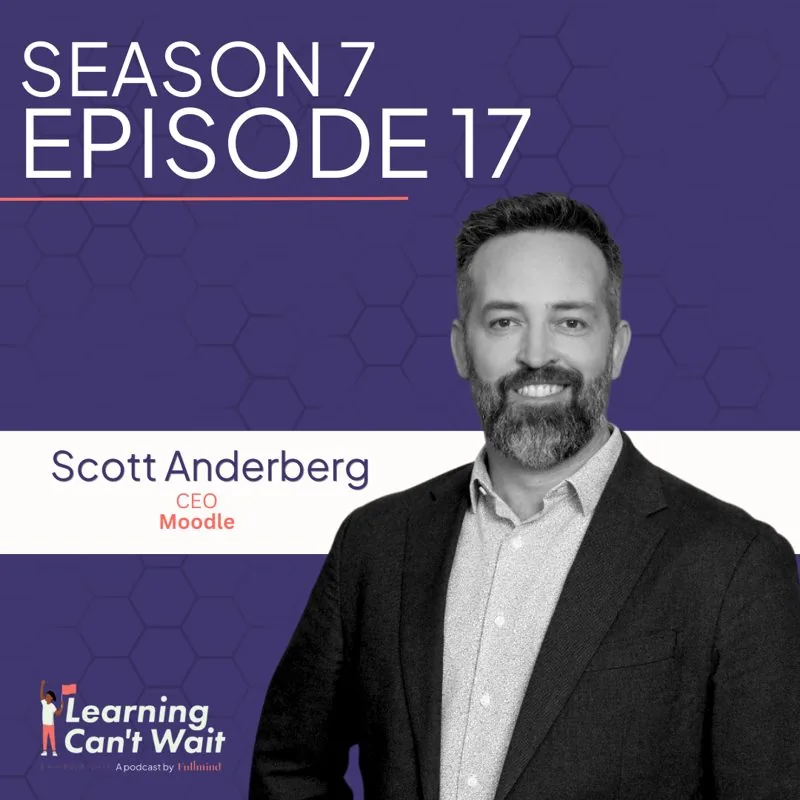
Scott Anderberg: Moodle, AI in Education, Learning Management Systems
- Scott Anderberg
 Hosted by Hayley Spira-Bauer, Chief Academic Officer at Fullmind
Listen now
Scott Anderberg: Moodle, AI in Education, Learning Management Systems
Episode summary
Scott Anderberg, CEO of Moodle, traces a career from eCollege help desk to leading Pearson's online program management business from London and Sydney, where seeing education's impact in developing countries made access his through line. Nearly a year in, he stresses what will not change: a free, open source LMS serving 400 million users in 237 countries. Plans include direct services in the US and India, a stronger partner program, major product investment, support for contributors, and an AI subsystem released so every user can innovate on top of it.
Key takeaways
- Education is unified by human curiosity but highly localized in regulation, culture, and values
- Open source invites community creativity, so continuity and innovation are not in tension
- Moodle will stay free and open source while adding direct services, partner support, and product investment
- Moodle's AI subsystem ships to everyone so innovation is not trapped in wealthy economies or one product team
- Social constructivism underpins the platform: learning happens and is created together
About this episode
Join Hayley Spira-Bauer, host of the Learning Can’t Wait podcast, as she sits down with Scott Anderberg, Chief Operating Officer at Moodle, to discuss the future of learning management systems. Scott shares how Moodle is integrating AI while staying true to its open-source philosophy and commitment to equity. From AI-powered tools to small but impactful educator-driven features, Moodle continues to evolve while ensuring accessibility for learners worldwide.
This conversation highlights the power of user-driven innovation in education and the importance of curiosity in teaching and learning. Tune in for an engaging discussion on technology, accessibility, and the future of education with one of the leaders shaping the field.
Episode notes
The Learning Can't Wait podcast recently featured Scott Anderberg, a key leader at Moodle, who shared insights into the platform’s evolution, its approach to artificial intelligence (AI), and the power of open-source collaboration in education. Moodle has long been a leading learning management system (LMS) used worldwide, and its commitment to inclusivity, innovation, and user-driven development continues to make a global impact.
If your school or district is seeking expert guidance on implementing virtual learning solutions or looking to fill vacancies with certified online educators, Fullmind can help. We provide state-certified, experienced virtual teachers and instructional support staff to help schools make the most of platforms like Moodle and ensure every student’s success—no matter where they learn. Learn how Fullmind can power your online instruction.
AI in Moodle: A Value-Centric Approach
With the rise of large language models (LLMs) and generative AI, the education technology landscape has dramatically shifted. Anderberg explained that Moodle is approaching AI with a strong focus on values, ensuring that new technologies align with the platform’s mission of inclusivity and accessibility. The latest release of Moodle includes an AI subsystem, providing users with the foundational tools needed to build AI-powered features within the platform.
This approach serves two purposes:
- It enables a diverse global community to innovate and develop AI functionalities tailored to their specific educational needs.
- It ensures AI is not locked within Moodle’s core product but remains an open, adaptable resource that educators and institutions can leverage in meaningful ways.
Moodle is already integrating AI into areas like content creation and administrative support, but its open-source framework allows the global community to explore and develop even more applications. However, a crucial consideration for Moodle is ensuring that AI advancements remain accessible to all users, regardless of geographic or economic constraints. With Moodle serving 237 countries, varying regulations and resource availability make it essential to develop AI tools that are equitable and widely usable.
For those interested in Moodle’s AI developments, explore Moodle’s AI subsystem documentation to learn more about its capabilities and future potential.
Moodle’s Core Philosophy: Social Constructivism and Open Source
One of Moodle’s standout features is its foundation in social constructivism, a learning theory emphasizing collaborative and interactive learning experiences. Anderberg highlighted that every element of Moodle is designed to connect learners with their peers and instructors, fostering a more engaging and community-driven educational experience.
This philosophy is amplified by Moodle’s open-source nature, allowing educators, developers, and institutions to customize the platform to meet their unique needs. Anderberg shared an inspiring example from South Australia, where an organization called The Inventory modified Moodle’s interface to support at-risk high school students. By completely redesigning the user experience, they created a self-directed learning environment where students can earn their diplomas in a structure that suits their learning styles.
A Small Change with a Big Impact: Activity Buttons
While major innovations like AI and open-source customization shape Moodle’s long-term evolution, sometimes small changes can have a significant impact. Anderberg pointed to a simple but highly effective update: the addition of a plus button that allows users to add activities anywhere on a page.
Previously, users had to scroll to the bottom of a page to insert new activities, which disrupted workflow and navigation. This change, originally suggested and developed by a high school teacher in Switzerland, has now been integrated into Moodle’s core, benefiting educators worldwide. It’s a perfect example of how Moodle’s open-source model enables grassroots innovation that enhances user experience on a global scale.
How Moodle Collects and Implements User Feedback
Given Moodle’s emphasis on community-driven development, the platform has several avenues for educators and administrators to provide feedback and suggest improvements. Moodle maintains an extensive network of forums and feedback channels where users can contribute ideas, report issues, and collaborate on new features.
For those looking to submit ideas or participate in discussions, visit the Moodle Community forums to engage with fellow educators and developers.
Advice for New Moodle Users: Stay Curious
When asked for advice for educators using Moodle for the first time, Anderberg emphasized the importance of curiosity. He encouraged teachers to explore Moodle’s features, experiment with different tools, and engage with the community to discover new ways of enhancing their teaching.
“Curiosity keeps you both open to relationships and open to discovery,” Anderberg said. “It allows us to go deeper and be surprised by what we find.”
For educators just starting with Moodle, a great place to begin is the Moodle Academy, where users can access training and resources to maximize their use of the platform.
Final Thoughts
Moodle’s continued evolution highlights the power of open-source collaboration, AI-driven innovation, and an unwavering commitment to inclusivity in education. As the platform adapts to new technological advancements, its user-driven development model ensures that educators worldwide have the tools they need to create impactful learning experiences.
Full transcript
Transcript generated from the recording; minor errors may remain.
Hayley Spira-Bauer: Welcome to the Learning Can't Wait podcast of Fullmind. At Fullmind, our vision is to ensure every child has access to an exceptional education. Each episode, we will be joined by Pathfinders within and around the education space who are bringing about transformational change. On behalf of deserving students, I'm your host Hayley Spira-Bauer. Our welcome back, everybody to the Learning Can't Wait podcast. I am very excited to introduce our next guest. We have Scott Anderberg, the CEO of Moodle. Scott, welcome.
Scott Anderberg: Thank you so much. It's great to be here.
Hayley Spira-Bauer: Moodle's just like a small company. I'm not sure if people know about it. No, I'm just kidding. This is one of the largest open source learning management systems in the world. Many people probably use Moodle every single day and don't even know it. And I'd love for you in just a few moments to dive into why you're at Moodle, what Moodle's up to the future of Moodle and all the things that come with that. But first, let's start off by having you tell everybody how did you come to be the personal and professional version of yourself?
Scott Anderberg: So through a lot of moving around the world and bouncing into new jobs and taking advantage of different opportunities, my first experience with online education was actually as a university student, I was working to do some support for the chair of our department in sort of a TA role, and as a result, after university got a tip off that the platform we were using was potentially looking for people, it had just gone public. And so I actually started my career at eCollege back in the early two thousands and I moved through that company. I actually started as a help desk technician there at eCollege and then moved into the product organization and then moved into sales organization. And then that company was acquired by Pearson. And so I had the opportunity after having worked in so many different places to take on a market development role with Pearson, and that really started my global journey as my family and I moved to London back in 2008. We were in the UK. I spent a lot of time traveling across Europe, the Middle East and Africa, learning an awful lot about education systems and those parts of the world. The journey took us back to Colorado for a short period of time, and then we had the opportunity to go to Sydney, Australia for three and a half years and moved my focus away from some of the technology specific business into helping Pearson build their online program management business in Australia. So focusing on partnering with universities and launching full degree programs. ([03:07](https://www.google.com/url?sa=E&q=https%3A%2F%2Fwww.rev.com%2Ftranscript-editor%2Fshared%2F4JYwyFHFxEHNpjU98QK58Kpdf_lO1KYLo2_Va1wGH3TujBHc8jafNmH1WSrDJ6k5QKaAeOOqjNAg3VfuzisyvoB4Lsw%3FloadFrom%3DDocumentDeeplink%26ts%3D187.42)): After three and a half years there, we took a decision to move back to Colorado. We thought we were ready to be settled. My oldest boys were headed towards high school. We bought a house, we got a dog and realized about 12 months in, we weren't quite as ready to be settled as we thought. And that corresponded with an opportunity to come back to London. And I had always felt like I had unfinished business in the UK. I had always felt like the UK higher education system offered a really interesting competitive advantage in the world of online higher ed because it's a very, very high value degree globally. And so I came back and jumped at the opportunity to come back and help build Pearson's brand new OPM business in the UK market. And that expanded to over five years or so, all of Pearson's OPM business outside of North America. ([04:04](https://www.google.com/url?sa=E&q=https%3A%2F%2Fwww.rev.com%2Ftranscript-editor%2Fshared%2FPpVTv53txYw-gv0rSJtzFCKVhYgPQZiBrkGjSq9sW2wPk0Ruu99IYjOs-lmxwJWJF3csCZfdta3AzUZmA-FUXOQOnj8%3FloadFrom%3DDocumentDeeplink%26ts%3D244.54)): And so I had the opportunity at that point to be managing teams in eight different countries. We were working with universities around the world. We had students from over 150 countries in those programs, and that was incredibly fulfilling because the thing that had really driven that through line on my career was the time I spent traveling. The first time we were in London, I spent a lot of time in developing countries across the Middle East and Africa saw very clearly how significant access to high quality education was in both quality of life and the development of those societies and economies. And that's the thing that has really compelled me. So when this opportunity came up with Moodle, I couldn't think of a better fit for an organization that has through its entire history, had educational access right at the center of its mission. And so I jumped at the amazing opportunity to get to step in and work with Martin on the transition point that he's at as he moves into focus exclusively on research and take take over the leadership of both the organization and the business and get embedded into the community more broadly.
[05:00] **Hayley Spira-Bauer:** First of all, I think we need to take a moment for the breadth of experiences that you named here. So often folks have you mentioned a through line and absolutely I can hear in your voice how equity is a through line for you and access is a through line, which makes so much sense as to why you're at Moodle now. But just going back to your own trajectory, you've really dabbled in so many different aspects of an organization and its growth pattern and its growth trajectory, working on product, working in sales. I imagine that makes it a really good fit for you as a leader now because you have not just knowledge, but actually experience. Do you see in your work today some, do you feel the lessons that you learned when you were living those roles in other organizations in your leadership today?
Scott Anderberg: Yeah, absolutely. It's incredibly helpful to be able to draw on real experience as opposed to hypothetical lessons or things you've heard third hand things you've read. It's incredibly useful for me as I step back into a technology organization working with the product team that does very good work to have spent time in a product organization as a business analyst where I was writing business requirements and having to understand what the process is to write that and what it looks like for that to go to a developer and how you have to prioritize those and how that then moves into your actual development and release process. I by absolutely no means can do any of those things and I don't really understand how they do them, but because I was close enough to it, I have a huge appreciation. But the complexity of the work that goes on to make all those things happen,
Hayley Spira-Bauer: I'm in a different position in that my background is in education. I'm now a COO, and sometimes when I'm managing a team that I have no experience with, I'm like reading every physical book I possibly can, listening to every podcast I will explain, I am not an expert in this thing. You are the expert. And of course there's lessons that I hope to bring to the people that I manage, but I have a lot of appreciation for what it must be like for you having been closer to it. So thanks for sharing a bit about that. Now I want to just touch on the breadth in terms of where you've lived and what kind of communities you've seen with education. I always think about the global scale of education and how they're so much more similar than there is different. Do you think that that's true in your experience? Are there similarities in the way that teaching and learning happens across the world or are we really looking at totally different systems depending on where you are?
Scott Anderberg: I don't think it's binary. I don't think it's one or the other. Education I think is linked across geographies by an innate human curiosity. There is a motivation to learn, and what education does is hopefully when it's done well, creates a structure around that that allows people to do it together and provide some guidance. In most of the educational systems that I have experienced and been a part of, there is both a value for creating better well-rounded citizens, but also for driving the development of skills to help with economic growth. So those things are all similar, but education is also highly, highly localized and as a result, it's a real mistake to believe that moving from one country to another, that education is the same thing from place to place. It's regulated differently. The underlying cultural values mean that the way that you engage in learning together looks different from one place to another, and ultimately the value on what you do within education looks different from one place to another. So you have to respect that there are unifying themes, but it's definitely something that's individualized and localized.
Hayley Spira-Bauer: I appreciate that message because I think it is important here and especially as we start to dive into Moodle, it is really relevant to the work that you're doing. So I'm going to switch gears for a little bit and I'm going to jump into some of my questions about the work you're doing today and what you see coming forward. Obviously when you took over Moodle, you were stepping into a role with a significant leadership transition. Your founder had been in the role for nearly 25 years and has done a great job. Martin had done a great job establishing an organization that has served many, many, many communities extremely well. Talk to us a little bit about that leadership transition and how you balance both continuity in the product with innovation.
[10:00] **Scott Anderberg:** Well, I think the first thing I would say isI don't think there's a tension between continuity and innovation, particularly as it relates to continuity in the open source values and innovation.A big part of the reason there's been innovation in Moodle from the very beginning is because it's open source and as a result it invites an enormous amount of creativity from the community. So that hasn't been a tension at all, but I do think leadership change creates continuity challenges. And I would say the first thing, building on something I said earlier, there's with regards to curiosity, I think is an intentional intentionality and being curious as I entered the business, there's a lot more for me, despite the fact that I have a broad background, there's a lot more for me to still learn than what I already know. And so I think that's been a really important piece of this, but it's also been really valuable and really rewarding. I mean, there's surprises still every single day that are both delightful and in some cases less delightful. Finding out things all the time about areas that we can improve or do better, but also finding out things that have been done really well. There's an incredible 25 year legacy to build on here. I think also just reminding myself in that sense that I'm joining something that's already well established and that as a result that the task is to work out how to become part of that thing and to do that really relationally.
Hayley Spira-Bauer: You mentioned a little bit here in your answer about the community and how the work that the users do really impacts the growth and change and trajectory of the product itself. I'm curious how you've nurtured that community and how the organization nurtures that community. I think there's a movement right now in education to come together and collaborate in K-12 schools, which is where I primarily work to collaborate in hopes of greater social change. What lessons have you learned about community building and fostering that environment that helps your product itself improve and grow?
Scott Anderberg: So having not been with Moodle for even 12 months yet, I'm just about 10 days shy of the one year mark. I want to be really careful that I'm not suggesting here that these are lessons I've drawn from the development of that community because that's something I absolutely can't take credit for. I mean, if anybody can, it's Martin, but I can say from 12 months of observation, part of what Martin did really well was create something that was immediately open and inclusive. It was hugely invitational, and as a result, people felt like they could be a part of something really important, really rapidly. And as a result, the project became really important, really rapidly and started to grow and proliferate. So that idea of openness and inclusion and transparency is huge at the heart of this, and that's not unique to Moodle, that's true of I would imagine most open source movements for me in terms of my background and my experience in community building, particularly within organizations and developing cultures of belonging, it's about authentic vulnerable relationships. There has to be a willingness to go in and have some exposure as you develop that so that you can create relationships that are real, that go beyond the transaction of just work tasks.
Hayley Spira-Bauer: I really appreciate your humility, Scott. I know that a good leader is humble, but you're modeling that nicely in this conversation, and I just want to call it out because there's so many things that leaders can be and in ways it can be. Excellent, and I appreciate the way that you've addressed some of these questions here. Thanks. Talk to me about what's next. So right, you can't take credit for everything behind you, but now you're at the house, so what's coming? You are excited. I can sense it in your tone in the way you're describing your work. What's coming for Moodle and what can you take credit for with your team?
Scott Anderberg: Well, not very much yet. I think there are some big things coming, but I would say firstly, what's really important to stress here in this part of the conversation is what's not changing. Moodle is committed to and will continue to be committed to an open source, freely available enterprise capable LMS moving forward. There's been a level of anxiety around the community as this transition has taken place. Martin is a stalwart champion of open source, and so what does this really mean? This guy from a big commercial education organization has been brought in, what is it going to mean? What's not going to mean is a movement away from those fundamental values. So that's really, really important. ([15:33](https://www.google.com/url?sa=E&q=https%3A%2F%2Fwww.rev.com%2Ftranscript-editor%2Fshared%2F9PKsmMBgU1T0S8_2U2d770-c2D-LBt14DRepP9xz4N9e5cnQtUBwYZaa0fFdLTZcerxUAvAqR8VHZy7JNfO58h6wzaY%3FloadFrom%3DDocumentDeeplink%26ts%3D933.02)): I think the other thing that's important as we think about what's next is to look kind of at where we are today and what we get to build from. So just you mentioned before the scale of Moodle, what that really means is it's 400 million registered users in over 237 countries and 40 languages. There is a lot to be able to build from. That's a fantastic and exciting platform. So we are going to be really active and beginning to offer more direct services in the markets where we have our own service organizations. So Moodle's longest standing service delivery model is through our well-established and highly qualified certified partner network. They are in countries all over the world, but over the course of the last four years, we've actually established our own service divisions in the US and in India. So we're going to be doing a lot more to offer services directly to our customers so that we have the opportunity for Moodle as an organization to work directly with those organizations. The second is we're going to be improving that partner program so that our partners can be even more successful and extend Moodle's reach all over the world. They are able to reach corners of the planet that would be very, very difficult for us to get to on our own. So they're highly, highly valued partners in that and highly valued to the customers that they work for. ([16:56](https://www.google.com/url?sa=E&q=https%3A%2F%2Fwww.rev.com%2Ftranscript-editor%2Fshared%2FR9C0QuFB32d1WHfQ35tVQRtViIaG6ox_R5pJy7_9GaKDofC_hBMtN2b-fPVuIEPdT8ai7rLA0i55ggWUUcJSocll_fY%3FloadFrom%3DDocumentDeeplink%26ts%3D1016.36)): And at the heart of everything we do is going to be an increased investment in our product development organization. We are adding some new teams, we are adding a lot of people, and we're going to be spending a lot of time rethinking the shape of the product portfolio to ensure that Moodle continues to be competitive, that we fix some of the areas that have become less competitive over the years, and that we're able to take some big leaps forward in some exciting areas of innovation. We're going to invest specifically in resources to better support that community that I talked about, particularly those individuals that are contributors, whether that's through developing extensions and plugins, whether that is our individuals out there helping with those translations and making it possible for Moodle to be available in other countries. We're going to build a team specifically around support for that, and we're going to find better ways to make their work available in more places around the world. ([17:53](https://www.google.com/url?sa=E&q=https%3A%2F%2Fwww.rev.com%2Ftranscript-editor%2Fshared%2FdkCLoYNCst1l4lvC2DIn4bIhWXbEpBaKqjZsQJshuS2zMkZNe-7W_PTPkGogTYLnSjp1kxYL2bZr96y6hO83V_dEDxU%3FloadFrom%3DDocumentDeeplink%26ts%3D1073.22)): So we're really going to be working on what the distribution of that innovation looks like, and we're doing all of this thinking on a hundred year scale, which is sort of unfathomable. It's impossible really to predict what's going to happen a year from now. And so a hundred years from now is very difficult, but so much has happened in the last 25 years of Moodle's history. We believe we've got to have the creativity and the curiosity and the dream of what it looks like for Moodle to stay relevant a hundred years from now, because that's what allows us to plan 10 years from now, five years from now, et cetera.
[18:00] **Hayley Spira-Bauer:** That is really exciting. And when I hear that, I think a lot about how LMSs have changed since Moodle's creation and also how the landscape has changed. If I were having this conversation with you five years ago, you might be talking to me about tools you're excited to integrate and what's on your product roadmap, but the world is very different with the release of LLMs and generative AI and all of these tools that you can't walk 10 feet in education without talking about. But I'd be remiss if I didn't ask you about it here. How is Moodle approaching the artificial intelligence conversation? Are the advancements moving Moodle forward? Are you integrating them as supplemental? Where are we at Moodle with AI?
Scott Anderberg: So we are approaching AI from a very value centric perspective from us as an organization, which means that the very first thing that we've done is to release an AI subsystem to our users. So with the most recent release of Moodle, you now have access to an AI subsystem, which means that all of the components are in the platform to build on top of. And that's really important to us for a couple of reasons. One, it means that it isn't something that becomes trapped inside our own product organization exclusively is something that we immediately distribute that allows us to really watch what's going on out in the community and understand what are the uses that are the most valuable, where is the creativity and innovation coming from? What are the kinds of things that make the most sense to then get behind and support? Now we are building on top of that subsystem ourself because we think there's some obvious places around content creation and administrative support that AI can immediately play a role. But it's also really important to us from an inclusivity perspective that we're not creating functionality that becomes exclusive to wealthy economies because of the costs to run it or the power constraints. And because we recognize that when you're serving 237 countries, there are a lot of different regulatory elements to consider. And so it's really hard to create something right now around AI that's universally usable in that many territories. So this gives all of Moodle users the opportunity to begin to innovate right on top of that platform already.
[20:00] **Hayley Spira-Bauer:** It is music to my ears to hear how equity just plays a part in every single decision that you all make at Moodle. It is a theme of this podcast and just in my personal life's work. So I appreciate that focus, obviously that's why Moodle is such a valuable tool across the world, and so continuing to ensure that every build incorporates that is huge. Can you talk about your favorite Moodle feature? What is it and why?
Scott Anderberg: Yeah, so this is going to feel initially like it's a little bit of a cheat answer, but bear with me ([21:47](https://www.google.com/url?sa=E&q=https%3A%2F%2Fwww.rev.com%2Ftranscript-editor%2Fshared%2FNQCYqtLIKslPUe8A_3Z3RssqLoTJNkBkrXDjgIBKr344isaog9CUy5grf7axH55X7b2l8Y-gNGYg78gEGf5ZOXOinIU%3FloadFrom%3DDocumentDeeplink%26ts%3D1307.35)): Because my favorite thing about Moodle is actually the two of the underpinning philosophies. The first being that Moodle was developed by Martin to really be a platform that utilizes social constructivism as the means of driving learning forward. And what that means is that everything that's built in Moodle is built with the notion of enhancing the learning experience by connecting users to each other and to the instructor. Recognizing that when you do that,learning is something that not only happens together, but learning is something that's created together.And I think that's an incredibly powerful idea when you're thinking about what it means to be a group, to be a society, to be community, like we talked about earlier. So I love the fact that that's actually the underpinning philosophy for how Moodle was designed. The second thing is actually in the open source nature of the product because you take that notion of social constructivism and then you overlay that with open source. ([22:48](https://www.google.com/url?sa=E&q=https%3A%2F%2Fwww.rev.com%2Ftranscript-editor%2Fshared%2FiHzpAuGYEG0QFzYFQPzrdxs36cvQ6WiXSc8gwQ89E9aze5pLib38JLChcd_BcaJxvCQbouhdBEWiOFpXPT7-OFoT0VI%3FloadFrom%3DDocumentDeeplink%26ts%3D1368.07)): Now you have this amazing ability to see innovation come in from other places that creates something very, very personalized for a specific institution or specific learning methodology. There is a great example of this. There's an organization that I've been in contact with that uses Moodle out of South Australia called The Inventory, and it's a woman who is really focused on serving the at-risk high school community. So high school students have dropped out because the typical learning systems in state schools just simply don't work for them, and she's worked with an organization to completely rework the entire interface with Moodle. If you log into The Inventory and you have no idea, you would have no knowledge that you were actually in Moodle because it looks entirely different, but it's designed so that it's all self-driven learning. These students who don't do well in a highly structured, highly assessed environment can come in and work through the process of completing their high school education in this environment that allows them to be entirely free from those constraints. ([23:56](https://www.google.com/url?sa=E&q=https%3A%2F%2Fwww.rev.com%2Ftranscript-editor%2Fshared%2FFClsN90eA7Z1FmxC2A5KIhJ4zLitMDp-psN7g6myK8xfSUSg0Yo4RH6bHqMICU4M4yHmTeMo-GkbvNx7FnxRGr6t36o%3FloadFrom%3DDocumentDeeplink%26ts%3D1436.63)): They work with a coach and a mentor in doing so. But that kind of flexibility on top of that social constructivist ideology creates opportunities that no other platform can create. And so that then leads to things like that openness of one little specific feature that I'll talk about that was released not too long ago. We changed the way that you can add activities to Moodle, and it's really simple. It's just that everywhere an activity can be added, there's now a little plus button. And so you don't have to go down to the bottom of the page and add it and move around and do this. You can really add it from anywhere. And the reason I love this is because it was both, it was imagined and then developed by a high school teacher in Switzerland and then was submitted to become core code for Moodle and was put into core code. And now that feature is one of the ones we get the most positive feedback on and is available to hundreds of thousands of educators everywhere because of that innovation from a high school teacher.
Hayley Spira-Bauer: I love that. I'm actually reading Continuous Discovery Habits right now about user interviews and product development. And so I have a personal related question, which is how does Moodle actually collect user feedback? So that teacher had a really good idea. They're a user you mentioned that they submitted it for, but let's say I am a user of Moodle. How do I tell you, Scott? I have a really good idea.
[25:00] **Scott Anderberg:** There are lots of Moodle forums out there, and so it's actually quite easy to find a way, particularly as an administrator or an instructor or a developer to provide feedback. There are a whole set of forms that are managed by our little community team to collect feedback of that kind.
Hayley Spira-Bauer: I love it. Well, it leads me to my last question now, which is I'm going to tailor it for you. Everybody knows. My last question is always, what advice would you give a teacher starting their career today, but for you, I'm going to tailor it to, what advice would you give? I'll say a teacher, but you could whatever grade, whatever year of education it could be. Who's using Moodle for the first time?
Scott Anderberg: I'm going to have to stick with what has kind of been a theme for me through this as well, which is be curious, approach it with curiosity. I would saycuriosity keeps you both open to relationship and open to discovery, and I think that's what you need. Anytime you are exploring something new, I think it allows us to go deeper to be surprised by what we find, and I think that's a super enjoyable way to experience something we've never experienced before.
Hayley Spira-Bauer: I love it. Curiosity is one of the core values I live by raising my kids by. It's like what I think is most important in education classroom, and I'm so excited to hear you say it here. Scott. It has been an absolute pleasure interviewing you and learning more about both your background and all the things you're excited about that happened in Moodle and are coming for Moodle. So thanks so much for joining us on the Learning Can't Wait podcast today.
Scott Anderberg: Thanks so much. It was a pleasure to be here.
Hayley Spira-Bauer: And thank you to everybody for tuning in. Thanks for listening to the Learning Can't Wait podcast. If you like what you heard, please rate, review and share this episode. Be the first to know when we have a new episode by subscribing wherever you listen to podcasts. If you'd like to be a guest on the show or have a suggestion for an episode, email us at podcast@fullmindlearning.com.