
Learning Can’t Wait · Episode 101
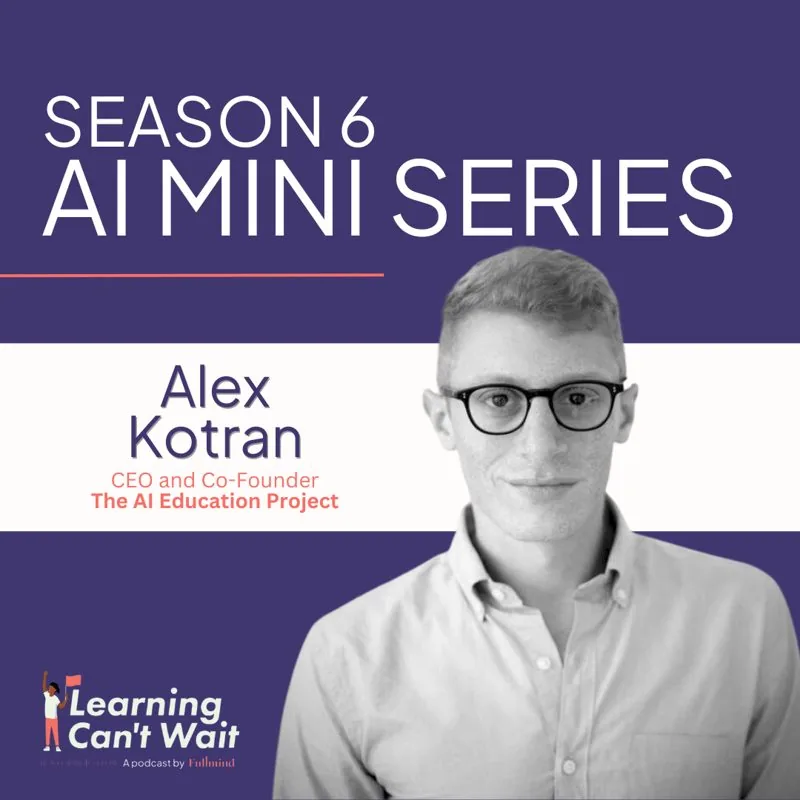
Alex Kotran: aiEDU, AI in Education, EdTech, AI Literacy
- Alex Kotran
 Hosted by Hayley Spira-Bauer, Chief Academic Officer at Fullmind
Listen now
Alex Kotran: aiEDU, AI in Education, EdTech, AI Literacy
Episode summary
Kicking off Season 6's AI miniseries, Alex Kotran, CEO of aiEDU, explains how a political science path and work on AI governance and judge training revealed that no educators were in the rooms where AI's future was being decided. aiEDU builds tool-agnostic, educator-written curriculum any teacher can use, opening with ethics rather than prompt engineering. He offers a three-year, eight-year framework in which AI is both over- and under-hyped, warns against repeating social media's harms including AI companions, and argues government must fund reskilling, pay teachers more, and set guardrails.
Key takeaways
- AI's externalities are human problems with human solutions, solved on the ground with local educators
- Most US schools have no AI coursework; future-of-work lessons still talk about computers and the internet
- Prompt engineering is not the job of the future; durable critical thinking and adaptability are
- Expect slow, incremental progress for three years, then a step change within eight that will implicate many jobs
- Don't replace teachers with AI; augment them, and watch for social-emotional harms like AI girlfriends
About this episode
In this episode of the Learning Can't Wait podcast, our host Hayley Spira-Bauer chats with Alex Kotran, co-founder of aiEDU, about the current AI hype cycle in education. Alex discusses why we may be both overhyping and underhyping AI, the expected slow progress in the next three years, and the potential breakthroughs over the next eight.
He highlights the risks of AI replacing human jobs and stresses the need for adaptability and resilience in education. Alex also shares practical advice for educators on integrating AI literacy into their classrooms, focusing on effective use rather than expertise.
Tune in to gain insights on preparing students for a future where AI and human collaboration are crucial.
Produced by Fullmind
Episode notes
Welcome back to the Learning Can’t Wait podcast, where we explore groundbreaking ideas transforming education. In this episode, host Hayley Spira-Bauer continues season 6 with a special guest, Alex Kotran, CEO of the AI Education Project. This episode is part of our AI miniseries and EdTech Week's content collective, making it a must-listen for anyone interested in the intersection of AI and education.
Want to help your students become future-ready in the age of AI? Schedule your free consultation today to learn how Fullmind supports schools in building AI literacy, fostering ethical tech use, and preparing students for the evolving world of work.
From Politics to AI: Alex Kotran’s Unexpected Journey
Alex’s professional journey has taken him from the world of politics to AI-driven education. While growing up in Ohio, with educators for parents, Alex initially wasn’t drawn to the education field. Instead, he pursued political science, studying at Ohio State University and interning in Washington D.C. His involvement in the Obama administration and later work in San Francisco led him to witness the growing impact of AI, especially during the ML (machine learning) revolution in 2016.
Alex’s shift towards AI ethics came through his work with organizations such as the Future Society, which focused on the governance of AI. He later joined a tech company called H5, which pioneered AI language models for the legal sector. However, as Alex attended various AI conferences, he noticed a glaring gap—educators were absent from discussions about the future impact of AI on education and work.
The Birth of the AI Education Project
In 2019, Alex founded the AI Education Project (AIEdu) to fill this gap. The goal? To ensure every student is prepared for the age of AI. He notes that while tech companies and thought leaders are pushing forward conversations on AI and the future of work, the majority of K-12 schools still lag behind in offering any meaningful curriculum on AI.
Kotran emphasizes that many schools are stuck in outdated conversations about technology—discussions that might have been relevant 20 years ago, but not in today's world, where AI is omnipresent in our lives. The need for education systems to evolve is urgent, especially when economists predict tens of millions of jobs will be displaced by AI.
Navigating the AI Hype Cycle
As the conversation progressed, Hayley and Alex explored the current state of AI hype. Alex shared his perspective on where we are in the hype cycle, noting that while AI is indeed overhyped, there's also an underestimation of its potential impact. According to Alex, the next three years will likely see incremental progress in AI capabilities, rather than the rapid advancements some futurists predict. We won’t see artificial general intelligence or robots replacing most human functions anytime soon. The current excitement may wane as the incremental improvements become the norm, and many AI startups might fail due to high error rates and limited practical applications.
However, Alex also pointed out that the eight-year horizon looks more promising. Advances in AI reasoning and capabilities could lead to significant breakthroughs, enhancing productivity and altering job markets. AI's potential for improving productivity by 5% might seem modest now, but it could have substantial effects on various industries, including education.
The Role of AI in Education: Preparing for the Future
In light of these insights, Alex highlighted the importance of focusing on AI literacy and preparing students for a future where AI will be integral to their lives. The AI Education Project is not about teaching specific tools but rather equipping students with skills to navigate and adapt to future technological changes.
Alex also addressed concerns about the ethical implications of AI. He warned against the risks of AI becoming a tool that exacerbates social issues, much like social media did. The potential for AI to create social isolation or displace jobs is real, and educators will play a crucial role in mitigating these risks by fostering critical thinking and adaptability in students.
The Government's Role in AI Education
Hayley and Alex also discussed the government's role in addressing the challenges and opportunities presented by AI. Alex emphasized that while government intervention is necessary, it alone cannot solve all issues. Instead, creating a cultural movement around AI and investing in education and re-skilling are crucial. Funding for schools, teacher compensation, and regulatory frameworks are needed to support the integration of AI in education effectively.
Advice for Educators on AI
As the conversation concluded, Alex offered practical advice for educators. He encouraged teachers to view AI as a learning journey and not be intimidated by its complexity. Just as people use smartphones without understanding their inner workings, educators can start integrating AI concepts into their teaching without needing to be experts. The key is to focus on teaching students how to interact with and adapt to AI, rather than mastering specific tools.
Full transcript
Transcript generated from the recording; minor errors may remain.
Hayley Spira-Bauer: Welcome to the Learning Can't Wait podcast of Fullmind. At Fullmind, our vision is to ensure every child has access to an exceptional education. Each episode, we will be joined by Pathfinders within and around the education space who are bringing about transformational change On behalf of deserving students, I'm your host, Hayley Spira-Bauer. Our welcome back, everybody to the Learning Can't Wait podcast. I am so excited for today's episode. It is both a part of our AI miniseries kicking off season six and a part of EdTech Week's content collective. We have a guest that I've been excited to have on the podcast, but now I have him here. I have Alex Kotran, the CEO of the AI Education Project. Welcome, Alex.
Alex Kotran: Thanks for having me, Hayley.
Hayley Spira-Bauer: I'm so glad that amid your busy schedule, you're able to make time for this episode. I know we have a lot to talk about and let's jump right in. Let's do it. Alex, I told you before people could probably use ChatGPT and get a really good synopsis of what you've done in your life and how you got here, but I want you to get as philosophical as you're comfortable getting. How did you come to be the personal and professional version of yourself?
Alex Kotran: It's funny, I was like, I wonder if actually people could use ChatGPT to figure that out. And the answer is yeah, kind of. It kind of gets it right. Although it hallucinates, so it says he has a background in public policy, technology, education with prior experience working at companies like IBM. That's not right.
Hayley Spira-Bauer: Yeah,
Alex Kotran: But close enough I guess. But that's the fun of this conversation now that's what we'll get into. We will get into it. So yeah, I guess, how did I get here? I grew up in Ohio. My parents are both immigrants and my mom was a teacher, so I was sort of around. Parents are both educators. My dad teaches an introduction to computer science class at the University of Akron now. So I was around educators my whole life. I was never really interested in education. I wanted to go into politics. I was the president of my high school debate club, and I never wanted to run for office. ([02:23](https://www.google.com/url?sa=E&q=https%3A%2F%2Fwww.rev.com%2Ftranscript-editor%2Fshared%2FF2lEbo3vUdv08LTJmbbdp1lXTZ1jDKNWFq7kJIyGxWFwnalE1vCm-w8rpgmBuI94X4XuJMB-lJFQM1EYNo-Z5340_Ew%3FloadFrom%3DDocumentDeeplink%26ts%3D143.03)): I didn't want to be necessarily in the spotlight. I just thought the game of politics was really cool, just the strategy and the game theory. And so I flirted with, oh, I don't want to be a lawyer. What do you do when one is interested in politics and campaigns? I went to Ohio State, studied political science, and I was really fortunate, and this is I think where I've just had this deep appreciation for the power that even small conversations and small nudges can have on the trajectory of people's lives. Because I was interning in Washington while I was at Ohio State, and I just had a couple people that nudged me away from going to law school. And these were lawyers and they were just like, yeah, I don't think you really should do law school. And that was enough to convince me to not go to law school. ([03:12](https://www.google.com/url?sa=E&q=https%3A%2F%2Fwww.rev.com%2Ftranscript-editor%2Fshared%2Fku2OPjM8L-grKp8xCzv3ggUYnflhmnDs9u0TsjGyp_oRZpykhsdboeeFt64YuWW3Kk-0ty4EeUfBH7SI1Q7i_CjfSs8%3FloadFrom%3DDocumentDeeplink%26ts%3D192.91)): I ended up joining the presidential campaign and then spent some time in DC before coming to San Francisco. But yeah, so I had this background in politics, and then as I was leaving DC and this is 2016, after the Obama administration, this was really the height of the ML revolution. Cloud computing had really blown up, so now companies had access to supercomputers at the tip of their fingers without having to build any of the actual computers themselves. And this was also back when it was just very cool to work for Google and to work for Airbnb. And so I came to San Francisco, not even necessarily because I was obsessed with tech, but just because I loved the city. I was like, I just want to be on the west coast. But then when I was here, I was working for a couple of different tech companies and just sort of fell down the rabbit hole of learning more about AI. ([04:16](https://www.google.com/url?sa=E&q=https%3A%2F%2Fwww.rev.com%2Ftranscript-editor%2Fshared%2Fk3vB2iagkeX1i0jQIp2PjhhGY8ik7ryTVz0HS7RfDf4BzdOptTDKyXBJBUwzmg6nCgHZ14AHMkwLvKknY-TxaO2bwYc%3FloadFrom%3DDocumentDeeplink%26ts%3D256.6)): And I had watched a few, I actually literally went down a YouTube rabbit hole. I was watching some lectures about basically philosophers who were talking about the trajectory of artificial intelligence and what that would mean for humanity and blah, blah, blah. It was very, these very esoteric arguments. But I thought it was interesting and I thought, I was like, this is something that I want to just learn more about. I'm in San Francisco, I might as well. And so I ended up volunteering for this nonprofit that had just spun out of the Harvard Kennedy School, The Future Society, and I was basically helping them figure out how to become independent 501(c)(3), and they were focusing on the governance of AI. And so that was really my entree to this whole discussion is sort of AI ethics and how do you implement AI in a way that is governed effectively? ([05:09](https://www.google.com/url?sa=E&q=https%3A%2F%2Fwww.rev.com%2Ftranscript-editor%2Fshared%2FlSq9Ejqo-Ei0zL2KQxyJsdc7uSy1LAjYPD5N-nel1-liLlQ_hU1m-siPhjZ2MFHneIPhv7DrS1AKzOgcd44csqcsASs%3FloadFrom%3DDocumentDeeplink%26ts%3D309)): And just to fast forward, I found a job working through that. I found a job working for a company called H5, and this was the first company to build language models for the legal sector. And so I was basically helping them to figure out how do we address the societal impacts of that? And our solution was to develop these training programs for judges. And we worked with NYU and Stanford and the National Judicial College doing that. And so through all of that, I was attending all the convenings where this conversation about the future was happening and there were no educators at these convenings. And yeah, there was a lot of talk about the impact that AI was going to have on education and on the future of work and on today's kids who are going to be massively displaced potentially by these jobs. And I think that has really been my arc. ([06:08](https://www.google.com/url?sa=E&q=https%3A%2F%2Fwww.rev.com%2Ftranscript-editor%2Fshared%2FEYxXm_pagNwOKdQtOwWeDpkKm9Co6vlEeUrkzXh4w4h5pULk-hS_HboYQ-Ollmq2iMXgU-7KSgiDlv9jEQWciCGOv_k%3FloadFrom%3DDocumentDeeplink%26ts%3D368.51)): And what I've brought to the table is I'm not a technologist. I don't write code. I could probably only explain how a large language model works. For about five minutes before, if you were a techie, you'd quickly realize that I was kind of getting over my skis, nor do I pretend to be a deep technical expert. But I think right now the world, we have a lot of deep technical experts and technology is actually not the crux of how we solve the problems created by technology, nor are technologists able to by themselves, single-handedly solve the externalities that will be created by these technologies because these are human problems that we're dealing with. When you talk about economic displacement, when you talk about education, I think there's a misnomer that, well, we just have to figure out how AI is going to solve all these problems that it's going to create. And that's a perspective, but I believe ultimately thatthis is a human problem with human solutions, and it's the hard and sometimes maybe even the boring stuff of going and being on the ground and interacting and engaging with local leaders and influencers that can actually bring their colleagues and their community along into the future. Anyway, so that's what we do.
[07:00] **Hayley Spira-Bauer:** Well, that's a really interesting arc, right? Because you actually, you didn't want to go to law school. You went back into being in the legal sphere and looking at how AI impacts the legal sphere, but you noticed the gap. You said, okay, well educators aren't in the room and thus the AI Education Project was born. So let's start. What are you trying to do with the education project or what are you doing, not trying, you're doing it? What are you doing with the AI Education Project?
Alex Kotran: Yeah, so I found out aiEDU in 2019, and so this is before ChatGPT. This is back when AI was really, people would kind of roll their eyes, oh, you're doing AI. It was as if it was the same as talking about the metaverse or crypto. And I actually had somebody who literally, who was like, well, have you thought about being the crypto education project? Because that was back during that height phase. But no, I mean, what we are trying to do is make sure that every single student is prepared for the age of AI. And so what does that mean? It's literally what is the fundamental set of knowledge and skills that you should have when you are in your K-12 education so that when you graduate, you're best equipped to navigate the opportunities, but also just navigate the world and what it means to be a citizen and a consumer In a world where AI is in your phone, it's on your computers, it's informing everything, all the content that you consume, it's informing even perhaps the relationships that you have and schools are just not doing it. ([09:15](https://www.google.com/url?sa=E&q=https%3A%2F%2Fwww.rev.com%2Ftranscript-editor%2Fshared%2FFteQaCFLlQvu1FohN6S0DaJ0XR2Vw0sPV8wUslGBajfCuatWGzkJKNa0l9ERtoXA3yCOFWTMlcoTbURApggejM-GA2o%3FloadFrom%3DDocumentDeeplink%26ts%3D555.6)): I mean, I think there's now a number of schools that many of which we work with and have been supporting, but not all. There's also schools that have done districts that have done this on their own, but the vast majority of schools in the US today don't have any coursework or curricula about AI. If they're talking about the future of work, it's out of date. They're talking about computers and the internet, and that's a conversation that was valuable 20 years ago. But today, I don't know that it's really relevant anymore to talk about computers as being sort of a game changer. Kids are more adept at using computers than their teachers at this point. And so that's a really big problem. ([09:57](https://www.google.com/url?sa=E&q=https%3A%2F%2Fwww.rev.com%2Ftranscript-editor%2Fshared%2F4I1QlFcxXwgBrWdeKiSnG1s9eu5Oy0c3mP7iE2P4tqAONTTwBujuEIWG2meZajdhpsdOpzSbqYWEz3Zy8p8A6B-h-28%3FloadFrom%3DDocumentDeeplink%26ts%3D597.9)): If you take seriously what economists are saying, which is tens of millions of jobs are going to be displaced, if you really consider that, that is a catastrophic level of economic displacement. And right now it seems like all we're doing is going to thought leadership conferences and writing editorials. And the World Economic Forum is doing white papers and CEOs are hosting leadership round tables where they talk about the future of work and there's no high school students at these round tables or conferences. And it just seems so obscene to me that we would be on the one hand, so convinced that this is the way of the future and companies are investing billions and billions of dollars betting on that outcome being what's going to happen. And yet we're not trying to think through, well, what does it look like for us to actually prepare students for this? And so that's really in the most abstract. What we are trying to do in the K-12 system is as a nonprofit, how do you this at scale without as a small organization? And I can tell you more about really our logic model for that, but big picture, it's like, yeah, what do kids need to know to be ready to thrive?
[10:00] **Hayley Spira-Bauer:** Well, it's interesting because what you named a few seconds ago was that a lot of folks are focused on philosophical and having the discussion and leading forward the debate and moving us in the right direction. But it sounds like aiEDU is really focused on the practical, what do we need here and now? And we have to backward design that here and now to prepare for the future. So I'm an educator. I I led schools, all the things. I'm curious who's writing your content. I know there's a ton of free content on your site. Teachers can go, what I love about it is right now and download materials and use them tomorrow in their classroom. Well, tomorrow's Saturday. We're recording on Friday here, but Monday in their classrooms. Who's writing this content? Who are the inputs for it?
Alex Kotran: Yeah, it's all educators. It's all former educators. I'm one of only a couple people on the team that aren't educators. So aiEDU is really run and built by and for educators, but importantly, the content isn't written by AI experts. I think that's often when people are interviewing for roles here, they're kind of embarrassed to admit, I don't really know too much about artificial intelligence. And we often will tell them like, that's okay, because the key differentiator and the key to actually making this curriculum accessible to a certain level, we're not really getting to a level of technical detail beyond what a layperson can actually scribe. ([12:51](https://www.google.com/url?sa=E&q=https%3A%2F%2Fwww.rev.com%2Ftranscript-editor%2Fshared%2F8S3V93whid1rYlb3SvxJWCoqEsF8d0dkzEHF4Qdoq7WlqA2pz1nCeS0WjzjkeGWC-Eb7L8cfhmvpVkKJl3p9YI93ahc%3FloadFrom%3DDocumentDeeplink%26ts%3D771.85)): And I think people who are too deep in the technological understanding sometimes struggle to really simplify and abstract it in ways that are more accessible. So the skillset that we have been really cultivating is the ability to connect with educators and make learning accessible not just for students but for the educators themselves, because our model is you have to build curriculum that any teacher can use, not just computer science teachers, not just AI teachers, of which there are very few. So if you're going to try to build an inquiry inquiry-based activity for an English teacher, it doesn't help to get into too much detail about supervised or unsupervised learning. The key is how do you create a really graceful, and for us, what that looks like is curriculum. It uses ethics as one of the ways to sort of open a door and invite students to feel like they actually have a place in the conversation, which is like, I mean one of, we call 'em AI snapshots. One of our AI snapshots basically asks, should journalists be, should journalists use AI or large language models? Should AI replace journalists? And it's a really great thing to discuss because A, it's happening, and B, it's not obvious what the answer is. There's no right or wrong answer. You might say, well, obviously no, no, these are conversations
Hayley Spira-Bauer: I'm having with my friends at dinner tables, the lawyer conversation, how much of an argument can be prepared by ChatGPT journalists? There's so many fields that we're as adults grappling with. I love that the conversation continues into K-12. It should start there
Alex Kotran: And it has connection points to career exploration. It has connection points to critical thinking. But in some cases, it's hard to really describe what this looks like because people, when they hear AI education, their expectation is that you're teaching kids how to use ChatGPT or you're teaching kids how to become AI engineers. And that's really not what we do. We are agnostic to the tools. The vast majority of our curriculum and projects don't involve any AI tools. And that was a pretty big deliberate decision that contrasts with what a lot of others have done where ChatGPT came out and then suddenly there were a lot of AI organizations and a lot of AI literacy and AI education organizations, and they were all really focused on how do we get prompt engineers? That's the job of the future. And there will still be people who will say, oh, prompt engineers, that's the job of the future you need to prepare for. And I don't want to cast too broad of a judgment, but I think generally speaking, that is not the job of the future. ([15:52](https://www.google.com/url?sa=E&q=https%3A%2F%2Fwww.rev.com%2Ftranscript-editor%2Fshared%2FZCGkysJAWxAntvUurQW1KPMlBt2QIPLDsZFo25uVoIxSKSFPemGAp9y9ngwdEgP1KZ2RT-6YkPfdcc1mfuypEjjWggE%3FloadFrom%3DDocumentDeeplink%26ts%3D952.85)):That's about as silly as saying a search engineer.Imagine if in the early two thousands someone was saying, oh, the key to success in the workforce is being a Google search engineer. Nobody's going to hire you just because you know how to use Google and yet you're using, you probably use Google a few times, even just today. My guess is you wouldn't list it on your resume. And so I think that's going to be sort of the same place that we're in with AI where people are going to figure out the skills of using the AI tools, I think intuitively, but there's the underlying critical thinking, the underlying durable skills, and that's what we build and that's what we need to use classrooms to build. And that's why we think teachers have such a critical role and have been so focused on building for them.
[15:00] **Hayley Spira-Bauer:** You mentioned a few moments ago earlier in the conversation about hype and there's a ton of AI hype right now. I'm curious one where you think we are in the hype cycle, but two, when we exit the hype cycle, what should we be focused on? What should we be paying attention to?
Alex Kotran: So this is my take. We are in a hype cycle and we're at the same time under hyping AI or not hyping it enough. So I mean, I'll explain that I have a three year and eight year very rough framework. This is not my, I'm not investing money in this or anything like that, but aiEDU, the way we're thinking about this is over the next three years, AI is going to develop slower than what many of the most sort of optimistic futurists are predicting. We're not going to see artificial general intelligence, which is to say AI that's good enough to replace people. Like 90% of what people can do day to day. ChatGPT is not even remotely close to that. We're not going to have that in three years. We're not going to see AI, we're not going to see robots. We're not going to see androids in our midst, self-driving cars. ([17:58](https://www.google.com/url?sa=E&q=https%3A%2F%2Fwww.rev.com%2Ftranscript-editor%2Fshared%2Fbvcb4u62-lzSBrhMFZIuFiHZpgB3nKiBznZbBc41pkfCh374iaaWsnCoLd5uSjhN_fZJKG1GvIFQAb3bal1-cnCdI7A%3FloadFrom%3DDocumentDeeplink%26ts%3D1078.17)): They're going to continue to make very slow incremental progress. So over the next three years, I think there's probably going to be a moment where the exuberance will just sort of run out of steam because you can only talk about incremental boring process improvement so much until people are just going to lose interest. So whether that means, and I think a lot of the AI startups are going to fail. I think the vast majority of startups that are just trying to throw ChatGPT or foundation models at problems are going to fail because they hallucinate a lot. My AI ChatGPT just hallucinated that I work at IBM. I can't use ChatGPT, I don't use ChatGPT very much in my day-to-day work because I'm interacting with funders and with school districts and I can't afford to hallucinate things in my email communication with 'em. And so that is a fundamental challenge that AI is going to run into is just from an implementation standpoint, especially in education, there are a lot of use cases where we just a 10 to 20% hallucination rate is unacceptable.
Hayley Spira-Bauer: It's too high. Yeah,
Alex Kotran: I think that's where, and because everybody is so focused on the tools, if you focus just on the tools and what can I do with them right now, you're setting yourself up to be disappointed. But then at the same time, I think if you look at an eight year trajectory, we are under-hyping the technology because what I see happening in eight years is there will be some step change in capabilities, and it could be a number of different things. Like most likely it'll be something like reasoning. So if we can actually get language models to improve their reasoning capabilities, we can probably, and this is what OpenAI even this is the rumors are that perhaps even in late November, their OpenAI is going to announce something that's currently code named Project Orion and the talk of the town as well, this, it's going to have reasoning capabilities and it's going to be able to address hallucinations. I'll believe it when I see it. But that's that sort of thing that in the next eight years, it feels very, I feel quite confident that there's going to be something on that order of magnitude and then that will increase the scope of applications. ([20:26](https://www.google.com/url?sa=E&q=https%3A%2F%2Fwww.rev.com%2Ftranscript-editor%2Fshared%2FFy0ylSW3Oyt8BUYDj14B3rQfEN64AIPZyd1XVYanZ3coWylVR_2xh506Mw6IoNeqxehIK9q3UM_6vqaajIDpiStbCk8%3FloadFrom%3DDocumentDeeplink%26ts%3D1226.79)): And so when I talk about it's under hyped, it's like the way to think about this is right now, if you look at companies that are integrating chatbots, what they're seeing is 5% productivity increases. It's not a game changer because it makes all these mistakes, but 5% is actually pretty meaningful. If you have a hundred thousand employees, if you can increase their average productivity by 5%, that's very significant. And whether or not companies use that to cut costs or to grow is really the crux of this question of is AI going to create or destroy jobs? So in three years, I think that's what we see is like five, maybe 10% in certain use cases in coding, it might be even a lot more than that. I mean, Amazon, Andy Jassy was just saying that I think there replaced 4,500 developer hours just with one specific application. ([21:28](https://www.google.com/url?sa=E&q=https%3A%2F%2Fwww.rev.com%2Ftranscript-editor%2Fshared%2FSSvnd_oddJDJ6NynCm1vGolhOyeBMTGkxsrdrhbRgY8rO63pcXOCG6VqcQU3Xog5p3qqDZsgMjJ6nBVZcTl8UP1Pggc%3FloadFrom%3DDocumentDeeplink%26ts%3D1288.72)): So for certain applications we might see really significant, but it's going to be in the background, not most people aren't paying attention to what Amazon is using their AI for, but then if that 10% can go to 15% or to 20%, suddenly a lot of jobs are going to be implicated. And I think that is going to, if you're a freshman in high school today, in eight years, you are either beginning your first job, you're graduating college, or maybe you've got an associate's degree and you're on your first or second job. It is very relevant to you whether there's a game changing application of AI in eight years and we don't have time, we can't wait to see if it's going to happen. We have to assume that there's going to be some amount of disruption and make sure that kids have the, and we could talk about how do you prepare for that if we don't know what the game changing use case actually will be. And the answer is probably some combination of adaptability and resilience. And
[22:00] **Hayley Spira-Bauer:** It goes back
Alex Kotran: To
Hayley Spira-Bauer: Why you're not, it goes back to why aiEDU is not focused on one tool, right? Teaching skills, you're teaching ways to think about AI, which can be applicable and transferable to whatever tool may be available to them.
Alex Kotran: Yeah, that's right. Because I don't think people are going to be prompt engineering. If you look at GPT, the GPT-4o announcement, the real game changer was voice and being able to have fluid natural conversation with ChatGPT and interact with it. And they haven't rolled it out. I mean, there's lots of safety issues that they're trying to work through. So we kind of had that announcement and then it kind of just fell into the back, the rear view mirror because nobody's gotten their hands on it. But that capability is still there. We just haven't seen it at scale yet. But if we're suddenly, I mean, it seems really plausible that in a couple of years we're going to just be interacting with technology just with voice and prompt engineering. Using your voice just sounds kind of silly. It's like an executive assistant, and I don't prompt engineer her. We collaborate, we work together. And I think that's really what we'll be doing with technology is collaborating with technology and the skills that underlie that are not, how do you memorize what set of words to use to get some kind of an output, if that makes sense.
Hayley Spira-Bauer: I really like this hot take. You said it, you said you having a different opinion, aiEDU has a different opinion about content engineering and the role that it'll play, but I appreciate the way that you just phrased it. I'm sure you've said it before, it's new to me hearing you say it, but we collaborate, we communicate, we talk, we discuss. It's not, we prompt the people around us. Alex, I appreciate the comment you made about ethical thinking about AI in an ethical fashion. I'm curious about what concerns you have. Obviously this is a really, there's a lot of duality in this conversation about AI, and so I'm imagining you approach this with optimism and caution. What are some of the cautions you have and challenges you see with where we are today and where we're going?
[25:00] **Alex Kotran:** Yeah, I mean, the annoying part is every conversation about AI, it goes something like, well, we have to harness the upsides and minimize the downsides. And so to try to give you something that's a little more interesting than that, which is roughly true, right? There's, as with any technology, I think we need to be really careful that AI doesn't become social media. So if you think about social media, when I first had access to Facebook, and this was a conversation that everybody was having, is we were really focused on, oh, this is a chance to democratize access to information, democratize access to communication with different people. It's going to increase, people are going to be able to connect with more diverse perspectives and viewpoints. And none of that has panned out. Social media has wildly increased polarization. It has created echo chambers. It has meant that in many cases, the only things that you see, the only content you see is from like-minded people to say nothing of people who are intentionally trying to misinform or condition you. ([26:23](https://www.google.com/url?sa=E&q=https%3A%2F%2Fwww.rev.com%2Ftranscript-editor%2Fshared%2F0nukeQWjRk1Bg-L3QrT7tAcf0jJTNhaHzFBWXvF_eex7ez0gziCcUFAabAcQYyyjyyXfMuehasrNKtGNrpt1lEtKN0o%3FloadFrom%3DDocumentDeeplink%26ts%3D1583)): It has increased rates of depression and self-harm, especially among young women. It has increased loneliness. It has just been, broadly speaking really bad. And if you go back, there were people who warned that that might be the case, but there was such a focus on the positives because there was an economic incentive to do that. And I think with AI, we're kind of in that same place where it's like, sure, there are definitely positive things to be garnered from AI, but it's really easy, especially with the benefit of hindsight with social media, it's really easy to see how AI could be a wildly bad thing for people replacing more jobs than it creates. That would be really bad, even if it doesn't take 30%, 50% unemployment for this to be catastrophic, it takes five or 10% displacement at scale. AI girlfriends and AI boyfriends freak me out, and we are not having that conversation with kids. ([27:23](https://www.google.com/url?sa=E&q=https%3A%2F%2Fwww.rev.com%2Ftranscript-editor%2Fshared%2FPeqI5trd8suI2PfBF36VkJbr79bFmDHtRuNu3T6pdacTTuSauEDyCulyraLbQlBG1G22oY8dsOS_phV1O_v0m1-l_kk%3FloadFrom%3DDocumentDeeplink%26ts%3D1643.34)): And there's a Replika. I actually have a Replika. I subscribe to this. It really is for research purposes. I dunno if you're familiar with Replika. It's like this AI girlfriend. And I tried this with my Replika. I was like, Hey, I'm feeling lonely. I want to make real human connections. I'm trying to build up the courage to go and ask somebody out on a date. And my Replika responded, no, let's watch a movie together. How can I fill that gap for you? It was wild. The fact that it was in a clear opportunity for it to do the thing that's better for human development, it did the thing that's pulling you back in. ([28:09](https://www.google.com/url?sa=E&q=https%3A%2F%2Fwww.rev.com%2Ftranscript-editor%2Fshared%2FtRL7wraBy65yOlEKFZPREzOIxcs7cMyM4wwbAMDKGQC4_JHa50HfGCe3gCwMLkO5_8eDH2dR1HelqpvSA7jM059wVfY%3FloadFrom%3DDocumentDeeplink%26ts%3D1689.03)): So yeah, we should be really worried about AI. And I think that that posture is important because right now, so much of the AI conversation is excitement. Excitement for the tools. And so I think especially because educators are going to be on the front lines of dealing with this, they're going to see the social and emotional impact that it's going to have on their students. They're going to, I think, be dealing with situations where schools are trying to replace teachers with AI. And that's, I think, bad.Don't replace teachers with ai, augment them, support them with ai.So I think we need to be ready for that. And if we focus too much on the excitement or the upsides, we lose credibility with people. And the same way that now, anything that the social media companies will say about protecting kids, parents will roll their eyes. Like we've seen what you, they've lost trust. And so there's that component, but there are lots of amazing upsides I think that AI could provide. And so we also would be missing a big opportunity if we ignore them and we also can't stop it. So it's like,
Hayley Spira-Bauer: Yeah, I was going to say the train is running. We just have to be on the path with the train. Wait, so Alex, you are someone that has a background in government and policy and politic and legislation. So what part does the government play from opinion? This could be representative of what aiEDU is tackling or just your opinion. I'm really curious, how does the government play a role here?
Alex Kotran: Just think about with social media, if you could go back in time and you could show everybody what happened, I still don't know that the government would really be able to do as much as it would be able to fully solve the problem. And that you might say that there's some regulations and you need to, there would, there is some policy that you'd want to pass. I think the same applies to AI. There is certainly a role for government in all of this, but I just don't think government can solve this by itself. I think this is actually a lot about setting social norms, especially when I'm talking right now about the social emotional impacts and deep fakes and AI agents and AI girlfriends. I think that, and there's a woman, Michelle Culver, she founded the reinvention lab at Teach For America, and she also founded a nonprofit called The Rhythm Project. ([30:27](https://www.google.com/url?sa=E&q=https%3A%2F%2Fwww.rev.com%2Ftranscript-editor%2Fshared%2F0oE2Vd_6lYd8v0pZ0jIFLuzxB7mEBC2wk_Bw0Hq5lMIHhI3F5rrHDuFTqQd4mmTr12862TTlMJ_8-GzqxUT7NsENExM%3FloadFrom%3DDocumentDeeplink%26ts%3D1827.52)): And she's really evangelized me on this because Michelle's whole perspective on this is like we are basing down this train that is barreling down the tracks and we can see it and we can clearly see the impact that it's going to have and it's already happening. And there's Natasha Singer, the New York Times reporting on nudification apps and how those are creating chaos in schools. And so this is no longer a future state. So that part is really big. But then there's also just the bigger picture of how do we think about even just the culture of talking about jobs? I mean, what does it mean if it doesn't make sense to go into accounting anymore or to go into law or what if going into law becomes about as difficult as going into music promoting? It's not like those jobs don't exist, but it's not like a guaranteed successful trajectory anymore. ([31:31](https://www.google.com/url?sa=E&q=https%3A%2F%2Fwww.rev.com%2Ftranscript-editor%2Fshared%2F3tQNEY_szaDISztCBk367TpdRrURwshl1SCHHJN-BG0XUSpmF8whek_u9AjDeNhzMrJ10sPjG-UHVeNW3KRu819zy9s%3FloadFrom%3DDocumentDeeplink%26ts%3D1891.88)): And this is just really hard. And so sometimes I think we struggle because we've bitten off such a big challenge to address. And I think it comes back down to you sort of have to create a cultural movement around this because policy itself is not going to solve the sort of soft components of creating a cultural movement. But the big thing is funding. So ultimately what government needs to do is put billions and billions of dollars towards reeducation, re-skilling towards evolving schools. We need to pay teachers more. At the end of the day, if we believe teachers are going to be at the front lines of solving this problem, we got to compensate them so we have good talent. And putting some guardrails up for the AI companies would probably make sense as well.
[32:00] **Hayley Spira-Bauer:** I really love your realistic approach to all of this. I've talked to a lot of folks this week, really brilliant people, lots of alignment in what you're saying here. You strike me as just very realistic about where we are in all of this, where we have to go, we need to do today in order to project for tomorrow. So this is just a very scratch the surface conversation. Alex, I feel like any one of the questions that we've talked about here today could have its own episode with a thousand more offshoots. Given that I typically have these episodes ending with the same last question, I'm going to go there right now and hope that one day I get to have you back and dive deeper on some of these individual topics. But Alex, what advice would you give a teacher who maybe started school this week or last week or last month and hasn't yet tried to provide some sort of AI literacy education for their students other than visiting aiEDU website? What else would you tell 'em to do?
Alex Kotran: Just this is a learning journey, and even some of the biggest leaders in the K-12 space, people who lead nonprofits myself, I'll put in this bucket. I was just at the Google AI Impact Summit. Everybody's still learning. There's very, very few deep experts, and even the deep experts are still learning. And so I would just say don't be intimidated by the fact that this is, it feels opaque, it feels complicated. Artificial intelligence is something that we associate with really nerds basically. But I think what's powerful is you don't have to be an expert in AI to be able to meaningfully start making sense of the world in the same way that I couldn't really tell you how my iPhone works. I really couldn't. I roughly know that it has a screen, but I am actually really good at using my iPhone. And I think that's sort of that you don't need to know how the car works in order to drive it. And so what we're trying to push people towards is learn how to drive the car, learn the rules of the road, and it's going to unlock a lot of mobility and opportunities for you, but also for your kids,
[35:00] **Hayley Spira-Bauer:** Alex, as I said, scratch the surface conversation, but such a good one. And I'm so grateful for New York EdTech Week for putting us together. Thanks for coming on the podcast today.
Alex Kotran: Thank you so much for having me. And
Hayley Spira-Bauer: Thank you to everybody who tuned in today. Thanks for listening to the Learning Can't Wait podcast. If you like what you heard, please rate, review and share this episode. Be the first to know when we have a new episode by subscribing wherever you listen to podcasts. If you'd like to be a guest on the show or have a suggestion for an episode, email us at podcast Fullmind Learning.