
Learning Can’t Wait · Episode 108
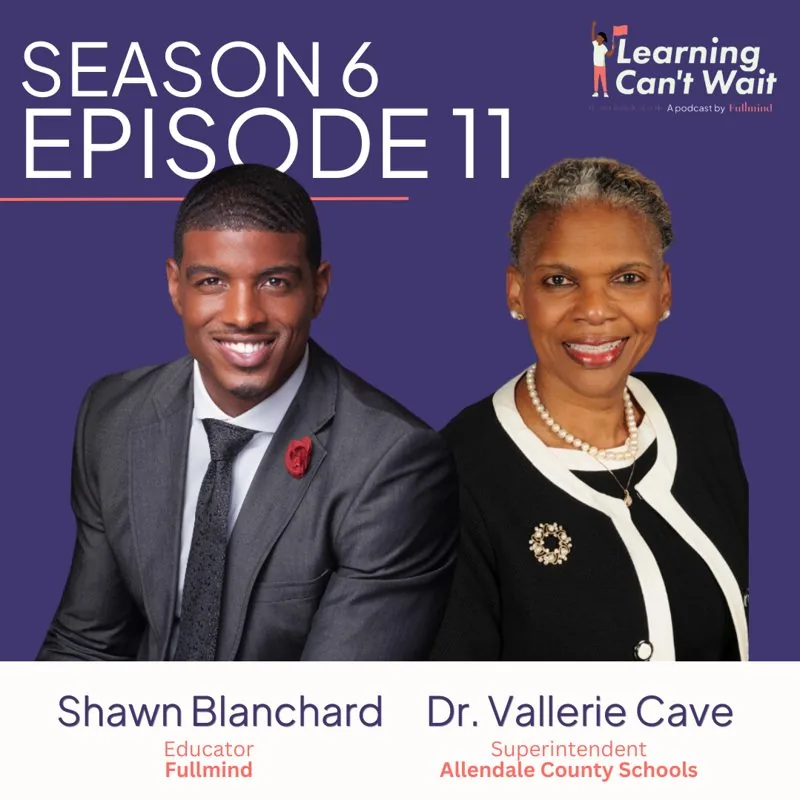
Dr. Vallerie Cave + Shawn Blanchard: Rural Education, Innovation, Student Success
- Dr. Vallerie Cave
- Shawn Blanchard, Renowned educator and speaker
 Hosted by Hayley Spira-Bauer, Chief Academic Officer at Fullmind
Listen now
Dr. Vallerie Cave + Shawn Blanchard: Rural Education, Innovation, Student Success
Episode summary
Dr. Vallerie Cave, superintendent of Allendale County Schools in rural South Carolina, and Shawn Blanchard, a Fullmind virtual educator and author, discuss how a small, under-resourced district creates opportunity for students. Dr. Cave explains her four E's for graduates, virtual partnerships that bring the outside world to Allendale, and expanded CTE, esports, CDL, and early college programs. Sean describes teaching Allendale students virtually, visiting in person, and winning the district's pay-for-performance award based on student growth. Both share what defines strong leadership, including courageous and crucial conversations.
Key takeaways
- Rural districts must do much with little, so virtual partnerships bring opportunities students cannot travel to
- A Fullmind virtual teacher earned Allendale's top middle school growth award after only half a year
- Every graduate should be employed, enrolled, enlisted, or an entrepreneur, the four E's
- Leaders need both courageous conversations with people they are close to and crucial ones made on the spot
- Expanded CTE, esports, CDL, dual enrollment, and early college give rural students real pathways
About this episode
On this inspiring episode of the Learning Can’t Wait podcast, our host Hayley Spira-Bauer sits down with Dr. Vallerie Cave, Superintendent of Allendale County Schools, and renowned educator and speaker Shawn Blanchard to explore the unique challenges and triumphs of rural education. Dr. Cave shares her innovative strategies for providing Allendale students with high-quality opportunities, from career and technical education programs to early college pathways. Meanwhile, Shawn Blanchard reflects on the creativity and resilience required in rural schools, where educators often make the most of limited resources to drive student success. Together, they discuss the importance of visionary leadership, the need for courageous conversations in education, and their shared mission to ensure that every child, regardless of background, has the tools to succeed.
Don’t miss this conversation filled with practical insights and heartfelt advice for educators everywhere.
Episode notes
Rural education faces unique challenges, but it also fosters creativity, resilience, and innovation among educators and students. This rural educator resilience and adaptability was explored in depth in a recent episode of the Learning Can't Wait podcast, hosted by Hayley Spira-Bauer, where Dr. Vallerie Cave, Superintendent of Allendale County Schools, and educator, Shawn Blanchard joined forces to explore the transformative power of education in rural communities. They shared insights on the importance of adaptability, the strategies for overcoming resource limitations, and the power of strong leadership in shaping positive student outcomes. Below, we highlight some of their key perspectives and inspiring stories.
Need help staffing your rural school with qualified, state-certified educators? Fullmind connects schools with top virtual teachers trained to deliver high-quality, synchronous instruction—no matter the zip code. Schedule a call with our team to see how we can support your district’s staffing and student achievement goals.
The Power of Resourcefulness and Creativity in Rural Schools
Rural schools often operate with limited funding and access to resources compared to urban and suburban districts. Dr. Cave explained that her goal as a superintendent is to ensure Allendale students receive the same level of educational quality as students in more affluent areas. By creating a supportive, high-quality environment, Dr. Cave exemplifies transformative leadership in rural schools as she aims to level the playing field, even if her students aren't aware of the disparities.
“I make sure my children have the very best of everything. They don’t know that maybe another school district has something different because I create the same kind of environment here that a wealthy area has.” - Dr. Vallerie Cave
Shawn, who has spent time working within the Allendale school system, echoed this sentiment, highlighting how the challenges educators face in rural areas demand a high level of creativity—a theme that resonates with broader educator experiences in rural communities.
"Rural America is the breeding ground of innovation. It literally took my respect level to another level because I realized just how creative you have to be to make things work," says Shawn Blanchard, reflecting insights that align with research on equity in rural education.
Their conversation emphasized how the challenges that rural educators face drive them to find innovative solutions, ensuring that students receive the best possible education despite any limitations.
Celebrating Shawn Blanchard's Award and Impact on Student Achievement
One of the highlights of the discussion was Shawn Blanchard’s achievement in Allendale County’s performance-based teaching model. In this district, teachers are recognized with monetary awards based on student growth, as measured by the i-Ready assessment in math and English Language Arts (ELA). Although Shawn joined midway through the year, his dedication and teaching excellence led his students to significant progress, earning him the top award for his middle school. Dr. Cave described the students’ joyful reaction when Shawn surprised them with an in-person visit and noted the lasting impact he had on their lives.
“The children just fell in love with Shawn. He was able to captivate them and instill in them the understanding of the content, allowing them to reach a point of growth.” - Dr. Vallerie Cave
Shawn's success exemplifies the potential for impact even within a limited time frame and the importance of building strong relationships with students. His example reinforces that teaching is about connecting with students on a personal level to inspire their academic and personal growth.
Creating Pathways to Success: Dr. Cave’s Vision for Allendale County
Dr. Cave has set ambitious goals for Allendale County Schools to prepare students for a range of post-graduation pathways, including employment, higher education, entrepreneurship, and military service. Recognizing that many students in rural areas transition directly into the workforce, she has expanded the district’s career and technical education programs to include eSports, STEM labs, a CDL program, and even early college opportunities.
“I’m meeting the needs of students who are sometimes overlooked, ensuring everyone has a place and the chance to find their niche.” - Dr. Vallerie Cave
In addition to these programs, Dr. Cave is fostering community partnerships that provide real-world experience for students. Some students are interning with local dentists and town halls, gaining skills that will serve them well in future careers. By creating these opportunities, Dr. Cave ensures that Allendale students are well-prepared for life after graduation.
Defining Leadership in Education: Lessons from Dr. Cave and Shawn Blanchard
Effective leadership is key to driving positive change, especially in education. Dr. Cave shared her approach to leadership, emphasizing transparency, humility, and the importance of servant leadership. She encourages leaders to empower their team members, removing barriers and enabling them to excel in their roles.
“Leaders have to be transparent, humble, and willing to go that extra mile. You have to have a passion for the work and high expectations for yourself and others.” - Dr. Vallerie Cave
Dr. Cave explained the importance of “courageous” and “crucial” conversations in educational leadership. Courageous conversations are difficult but necessary, often involving feedback to help someone improve or transition to a new role. Crucial conversations, on the other hand, are immediate, requiring swift action to address issues in the moment.
Shawn Blanchard added to this perspective, underscoring the importance of establishing standard operating procedures (SOPs) for consistent growth and improvement. He highlighted the need for a safe environment where educators feel comfortable discussing challenges and failures without fear of judgment.
“If people are afraid to talk about their failures, then you don’t have a healthy, safe environment. A growth mindset lets everyone know that messing up is a beginning, not an end.” - Shawn Blanchard
Looking Ahead: New Opportunities for Allendale Students
As the 2024-2025 school year unfolds, Dr. Cave is excited about the expanded opportunities for Allendale students. Her focus on career and technical education, combined with early college programs and community partnerships, promises to make a lasting impact on students' lives.
By offering a variety of pathways—from local internships to advanced STEM and CDL programs—Allendale County Schools provides students with the skills, knowledge, and experiences needed to thrive in today’s world. Dr. Cave’s commitment to creating these opportunities reflects her belief in every student’s potential, regardless of background.
Advice for New Educators: Wisdom from Shawn Blanchard and Dr. Cave
As they closed the conversation, Hayley asked both Dr. Cave and Shawn Blanchard to share advice for new educators entering the profession. Shawn emphasized the importance of treating education as a marathon, encouraging new teachers to define their long-term goals and understand the impact they can make in their students’ lives.
“Education is a marathon, not a sprint. Whether you want to become an administrator, author, or speaker, think about where you want to take this journey.” - Shawn Blanchard
Dr. Cave advised new educators to remain open-hearted, resilient, and committed to continuous improvement, reminding them that the road will be challenging but rewarding.
“Always give it your best, keep your heart and mind open, and remember that change is part of the journey.” - Dr. Vallerie Cave
Final Thoughts
The Learning Can’t Wait podcast episode with Dr. Vallerie Cave and Shawn Blanchard illuminates the transformative power of dedicated educators in rural communities. Their stories showcase the resilience and innovation required to overcome obstacles and provide high-quality education, proving that students in any setting deserve the best possible start in life. As Allendale County Schools pushes forward with expanded programs and new opportunities, their commitment to student success serves as an inspiring model for rural education across the country.
For more inspiring stories and insights from educational leaders, tune in to Learning Can’t Wait, where conversations with changemakers like Dr. Cave and Shawn Blanchard continue to highlight the passion, innovation, and dedication that drive excellence in education.
Full transcript
Transcript generated from the recording; minor errors may remain.
Hayley Spira-Bauer: Welcome back everybody to the Learning Can't Wait podcast. I am ecstatic to introduce our two next guests. Today we have Sean Blanchard, education specialist and incredible educator. I'm so happy to have you here, Sean.
Sean Blanchard: It's a pleasure to be here.
Hayley Spira-Bauer: And we also have Dr. Valerie Cave, superintendent of schools of Allendale County Schools in South Carolina. Welcome Dr. Cave.
Dr. Valerie Cave: Thank you so much for having me today.
Hayley Spira-Bauer: I think I told you before we started recording that today feels a little bit like my birthday. I feel like I'm meeting a celebrity. As you know, Dr. Cave, you and Sean know each other from before this recording, but this is our first time meeting, so if you hear the listeners hear an extra smile on my face for this episode, they now know why.
Dr. Valerie Cave: Oh my. Thank you so very much. It's my honor to be here today.
Hayley Spira-Bauer: I'm excited to have folks realize why this combination of powerful people is going to make an incredible episode. So I'm going to start off with my first question and let the story of your incredible impact in education, education speak for itself. I'm going to ask both of you this question. How did you come to be the personal and professional version of yourself, Dr. Cave? I'll start with you.
Dr. Valerie Cave: Okay, thank you for that question. I started my educational journey in a home that the mother was an educator. My father was in law enforcement, so I was born in the leadership that way. They instilled in me that I had to be the very best person that I could be all of the time. They made sure that I spoke in front of groups, I came up in church so that I had those speeches on Sunday for Easter programs and those various types of things. I always was a part of directing the choir, so leadership came up in me. I think I was born in the leadership, my aunts and my uncles, all of my cousins. We were always very outspoken. So it was just a natural thing for me to always want to be out front and to make sure that I was being the very best version of myself that I could be all of the time, and always to be humble with it always, but always to make sure that I was a servant leader and make sure that I always gave back to others.
Hayley Spira-Bauer: Thank you for sharing that. It sounds like your story is one of the people before you who have brought you into the fold of both skills, but also morality and the kind of environment you want to be in and how you want to pursue a career.
Dr. Valerie Cave: Most definitely. It was. That's
Hayley Spira-Bauer: Very beautiful. Thank you for sharing that. Sean, same question for you. How did you come to be the personal and professional version of yourself?
Sean Blanchard: I like that question and I like it because when you talk about the personal and professional, I actually never been asked a question that way before. It's usually the professional side that people want to know, but I think that the personal aspect, it really pushes the professional side of things. So I was born on West Side Detroit, didn't have my mom and dad in my life, so I was given to my grandparents and doing, so I came up on the west side of Detroit where I went to schools where my high school had a very low graduation rate. And so the types of schools that I went to were Title I schools, and so it wasn't the type of environment that a lot of my peers went off into college and I didn't have a lot of family members in college. But while I was actually in high school, I met this amazing person who happened to be my high school counselor and she was so beautiful to me. I just listened to everything she said. And so she told me I would be her Michigan man. She went to University of Michigan. I listened to everything she told me and because I followed her yellow brick road to success and she mentored me once I got to college, once I actually graduated, one of the things I wanted to do was to do the same thing that she once did to me. And so I wanted to go into a community that was a need to be able to help people in the same way that I once needed help myself. There's this statistic that says that 90% of people that are young, that are mentored when they're young, grow to become mentors. So I became an educator, ran a high school math department, had a mentoring program, adopted a young man, changed his life around, got book deals because of that, and got my bachelor's, my master's and moved on to working with the Mayor Detroits director, youth services, raising millions for youth, working with President Barack Obama National Youth Initiatives, speaking about mentorship, have TED Talk about the science of mentorship and all those things and the successes that comes with those things lead me to being a bestselling author over a book and then going into a space where I'm like, you know what? I want to go back into this education realm because I was so detached from it from a business perspective. So I actually go back into the education realm actually through Fullmind, which was awesome because I had a chance to do it virtually, and that is how I met Dr. Cave And so I had a chance to interact, integrate back into my love, if you will, with education, which brought me to the moment of now even working with Fullmind. But I'm just so excited to be entrenched in my passion because of my personal upbringing.
Hayley Spira-Bauer: I so appreciate the way you share your story. First of all, thank you for your vulnerability and also I want to make space for how impactful educators have been in your life and in Dr. Cave's life. I do a lot of these episodes with brilliant people who are committed to changing the lives of children, and so often we learn about teachers who made a difference. So perhaps this podcast is more than just storytelling and it's really a recruitment tool to get more teachers into the profession, which we definitely need.
Dr. Valerie Cave: Yes,
Hayley Spira-Bauer: Everybody remembers that great teacher, right? Most definitely. A story of somebody who changed their life. You're around teachers all day every day. Yes, I
Dr. Valerie Cave: Am.
Hayley Spira-Bauer: You're leading a beautiful school district that is making great changes for children's lives, but also an interesting fact about that is that you grew up in
Dr. Valerie Cave: Allendale. I did. I am. I'm born and raised in Allendale. I went to school here. Allendale is the third poorest county in the state of South Carolina, and we are the ninth poorest county in the nation. So growing up in Allendale, very rural, I ascended now to be the superintendent here. So being the superintendent here means the world to me and being able to give back to a community. But I grew up here. I was educated here. I went to high school here. I went away to college, and then I came back to be a teacher. And then as I started my career here, I also worked on my master's degree here at the local college that's in our community. So truly I am a product of this community, and if I can come through this community and ascend to be the superintendent, I believe the same thing for my children here. So with me being able to come back and give back to my community and work with the teachers here, so many of the teachers are products of the community here. So it means so much for our children here to be able to see many of the teachers that they see in the grocery store every single day that they see at football games in various places to be able to teach them. It allows for that relationship piece to be able to be there, and it allows for them to see them Sunday at church in various places. It means more for them be able to impact their lives and be able to impact what they do on a day-to-day basis.
Hayley Spira-Bauer: I need to quote Sean here because I'm the one who was talking to Sean a little bit before this episode and he said she is the definition of a hometown hero, the definition, Sean. Now you've seen Dr. Cave in action in Allendale. You've had this good fortune even though you were a virtual educator in the community to actually visit. What impact do you see that hometown hero status when you watch the interactions between the community and Dr. Cave?
Sean Blanchard: Yeah, no, this is good. This is one of the highlights of my day that I wanted to talk about. So one thing for sure is I had a chance to really see things from an outside perspective and an inside perspective. And one thing that I noticed about Dr. Cave is that she's all over the community with love. And so what does that look like? So that means that every email that you receive from Dr K is riddled with passion. It's just like, so there's no assistant doing this for you. This is you typing these words that are so passionate and meaningful, whether it's the educators, whether it's the community. Even when I see text blasts that come out, it's like her actual passion resonates through all communications and all comps. And so that's one aspect. And then it's the aspect of seeing her in the hallways, interacting with the young people, interacting with the educators. It's a matter of just knowing that her passion just exudes everything. And so she's also reachable because she likes to make sure that she connects. So I see her, she goes to events there doing even observations with educators. She's handling the business, the boardroom things, but she's also just present and there. So when I see her and I see her doing the work that she does, it just makes it seem very like a family that's run very well, like a business as well. And so it's a very good marriage that you have with the way that you run things and the passion that you put into the work that you do.
Dr. Valerie Cave: Oh my, thank you so much.
Hayley Spira-Bauer: What's really special about what you've shared there, Sean, is how the community feels like a family. For listeners of the podcast who heard last season's rural miniseries, we did a bunch of episodes talking to rural school leaders, Dr. Cave, I missed you for that miniseries, but I'm glad you're here today. There is something special about rural America. There is often less resources allocated to rural schools, but very true rural schools are known for their innovation. How does rural innovation come to light in Allendale for you, Dr. Cave?
Dr. Valerie Cave: Oh, good question. Great question.We have to do so much with so little. So we have to be very creative with what we do for our students.So we have to create opportunities for them. We have to make sure that we expand opportunities for them. We have to reach out to the students so that they tell us exactly what they need. We have to be able to bring in various aspects of community to them because oftentimes because we're rural, we can't oftentimes take them places because it takes a long journey for them to be able to get the various places. So we have to create virtual spaces for them to be able to get those opportunities and take advantage of additional partnerships to be able to bring the outdoor world for them to get those experiences. It's interesting because oftentimes partnerships from far away places, universities that might be on the West Coast oftentimes want to reach out to present a virtual opportunity for our children or just through virtual reality to be able to do various things for them that way through STEM and various opportunities that way. Getting our children to take courses at various universities through dual enrollment, through emerging scholars, just any kind of opportunity we have, even just bringing a speaker in to make sure that our children have those opportunities, sending them to NASA camps in various places, to Huntsville, Alabama. We do all kinds of things for our children just because we're in rural America, but I don't want that to limit the opportunities for them. So I try to make sure that they understand just because you are here, it does not mean that you cannot be the very best that you can be because it doesn't limit it because I can bring it to you or I can take you to where it is. So we try to make sure that those opportunities are there for them. I believe that children have to have the four E's, and I don't know if Sean's ever heard me say that. I have to create for them the opportunity to be employed, to be enrolled in a college, university or certification or some kind of course I need for them to be entrepreneurs or I need for them to be enrolled or enlisted in armed forces or something of the nature. That's good because being a dropout is not something that I want for them at all. So I try to create every space for them to be successful.
Sean Blanchard: That's beautiful. I like that.
Hayley Spira-Bauer: And the work you're speaking of here speaks for itself. It takes effort to form partnerships that are meaningful for your children. Sean, most of your experience like me is in the heart of a very different type of community. You and I have taught in New York City and LED schools in New York City. How was your experience last year with a rural school? How did it differ or how was it similar to your experience working in and around urban schools? And for context, I'm asking this question not just so you can compare, but I had never worked with rural schools. I grew up in suburbia. I lived in, I went to an urban college. I worked in urban schools for 15 years, and now I have the opportunity to learn about rural schools. So for listeners who are unfamiliar, can you do a little compare and contrast for us, please?
Sean Blanchard: Absolutely. So what's interesting about Allendale is when I actually talk virtually there, so I taught virtually there and while doing so, I'm interacting with the students and while I'm interacting with them, because it's virtual and I'm not commuting in to see the community at all, I see are the same type of kids I see from New York City or Detroit and the places where I grew up or the places where I've taught. And so when I'm looking at the kids and I'm interacting with 'em, it's like, oh, everything's all the same here. I have no clue how small, big or anything the community is at all. But I had the opportunity to visit Allendale a couple times. I went there to speak and teach to the students, and I also went there when I actually had a chance to receive a teacher of excellence award.
Hayley Spira-Bauer: Oh, we're going to make sure we get to that. By the way, we're not burying that lead shot.
Sean Blanchard: And so when I went to actually go teach in person is when I realized that their community was different. And what I love about this is that I'm driving there and I'm just like, oh, wow, okay. Whoa, okay. This is very rural, so it's not a lot around the school, but you'll never know that in the school.The school to me feels like any major city school that you would go to.And that's why that's one of the things I love because the kids don't feel like they're shortchanged because they live in a different community without as many resources on the outside of the school, it seems like the exact same. So the difference was really what's going on outside and the lack of resources that are outside. But when you step foot inside that school, you will never know it. I'm talking about, I'm walking in the building and the cheerleaders are over here. These kids are on a football team. The kids over here are working on some projects in this class or that class. They're after school with these people here that's teaching math, english, science, whatever. They're a part of this club or that club. Everything is pretty much the same inside of the building, which to me, I felt like Dr. Cave, you're just doing a great job because the kids will never know the type of innovation that needs to take place to make sure that the in school situation feels like anywhere. So that's one of the things that I loved about the community. I didn't even know about teaching virtually until I actually went to the school.
Dr. Valerie Cave: They don't know. They don't know. I make sure that my children have the very best that of everything. They don't know that maybe another school district may have something different becauseI try to create the same kind of environment here for them that a wealthy environment has.
Sean Blanchard: Speaking of the very has, you have to absolutely be creative though. So that's something that I realized once I went to the community and started to understand the dynamics, it literally took my respect level for you to another level because I understood that it's like, oh, you have to be creative to make this work. Okay, I get it.
Dr. Valerie Cave: You do.
Hayley Spira-Bauer: Rural America is the breeding ground of innovation. I will live on that forever. I have learned so much about brilliant folks like you, Dr. Cave, who
Dr. Valerie Cave: Thank you.
Hayley Spira-Bauer: You really have to think outside the box to ensure, definitely do. To ensure that the students are getting the very best possible educations
Dr. Valerie Cave: You do.
Hayley Spira-Bauer: Speaking of the very best Dr. Cave, tell us a little bit about Sean's award and why he was honored at Allendale last year.
Dr. Valerie Cave: So we are a pay for performance district, and what that means is that our teachers in grades K through eight, they compete for a monetary award based upon an assessment, and we use an i-Ready assessment. It is a competition with math and ELA teachers based upon a student growth model. And Sean competed in that model and he got the top award for his middle school because his children received, or they progressed to a point where he did some phenomenal teaching. But what's very interesting about Sean's performance is that Sean was not with those children from the beginning of the year. Sean only came at a midpoint, and if Sean had had those children all year long, Sean probably would've walked away with a top award in the school because he only had them for a period of time and he received $13,000. Sean, I believe.
Sean Blanchard: Yeah,
Dr. Valerie Cave: And he only had them for a portion of a time, but he did phenomenal. The children really just, they fell in love with Sean, and that's literally fell in love with Sean.
Hayley Spira-Bauer: I love,
Dr. Valerie Cave: I had the opportunity to see Sean teach with the children in person as well as virtually, and he had no problems. He knew the children by name. He was able to captivate them and take them from a point where if they were low performing children, he was able to instill in them the understanding of the concept and the content so that they could get to a point of growth so that when it was time to take that assessment, they did well on the assessment, which allowed him to be able to earn that additional money. So we're really excited for that. He came in, surprised them, and they just kind of fell out if you could see the video, we captured that on video, they fell out, they didn't even know. He talked from his hotel room close by, and then he came in and walked in the gym. They just screamed and hollered and fell all over the place, and then he was able to stay with them for a couple of days and teach them in person, and we gave out the awards. So it was just a really special moment for the students to be able to see them, and they got an autographed copy of his book as well. So that was really special for all of them, and we're really proud we had him for that period of time, but the impact that he made on the lives of those children will be forever entrenched in their lives.
Sean Blanchard: You know what, Dr. Cage something first I want to say, I think it is very awesome that I received the war because I never even knew I was competing for anything. So I remember you gave me a call and let me know, and I'm like, oh, wow. Well that's awesome. I didn't know. But the other thing I would say is last year I had an opportunity to hire one student as a summer intern. And so I gave one student a job and which was awesome. And what I want to do this year, I actually want to give three more students a job. So I'll talk to you about that offline afterwards. But I want to make sure that I can get three students a job in the summer, specifically middle school because they're not at the age yet. So I want to make sure it's three middle schoolers, but we'll talk about it.
Dr. Valerie Cave: Okay. Alright. I heard it here first. I heard it here first. And what's interesting, I have to say that we made sure that Sean's class continued with the other virtual teacher who also won the award because we knew that they had the same kind of teaching method and the children would be successful. And those kids, Sean, are just doing remarkable because he embedded in them that kind of teaching and the kind of understanding and they're doing well with this year as well. So we're happy with what they started with him.
Sean Blanchard: Oh yeah. I love it. I love it. So I love to hear that. And hopefully [student], the former student that was working for me last summer, hopefully she's doing well, which I know she is. And what I should do is make sure that she can have a repeat. So even I'll just do four, so I'll make sure that she has a repeat and then we'll pick three. I'll double check.
Hayley Spira-Bauer: So we can go from there. Okay. Alright, great. Thank you. Oh, my Dr. Cave. I want to switch gears for a little bit because that's a heartbeat moment right there. And this is why I'm still smiling this whole episode because there's so much joy and there's so much respect between the both of you and also for the work that each of you has done in the community and other communities in Sean's case. Right. I'm curious, Dr. Cave about when you think about leadership and running a school community, what are the most important attributes of an excellent leader? Clearly you're respected. So how do you do
Dr. Valerie Cave: It? I'm very transparent. Leaders have to be transparent. They have to be very humble. They have to be a servant leader and they have to be willing to go that extra mile. You can't be a leader if you're not willing to that old saying, walk the walk and talk the talk. You have to be willing to do the hard work and you have to really believe in what you're doing. You have to have a passion for the work. Leaders have to be able to work to remove the barriers, and you have to empower other people to do the work. You have to believe in the people that are working for you and you have to trust them to do the work. Now, do have to provide, you have to give them guidance and you have to be able to have two kinds of conversations with people. You have to have crucial conversations and you have to have courageous conversations. And those are two different kinds of conversations to have with people. But you have to be able to do all of those things. I'm able to do all of those things with people, and I expect them to be able to work hard and have those high expectations. I have high expectations for myself, and I expect them to have high expectations for themselves as well as for the children that we serve. So I have to know that leadership is a lonely road and I don't expect to make friends all along the way, but I do expect for people to have a level of respect for me in this position because I have a level of respect for them. They may not always agree with everything that I say or everything that I do, but I'm going to trust them to be able to do the work and I'm going to empower them to do the work. And if they don't know how to do it, they can rest assured that I'm going to help them learn how to be able to do their job.
Hayley Spira-Bauer: I want to hear more about this courageous, you said two C words, courageous and crucial. Crucial. Thank you. Courageous, crucial conversation. So what are they? You said they're very important. I want to know how you define.
Dr. Valerie Cave: They are. They are. They are. So sometimes a courageous conversation comes when sometimes a person, when you're close to a person and you have to be able to tell them, you're not quite doing this right. And we have to have a courageous conversation about you need to make some changes. It may step on their toes sometimes. And you have to have that courageous conversation with a friend or a family member or someone that has been in a role for a very long time, and that's a courageous conversation. I like that. That courageous conversation sometime has to be that maybe this is not the right job for you. Maybe you need to step aside and you need to move to another position. Maybe this is not the right fit. That's a courageous conversation sometimes. Okay, maybe you weren't teaching that standard the right way. That might be a courageous conversation.
Sean Blanchard: Yeah, absolutely.
Dr. Valerie Cave: A crucial conversation sometimes might be we need to make an immediate change because this is something that has to happen right now. And sometimes crucial conversations have to happen right there in impact, that change immediately. So you just have to make those crucial conversations and those decisions on impact, and you don't have time to second guess yourself, and you just have to make 'em right on the spot. So I have to make crucial sometimes right on impact, and I don't have time to second guess myself, and I have to teach my principals that. You have to make those decisions quickly.
Hayley Spira-Bauer: That is so clear about what you meant, and I love the examples you gave here. I think a lot about school leadership and both how and innate skillset plays a part in efficacy. Sean, you've also been a leader, so probably very clearly what Dr. Cave is talking about here. What would you add on to that when you think about great leadership and exemplars of leadership from your own career and the people around you?
Sean Blanchard: Yeah, you know what? I think that I'll take it from an education leader perspective and also a business leader perspective. And I feel like one thing that you have to do is you have to constantly, while you're making those crucial and critical conversations, I think that's something we have to do is continually create SOPs for everything that's going on. I feel like having an SOPA standard operating procedure so important for everything that we do, because everything is like the constitution. It's constantly being amended time and time again to make it better, to make it fit, to make it work with the time and the time of the company, the time of the people that are within the company to make things improve and get better. So I think that one of my favorite things to do is to be able to create an environment where people can openly talk about issues. And I feel like if people are afraid to talk about their failures, then you don't have a healthy, safe environment. And when you have a healthy and safe environment and environ, people can openly talk about their failures so that we can also talk about the solutions to them.
Dr. Valerie Cave: Now
Sean Blanchard: We have an environment where we're constantly getting better because people know that, well, if you mess up, that's not the end of you. That's the beginning of something great. That's a growth opportunity that we can capitalize on. So I think those type of safe environments, those growth opportunities, and also creating SOPs to constantly refine and get better at everything, those are some of my hallmarks, whether it's education and business leadership that I think there are crucial.
Hayley Spira-Bauer: It is so clear why y'all have such respect for one another, because you have very similar approaches to leadership and education. Just in the short conversation, it is abundantly clear to me why last year was such a success and also why there is such mutual respect here, which is so cool and so beautiful to see.
Sean Blanchard: Dr.
Hayley Spira-Bauer: Cave. What are you most excited about for this school year? We're just hitting the beginning. I mean, actually in South Carolina, you started well before we did up in New York where my students, my own kids go to school. You're probably just about finishing quarter one for your school, but what are you most excited for the 24 25 school year in Allendale?
Dr. Valerie Cave: The expanded opportunities that I have created for my students, I really focused on expanding my career and technology education programs for my kids in rural America. Sometimes you have students who are going to graduate from high school and they're going to go immediately into the workforce. So I really wanted my students to have the opportunity for that this year. So I expanded those types of programs. So I created an esports program, expanded my STEM labs. I created a CDL program for my students as well. So those opportunities presented itself for my students this year. So I'm really excited about those. I've changed my alternative learning program so that I have an overage academy for my students. I had some students that were behind, so I, I'm meeting the needs more of students who are sometimes those students who you just don't remember all the time and trying to make sure that I capitalize on experiences for everyone so that everyone has a place to find a little niche there.
Hayley Spira-Bauer: I'm excited about
Dr. Valerie Cave: This for you too. This sounds
Hayley Spira-Bauer: Incredible.
Dr. Valerie Cave: That's a lot about that. I also have two students who are working with a local dentist to get their dental hygienist. I have some other students who are doing some internships with our local town halls, so I'm giving children various experiences this year, so I'm
Hayley Spira-Bauer: Making sure those four e's come true. The employee, the enrolled, the entrepreneur or the enlisted, you're making those pathways?
Dr. Valerie Cave: Most definitely. And we started our early college this year as well, so I have eight students who are in the early college academy at the local university, so we're doing some things this year.
Hayley Spira-Bauer: Incredible, beautiful,
Dr. Valerie Cave: Incredible.
Hayley Spira-Bauer: I cannot believe we are upon our very last question, but yet here we are. Sean, I'm going to ask you first, what advice would you give an educator who is starting their career today?
Sean Blanchard: I would say first, I just want to piggyback on what you and Dr. Cave just said. Those score e's. When you give a kid a destination, they know how fast they need to run and they know how to pace themselves. And I think that's amazing. I'll segue and I'll say that when you're dealing with education, it's also a marathon. It's not a sprint. And so when you come into education, it's important to be able to understand what do you want to do with education? If you're just starting out, where do you want to end up ultimately, because this is a marathon of a long lasting life of impact that you can make, and how do you want to do it? So whether it be you start out as an educator, you may become an administrator, you may become an author that's solving some solution, a speaker that's solving some solution, you may create some tech company from that's solving some solution too. But once an educator, always an educator, well look at the education concept and look at it from a standpoint of where do you want to take this and run that race?
Hayley Spira-Bauer: That was powerful. Dr. Cave, same question for you. What advice would you give an educator starting their career today?
Dr. Valerie Cave: I would definitely tell them that to give it a hundred percent every day, to never take anything personally, to remember that the road is not going to be an easy one, but to remember that sometimes that what you see is not necessarily what it actually is, is that oftentimes you need to know that you have to make change even sometimes when you don't want to make change. And to always remember to keep your heart open, keep your mind open, and remember to keep your heart open. Keep your heart open, keep your mind open and just to give it your very, very best and be willing to listen and learn from others.
Hayley Spira-Bauer: You two are so incredibly special. I am so grateful that we were able to get together for today's conversation to share with the world the beautiful things that are happening in Sean's classroom and Sean's life, and Sean's journey in education, and the powerful stories and work happening in Allendale County schools. Dr. Cave, Sean, thank you so much for coming on the podcast today.
Dr. Valerie Cave: Thank you so very much. It's been my pleasure. Pleasure's been mine. Thank you. And
Hayley Spira-Bauer: Thank you everybody who tuned in today.