
Learning Can’t Wait · Episode 111
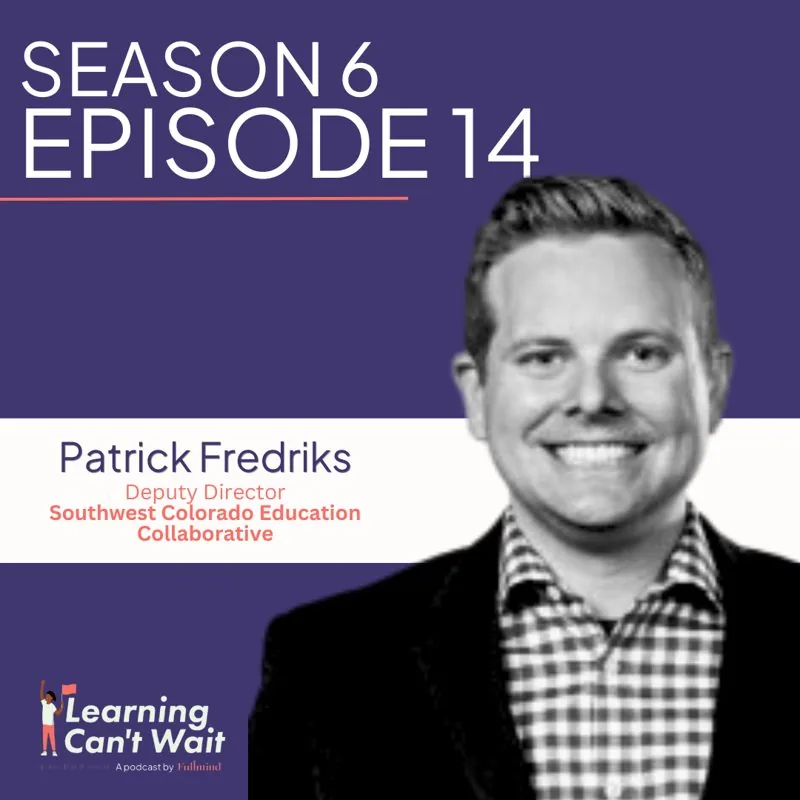
Rural Education, Work Based Learning, Career Readiness, Southwest Colorado Education Collaborative: Patrick Fredricks
- Rural Education
- Southwest Colorado Education Collaborative
 Hosted by Hayley Spira-Bauer, Chief Academic Officer at Fullmind
Listen now
Rural Education, Work Based Learning, Career Readiness, Southwest Colorado Education Collaborative: Patrick Fredricks
Episode summary
Patrick Fredericks, deputy director of the Southwest Colorado Education Collaborative, explains how eight rural districts near the Four Corners work with two colleges to expand career exploration and work-based learning. He describes an agriculture teacher who built a class around fixing aging tractors, summer institutes like Behind the Drywall that connect students with trades professionals, and Career Launch Southwest, an online platform matching industry with students, including virtual internships that reach isolated towns. He advises new rural teachers that they are not alone.
Key takeaways
- Rural districts collaborate so no single school has to be everything for every student
- Work-based learning that responds to local need, like a tractor-repair class, keeps students engaged
- Summer trade institutes connect students with industry professionals who become repeat partners
- An online platform with virtual internships extends opportunities to the most isolated communities
- New rural teachers should reach out to nearby districts; regional collaboratives make that easier
About this episode
On our latest episode of the Learning Can’t Wait podcast, our host Hayley Spira-Bauer sits down with Patrick Fredriks, Deputy director of Southwest Colorado Education Collaborative, to discuss how rural education can thrive through innovation, community, and collaboration. By partnering with local industries, the Collaborative fosters hands-on learning opportunities, like the "Behind the Drywall" program, where students engage with professionals to explore HVAC systems and creative sheet metal work. Patrick also highlighted the importance of embracing AI as a tool to enhance productivity and prepare students for future careers. For new rural educators, his advice was clear: you are not alone. He encouraged building networks within and beyond districts, emphasizing the power of collaboration to support both educators and students.
Episode notes
Rural education faces unique challenges, but as this episode of the Learning Can’t Wait podcast reveals, innovative approaches and strong community partnerships can transform obstacles into opportunities. Host Hayley Spira-Bauer welcomes Patrick Fredricks from the Southwest Colorado Education Collaborative (SWCEC) to discuss how this organization is making a profound impact on students, educators, and local industries in rural America.
By aligning education with real-world skills and creating community-driven solutions, the Collaborative is proving that rural schools can be hubs of opportunity and innovation. For other rural districts facing staffing gaps or looking to expand career-connected learning, Fullmind can help. Through live, state-certified virtual instruction—including CTE-aligned programs—Fullmind supports schools in building capacity and delivering high-quality education, no matter their zip code.
Building Career Pipelines in Rural Communities
SWCEC is breaking new ground by bridging the gap between education and industry through innovative technology solutions. Patrick highlights initiatives like the "Behind the Drywall" summer institute, where students work hands-on with professionals to gain real-world skills in fields like HVAC and sheet metal fabrication. These programs not only inspire students but also engage local industry leaders, fostering a talent pipeline that benefits the entire community.
As Patrick explains, connecting with industry professionals can be a challenge, especially in rural areas where resources are stretched thin. However, once engaged, these professionals often discover a passion for mentoring the next generation. The collaborative's ability to unite educators, students, and businesses has created a sustainable model for workforce development that addresses the needs of both learners and local economies—an approach that mirrors successful rural superintendent leadership initiatives in career-focused education.
Harnessing AI as a Tool for Education
Artificial intelligence is transforming industries, and education is no exception. Patrick shares how AI tools like ChatGPT have become a valuable resource for streamlining work at the Collaborative, much like innovative career pathway programs are revolutionizing rural education. From drafting emails to brainstorming creative ideas, AI is enhancing productivity and innovation.
Importantly, the Collaborative views AI not as a replacement for human creativity but as a tool to augment it. Patrick emphasizes the need to teach students and professionals how to use AI effectively, preparing them for a future where these innovative technology solutions will play a central role in nearly every career.
Advice for New Rural Educators
For educators starting their journey in rural schools, Patrick offers a powerful message: You are not alone. Rural teaching can feel isolating, but building relationships within and beyond your district can make all the difference. Collaboratives like SWCEC provide opportunities for professional learning communities where educators can share resources, mentor one another, and find support.
Patrick’s story about a school counselor finding mentorship through SWCEC’s professional learning community highlights the importance of collaboration. By reaching out and forming connections, rural educators can overcome the challenges of working in isolated settings and foster a vibrant, supportive professional network.
Transforming Rural Education for the Future
The Southwest Colorado Education Collaborative exemplifies how innovation, community involvement, and a forward-thinking mindset can revolutionize education in rural America. By aligning education with industry needs, incorporating AI as a tool for growth, and fostering collaboration among educators, SWCEC is empowering students to succeed in an ever-changing world.
If you’re inspired by Patrick’s work and want to learn more about how rural communities can thrive through education, tune in to the full episode of the Learning Can’t Wait podcast. Together, we can reimagine what’s possible for rural education.
Full transcript
Transcript generated from the recording; minor errors may remain.
Hayley Spira-Bauer: Welcome back, everybody to the Learning Can't Wait podcast. I'm so eager to introduce you to our next guest who I found because of my rabid news consumption. I'm about to introduce you to Patrick Fredericks, the Deputy director of Southwest Colorado Education Collaborative. Patrick, welcome.
Patrick Fredericks: Thanks for having me, Hayley.
Hayley Spira-Bauer: I am so grateful that you are spending some time with us today. I read the article from Hechinger by Neal Morton that came out this August and immediately tried to get in touch with your team because I am enamored with what's happening in Southwest Colorado and I can't wait to learn more about it and share with the audience.
Patrick Fredericks: Yeah, I'm excited to share more beyond what the article shared as well.
Hayley Spira-Bauer: I hope so. That article was great, but I know you have a lot of tricks up your sleeve that you want to share. So we'll dive right in. Patrick, can you tell everybody how you came to be the personal and professional version of yourself?
Patrick Fredericks: Absolutely. So I grew up in Michigan and in my family you are either an educator or an engineer, so you're one of two paths. I think I blend both of those together really well. I've always done well in education. I've always been drawn to education, but I'm really a systematic problem solver. So maybe not building and constructing things, but identifying the problem, building structures for success for teams, and really working together to solve problems. So I thought my career was going to take me through sports and sport management, and then it was higher education for 15 years. And then I got to a place of working with students that this generation that I was working with was so pressured to find a path for themselves and what's your major and what's your next steps when really we weren't building the systems of support to help them explore. ([01:46](https://www.google.com/url?sa=E&q=https%3A%2F%2Fwww.rev.com%2Ftranscript-editor%2Fshared%2FndM6NHXaBsgdLSwCRGg5Tw5BEG87uh6gU2PwzmRI9TFp0i3FUzKTEBVlHzftEwrRW9Ujw0yOWlWU7nfuZwtTC54U-d4%3FloadFrom%3DDocumentDeeplink%26ts%3D106.11)): And so that's what drew me to the job here with the Southwest Colorado Education Collaborative is helping students career explore, helping them find pathways for success, and knowing that maybe college isn't the right path. And ultimately, I think being a father myself of great children, I wanted what was best for them. I wanted them to have opportunities that maybe I didn't. I wanted them to have the patience and the time and the resources to really find themselves in a career. So I think that's what landed me. Where I am today is a lot of problem solving, a lot of project management, a lot of relationship building, and a lot of care for my family, but also my community
Hayley Spira-Bauer: Does your family, they're giving you the check mark now formally in education, you went from sports management to higher ed, so you got the check mark, you fit into the two pathways per minute, it sounds like.
Patrick Fredericks: I have, and I definitely lean on those strengths, but it also comes with flaws as well.
Hayley Spira-Bauer: Doesn't everything though, Patrick? Doesn't everything It does. It does. You just got to take it in stride. I really appreciate how you ended your introduction with you not only care about your family, but you care about your community. I, as you may know, have done a mini series as part of season five on rural schools in America. I have become certifiably obsessed with learning about rural communities, and there is no more important term than the one or no more important belief or kind of feeling than I took away from those episodes and meeting all these amazing people than what you said, which is this love for your community. Let's talk about Southwest Colorado. So for folks that are not in that region of the country, what is it like? Why is it special? Why did you make it your home?
Patrick Fredericks: Yeah, so let's start out with setting the tone of what is Southwest Colorado? So southwest Colorado for us takes place right near the four corners. And so we work with eight different school districts. So Durango, Silverton, Bayfield, Ignacio, Mancos, Dolores, Cortez, Dove Creek, I got 'em out. There we go. So we work with those eight school districts as well as two higher education partners. So we have Fort Lewis College in Durango, Colorado, and then we have PCC Southwest, which is based in Cortez, Colorado. And so working with all those entities, it really makes our work spread out throughout the region. But I can probably get to all those schools within an hour, hour and a half, sometimes 20 minutes right down the road. So a lot of collaboration and building. I think when people think of rural education, it's really easy to think of the challenges and the limitations that they may have. ([04:26](https://www.google.com/url?sa=E&q=https%3A%2F%2Fwww.rev.com%2Ftranscript-editor%2Fshared%2FzuVCEGKJSoLo5zqSCUwpx_9d_efTgxrv5Xz7nFHX-WPjkNtQlQPWEV6Fw-GdnPMYTRIWGds-C84S3zX6RTYpK7Eu8Yw%3FloadFrom%3DDocumentDeeplink%26ts%3D266.41)): And what I have found in my job in my career is that's not the case at all. Don't get me wrong. There are challenges, there's funding issues, there's teacher shortages, nothing that we're surprised by, butthe innovation and creativity that I have found within our community and our region is unmatched from my educational experience.So for example, there is a school, one of our smaller school districts, and one of the big issues in their community was their aging tractors. So it's a big farming community, and they couldn't afford to buy new equipment. They couldn't necessarily afford to bring it to a big dealer to fix or anything like that. And so one of the agriculture teachers decided to create a class around fixing tractors. And so having education responsive to community need was so impactful for them. Those students could take those skills that they learned that day and immediately go home and apply it to their families and contribute to the local economy, which was incredible. And so that's what inspires me about rural education is that there's so much creativity and innovation and now that we've kind of helped foster the conversation, there's collaboration as well. And sonot every school has to be everything for every student.So I think that's what inspires me about rural education and the work that I engage in and the teachers we get to work with and the counselors and all the coordinators, the principals, the superintendents. There's real momentum to create change in our community, which excites me
[05:00] **Hayley Spira-Bauer:** So much innovation. I've said this quote a few times, but necessity is the parent of invention and there is no true replace than in rural America. Some of the most innovative ideas have been born in communities like the ones you're describing. Thank you for sharing that awesome anecdote about how the school needed to fix some machinery and taught the kids to do it. I mean, those kids now have invaluable skills to bring forward with them into their future lives, whether they turn that into a career pathway of a source of income or whether or not they use it for their own home, they have a lot of choice, which is always important in education.
Patrick Fredericks: Absolutely. Absolutely. The tools and success are right there at their fingertips and they can use it right away.
Hayley Spira-Bauer: Right now, the United States is experiencing a moment of clarity around the impact of the pandemic on not only our students' academic health, but also their social emotional wellbeing. Talk to me a little bit about how this comes through in the schools that the collaborative supports and how you may be supporting those schools and tackling these challenges.
Patrick Fredericks: Big question and concern. I thought it at my level of working within higher education, we see it now. So one of the kind of buckets that we work in is what we call work-based learning. And so there is job shadows, there's career fairs, hire me fairs, summer institutes, all these things are in person, and so we're having students engage with industry. All those opportunities are with industry to engage in person, doing hands-on activities, working in small groups with other students. We're trying our best to pull the students outside of the school to engage in some different types of learning. And what we're finding is that students are really enjoying it. We had a student from Behind the Drywall, which is a summer institute of ours around plumbing, electrical, hvac, welding, building trades, things like that. And we had a student who commented after that of, you know what? ([08:10](https://www.google.com/url?sa=E&q=https%3A%2F%2Fwww.rev.com%2Ftranscript-editor%2Fshared%2FVEDq9zNaDb1oC0G_2qZr-Cdmf7ROJvIWaHErl2PDAeGvMNIY03aeo2CK2rohShI0eLzQ08jRtSpW3XWMkIbuV2FyDkc%3FloadFrom%3DDocumentDeeplink%26ts%3D490.07)): I've been so nervous to get out of my bubble that I've been in a different bubble than what we had through covid, but my bubble that it was so nice just to engage with other students who had similar interests as mine. And I think there's, that naturally happens in some school systems as well, but this was a chance to pull them out of the environment. They were used to doing something completely different with students from across the region, so not just their schools. So it allowed them to develop relationships throughout the region, which was really exciting, and provide them with motivation that they weren't alone, that they had interest in plumbing, electrical, hvac, but maybe not many in their school did. But now they had a community of support, which is really exciting. So we also work, we have two members of our staff that are in the schools kind every other week working with teachers, working students, working with administration. So that in-person piece is super important. It's so easy to jump on a virtual call with people from across the country across the world, but if we get a chance to work individually with the teachers, the counselors, the students, the higher education professionals, the industry, we're finding that impact and that relationship is that much stronger for everyone.
Hayley Spira-Bauer: And I know you referenced earlier some of the work that happens in the summer, and that was what the Hechinger article was focused on. The title captured my attention. It said, not waiting for people to save us. Nine school districts combine forces to help students. It speaks to what you're naming here, which is trying to provide more opportunity for these schools in a collective manner, but also having these in-person experiences to prepare students for college and career readiness, which is really exciting. I know that some of the work you're focused on though is really transforming right now. It's really in an evolution stage. Can you talk a little bit about your learning opportunities and your career launch, the online platform that the collaborative is working on?
[10:00] **Patrick Fredericks:** So as we've been working within work-based learning and engaging with industry, we're hearing from schools, we're hearing from industry of how do we know what the opportunities are, how do we share our opportunities, which is really exciting. And so we took it upon ourselves to create a platform called Career Launch Southwest. It's an online platform that's going to connect industry with students and educators around work-based learning opportunities. And those can be anything from classroom presentations to offering to sit on a career panel to job shadows, to company tours, to offering internships or apprenticeships, classroom presentations. There's a whole wide variety of different work-based learning opportunities. And so what we're trying to do is connect with industry, see what kind of opportunities they're already offering that maybe it just isn't listed on our website, introduce them to the website and the resource and then maybe also potentially, hey, great, you offer this one opportunity. ([11:07](https://www.google.com/url?sa=E&q=https%3A%2F%2Fwww.rev.com%2Ftranscript-editor%2Fshared%2FZDfoFbBUzGEolKAKspRKuGZdyoUfZ7CnoLpyf7fTdk00EZuXdtG99AfnwrwWqnKvSjlZ4w8Xg80ZznC5ixoJ-OFqJko%3FloadFrom%3DDocumentDeeplink%26ts%3D667.89)): What are your thoughts about potentially, hey, attending a career fair for students? What about potentially building an internship? What could that look like? Could we help support you in building that? Let's talk about the responsibilities for an internship in creating a quality experience for students and yourselves. So it's going to be a really awesome connection point for industry students and educators to find what the opportunities are available and start connecting students and industry together, which is really, really exciting. So that's been our big focus is setting up those meetings, chamber meetings, leaning on partners that we have been using in the past from nonprofits to organizations, just trying to get their information and then load it into the system. The cool thing about that is let's say there's an internship opportunity with a business in Bayfield, Colorado. There is a virtual option for students to do this internship. This opens up the opportunity for students maybe in Silverton, which is kind of a more isolated community to potentially engage in that internship. So it opens up more opportunities for students across the entire region, not just in that Bayfield school district. So that's a unique opportunity that could happen as well.
Hayley Spira-Bauer: I so appreciate this dedication to that term again that you used at the beginning of our conversation, which is community. I imagine that small business owners and community members are also really excited about this. I mean, we talk all the time about the teacher pipeline, but there's also in small communities concerns about retaining talent to stay in the community longterm and further businesses. So this seems like a pipeline issue as well, like a pipeline supporter as well. Does that sound right to you?
Patrick Fredericks: Yeah, absolutely. A lot of our opportunities and a lot of our conversations, I should say start with just seeing what their capacity is and if this is important to them and talking about the importance of it. Sometimes we'll walk into an organization or a business and they're like, I don't have the time for this. I'm so understaffed. I have so many projects that I can't engage in this. Which ultimately is like, that's the problem we're trying to solve is that pipeline is that pathway so that you don't feel that way, but you also can't push them and force them to do anything either. And so what we're fighting is when we can get industry to the conversation, to the table, to these events and programs, they fall in love with it. We had for behind the drywall, the summer institute I was talking about, we were having a hard time finding an industry professional for HVAC come in and work with sheet metal and that venting and cooling process, and we ended up stumbling upon this one man show in one of our smaller communities and he's like, listen, I don't have time for this, but I need to be doing this. ([13:53](https://www.google.com/url?sa=E&q=https%3A%2F%2Fwww.rev.com%2Ftranscript-editor%2Fshared%2FIxQ7a9PvkI7_LhKhcEBiLpgtm8zfSF3Vp4ixqNKGXV_RGUzfFMKdDp6GvRNOAnqGLNrS0FiDuspf_wdqGBIdXWi7nAI%3FloadFrom%3DDocumentDeeplink%26ts%3D833.5)): This is important. And so you had to get him on the phone, you had to convince him a little bit, but he loved it. He showed up, I think it was day three or four of the institute and absolutely crushed his demonstration. He's like, I just came up with this at six o'clock this morning. And so he had students working on the whole ventilation system, and then he had them working with tin snips with the sheet metal to build human beings or robots out of the sheet metal. So they knew how to work it, but in a creative way. And so they all made these little robots out of sheet metal, and it's so fun to watch the students of course, because lighting up, they think this is fun, this is different than what they're used to. And then you see the industry like, wow, I can actually teach this. ([14:35](https://www.google.com/url?sa=E&q=https%3A%2F%2Fwww.rev.com%2Ftranscript-editor%2Fshared%2FNQ0LK3cLJKzTj2SYc8Y0LZxXCRnR4FOucBUdZXLIWNOefBqtV39-VXupiwrHZ1be5F272az2L9u5zSd6cg7huhs48PY%3FloadFrom%3DDocumentDeeplink%26ts%3D875.17)): This could actually be something cool I could give back on. And so when we're reaching out to industry again for the same opportunity, like, oh my gosh, when are the dates? Let us know we want to be there. I want to improve my program from the last time. They get excited, they take ownership of this space, and we're trying to just be the connector and the facilitator of these opportunities and bringing them together because ultimately that's not just our project that we're creating and just our industry. It's industry for the whole region. So if we can take that and say, Hey, HVAC individual, can we maybe put one of your programs up on career launch Southwest to expand that opportunity? That's an opportunity that they're like, yeah, absolutely. I would love to do that. So industry is once they're understanding the importance, they interact with the students because these students, they're just so incredible and passionate and they ask really thoughtful questions. It's inspired me of this generation. We get industry, they're locked in, they're with us, and they're willing to move through a work-based learning continuum as we phrase it.
[15:00] **Hayley Spira-Bauer:** That is so fun, and if any of your folks are listening, the best teachers sometimes come up with their lesson plans. It's six in the morning too, so that sounds right in line with all of education. You can have all the thoughts and planning in the world, and then inspiration strikes when you're in the shower. It really does. It really does.
Patrick Fredericks: I say the same thing all the time, walking the dogs shower, just driving, going to the shopping market. Inspiration can hit at anytime at any point, and I'm always like, I type it in my phone, write a note, but you got to run with it whenever it hits. Run with it, for sure.
Hayley Spira-Bauer: Patrick, another thing that our space is really grappling with right now is the rise of AI. I'm curious, has this impacted the work at the collaborative or is it more periphery at this point?
Patrick Fredericks: I would say I probably use ChatGPT at least once a week, and that can range from drafting emails to, Hey, we need a marketing plan. Hey, I'm building a presentation. What are some talking points? It's not something we usually just copy and paste. I think of AI as kind of a thought partner. Sometimes I just need someone to provide a different perspective on things and provide an angle that I haven't thought of, and it helps me just kind of think about projects differently, how I word things a little differently. I think it's a great tool to help streamline my work and ultimately make me more a creative person because then I process that information just like AI does, and it makes me stronger going forward. So it's not a tool I use to duplicate copy and paste for projects, but it's definitely a tool I use at least once a week in a variety of different ways, and I know my colleagues do as well.
Hayley Spira-Bauer: Yeah, I ask this because I've spent a lot of time with educators recently and I've learned a lot about how schools are, there's a spectrum of how they're approaching this. I also think as you talk about career and college readiness, AI is going to fundamentally transform the careers our current students enter into. And so a lot of folks are talking and thinking and marinating on how do we prepare our learners for the future that we don't even know what it looks like yet. And that for me is such a big, hairy, audacious question. It really gives me pause to think about,
Patrick Fredericks: Yeah, it can be super intimidating and scary, and I'm really lucky that I'm not an English teacher that has to worry about copying and pasting students, copying and pasting it and putting it into an essay. I am kind of a firm believer of use it as a tool. I don't think it's the answer to everything, but I think if we try to hide it, it's kind of like me as a parent, if I try to hide something from my kids, they're going to be naturally attracted to it. Like, Hey, don't go do this. They're going to go do that. So if they're going to go there anyways, then can we help and teach students and professionals, because professionals need to be trained in this too. How do you use it proactively in a way that's going to improve your work, improve your efficiency? It's here, it's not going away, and it's probably going to expand even further as we've seen now. It's on our phones and tablets and in our emails and things like that. So might as well use it in a way that's productive, but still keep that creative flare for ourselves as well.
Hayley Spira-Bauer: Well said, Patrick. Well said. I think this conversation has really brought to a fine exclamation point what incredible work is happening in and around rural America. I want to ask my final question for you, which is what advice would you give to an educator starting their career in a rural school today? Maybe they're not from rural America, so let's try and give them a little runway here. What would you tell them?
Patrick Fredericks: You are not alone. I think it's really easy to think that you're coming into a new situation, maybe smaller school district. You're the only one teaching that subject, and it's like, who do I go to as a resource? The wonderful thing about rural communities, smaller school districts is that there's a lot of relationship building that can happen. And so maybe if you are the only environmental or ag teacher, natural resource teacher in your district,there's nothing stopping you from finding a district nearby and reaching out.I have found that educators want, they're naturally collaborative, right? They're collaborative with their students, they're collaborative with their colleagues, and so reaching outside of your school district to find another colleague that you can connect with virtually in person, share curriculum, share resources, ideas, it can be so impactful. One of the success stories that we've had is we helped facilitate professional learning communities for teachers as well as counselors. ([20:38](https://www.google.com/url?sa=E&q=https%3A%2F%2Fwww.rev.com%2Ftranscript-editor%2Fshared%2Fx8NvUs0UXLYqBe_QHnrRlslxP2Jj7ZbNE5-UDhQlZtFn9pBPqUMnBszb564L2cfpwgxLXLj5RbzENp2KTEWpIoQvKkc%3FloadFrom%3DDocumentDeeplink%26ts%3D1238.88)): And so there was a new counselor that was hired in one of our districts, and she was one of one. She was the counselor for this high school, and she had a lot of questions and she was tasked with doing a lot. And then there was a school that's about 20, 25 minutes down the road. And so when we had these professional learning communities, they started to develop a friendship, a relationship kind of mentee, mentor, and they helped each other. They helped each other grow. It was a grit. They could email, they could text, ask questions. Once again, my biggest advice is you're not alone. And so you can reach out to those in your district outside of your district, and there's a lot of rural collaboratives like ours actually popping up all over the country. That might be an opportunity to engage in, but the collaboration with an education has always been there. I would just lean into it and find your community, build that community, find that level of support to learn, engage and have that counterpart to provide feedback and be a thought partner for you. But you're not alone. There's a lot of folks that can be helpful for you.
[20:00] **Hayley Spira-Bauer:** What a great message. I think when you're in a challenging spot, especially at the beginning of an education career, as you said, it can feel so lonely and maybe even further in rural America, you can't, as I was doing when I became a teacher, I can't go down the hallway and ring the apartment bell of my neighbor. That's just fundamentally different than in an urban setting. So Patrick, thank you so much for coming on here and sharing a little bit about the work of the Southwest Colorado. Oh, Hannah, I'm so sorry. I just went to quote it and it is a mouthful. Patrick, thank you so much for coming on today's episode and sharing just a little bit about the Southwest Colorado Education Collaborative. I know that your work is touching so many lives, and I'm so grateful to be able to share some of that on the podcast today.
Patrick Fredericks: Thank you. I appreciate the time and a platform to share what we're doing.
Hayley Spira-Bauer: Of course, I look forward. Michael Gonzalez told me I was going to do a panel upcoming, so we'll do a little collaborative action panel upcoming and hopefully you'll join us again soon.
Patrick Fredericks: Happy to thank you
Hayley Spira-Bauer: And thank you everybody who tuned in today.