
Learning Can’t Wait · Episode 99
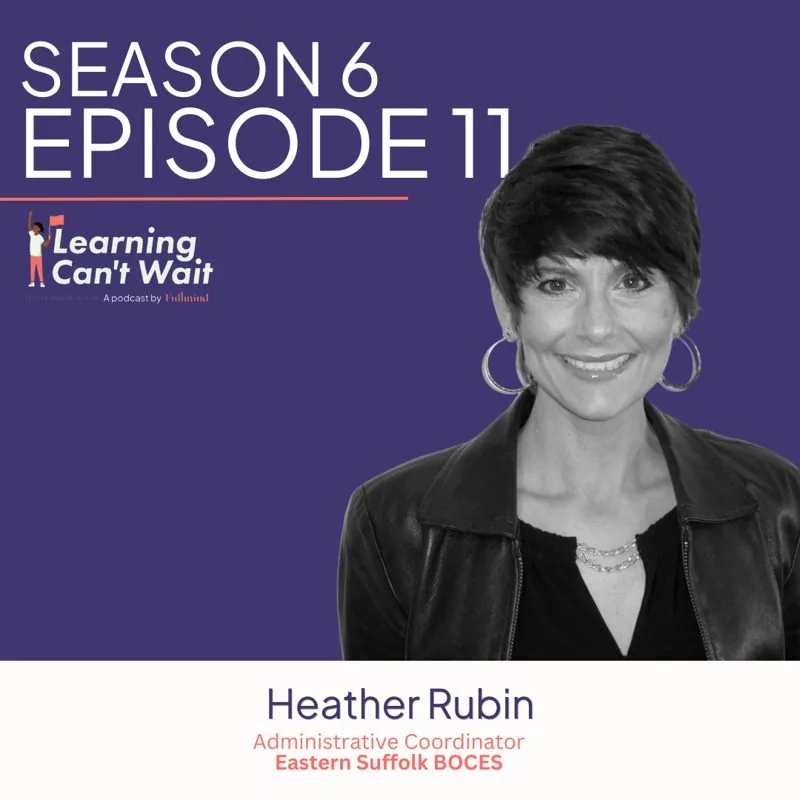
Heather Rubin: Cultural Responsiveness, ELL, Project-based Learning, Digital Age Teaching
- Heather Rubin
 Hosted by Hayley Spira-Bauer, Chief Academic Officer at Fullmind
Listen now
Heather Rubin: Cultural Responsiveness, ELL, Project-based Learning, Digital Age Teaching
Episode summary
Heather Rubin, who coordinates ENL and bilingual programs for Eastern Suffolk BOCES in New York, discusses cultural responsiveness as a daily practice, project-based learning for multilingual students, and the ideas in her book Digital Age Teaching for English Learners. She explains how AI can let teachers modify texts for every proficiency level within minutes, what a classroom ready for technology looks like, and how her 46-district Title III consortium works with Fullmind on virtual ENL enrichment, Regents prep, and Saturday enrichment so small districts can pool students regionally.
Key takeaways
- Cultural responsiveness is a practice, not a definition you learn once
- AI lets teachers modify a text for every proficiency level in minutes, a real differentiation breakthrough
- Great classrooms are student-centered, collaborative, and full of displayed student work, not rows
- Regional virtual programs let 46 small districts pool English learners for after-school and Saturday enrichment
- Virtual Regents prep gives English learners test preparation access they otherwise lack
About this episode
the administrative coordinator for ENL and bilingual programs with Eastern Suffolk BOCES in New York State. Heather shares her insights on cultural responsiveness, project-based learning, and the critical role of technology in fostering equitable education for all students, especially English language learners. We explore how the digital age has transformed teaching, the power of AI in education, and the importance of building trust and creating inclusive, engaging learning environments. Plus, Heather talks about her innovative partnership with Fullmind and how virtual learning programs are providing equitable access to language support, Regents prep, and enrichment opportunities for students. This is a must-listen for educators, school leaders, and anyone passionate about the future of education!
Read Heather's Book: Digital-Age Teaching for English Learners: A Guide to Equitable Learning for All Students
Episode notes
As schools continue to adopt digital learning tools, the role of technology in promoting inclusivity and providing equitable education opportunities for English Language Learning students is vital. In the latest Learning Can’t Wait podcast episode, host Hayley Spira-Bauer dives deep with Heather Rubin, the administrative coordinator for ENL and bilingual programs with Eastern Suffolk BOCES in New York State into how educators can harness the power of technology to help ELL students overcome language barriers and thrive in both academics and personal growth.
Looking to better support your English Language Learners with technology that truly meets their needs? Schedule a free consultation today to explore how Fullmind can help you implement personalized, tech-driven strategies that empower ELL students and foster inclusive classrooms.
Key Takeaways
- Technology Enhances Equity: Implementing digital tools in the classroom ensures that ELL students have equal access to learning opportunities, leveling the playing field for all learners.
- Personalized Learning for ELLs: Tech-enabled platforms allow teachers to create individualized learning experiences for ELL students, addressing their unique language and academic needs.
- Engagement Through Visual and Interactive Tools: ELL students benefit significantly from visual learning aids and interactive tools, which foster active participation and support language acquisition.
- Real-time Support: Apps like Google Translate and Microsoft Translator offer immediate language assistance, enabling ELL students to engage more confidently in classroom discussions.
Why Supporting English Language Learners (ELL) Is Important
With the number of ELL students steadily rising in U.S. public schools—accounting for nearly 10% of the total student population according to the National Center for Education Statistics (NCES) —it is crucial for educators to integrate effective teaching strategies that accommodate linguistic and cultural diversity. Schools must ensure that language acquisition doesn't become a barrier to academic success or personal growth, emphasizing the importance of building meaningful connections with diverse learners. This is where educational technology plays a pivotal role.
How Technology is Revolutionizing ELL Education
The intersection of technology and education has opened up innovative ways to teach ELL students effectively. Teachers no longer need to rely solely on traditional methods; they can now take advantage of the latest digital tools to provide immersive, engaging, and individualized learning experiences.
Four key technologies supporting English Language Learners include:
1. Translation Apps
Real-time translation tools such as Google Translate and Microsoft Translator are invaluable for both teachers and students. These apps offer instant translation of text or speech, which helps ELL students comprehend instructions, participate in classroom activities, and complete assignments without the language barrier hindering their progress. Such tools represent just a fraction of the broader AI applications in education that are transforming how we support diverse learners.
Teachers can also use these apps to communicate effectively with ELL students' families, ensuring everyone stays informed and involved in the student's educational journey as part of comprehensive school-wide technology planning.
2. Language Learning Platforms
Online platforms such as Duolingo for Schools, Rosetta Stone, and Quizlet have revolutionized how ELL students practice and learn English. These platforms are designed with adaptive learning algorithms that tailor lessons to each student's proficiency level. They allow students to build vocabulary, improve grammar, and practice pronunciation—all at their own pace. This personalized approach mirrors what innovative educational models are achieving across diverse learning environments.
Moreover, many platforms provide gamified lessons, making learning fun and interactive, which can be especially beneficial for younger learners or those who might feel intimidated by traditional classroom settings.
3. Visual Learning Tools
ELL students often benefit from visual aids that complement their language learning. Tools like Canva and Google Slides allow educators to create visually engaging presentations and materials that reinforce new vocabulary, concepts, and ideas. By pairing visual elements with written or spoken words, these tools help ELL students make connections and contextualize new information more effectively.
Teachers can also encourage students to create their own visual projects, giving them the opportunity to express their understanding of lessons through a combination of visuals and language.
4. Video and Audio Resources
Platforms such as YouTube, Khan Academy, and TED-Ed provide a wealth of video lessons that can support ELL students’ academic needs. Many of these videos are available in multiple languages, allowing ELL students to access content that aligns with their curriculum while improving their language skills.
Teachers can incorporate these videos into their lessons or assign them for independent study, making it easier for ELL students to grasp complex subjects while enhancing their language proficiency. Additionally, podcasts and audiobooks can also serve as effective resources for developing listening skills and reinforcing vocabulary.
Personalized Learning for ELL Students
One of the most significant benefits of using technology to support ELL students is the ability to personalize learning experiences. Unlike traditional one-size-fits-all approaches, educational technology allows teachers to tailor lessons to each student’s learning pace and language proficiency. Tools like adaptive learning platforms and learning management systems enable teachers to monitor individual progress, assign differentiated tasks, and provide timely feedback.
Personalizing instruction for ELL students not only enhances their language development but also fosters confidence and motivation. ELL students can work on areas where they need the most improvement without feeling left behind or overwhelmed. Furthermore, personalized learning empowers ELL students to take ownership of their learning journey, leading to greater academic success.
How Educators Leverage Technology for ELL
While technology is a powerful tool for ELL education, it is the role of the educator to effectively implement these tools in the classroom. Teachers should be intentional about integrating technology that aligns with their students' needs and the overall learning objectives. Whether it’s providing real-time translation during a lesson or assigning language learning app activities for homework, educators need to ensure that the technology enhances rather than complicates the learning experience for ELL students.
Additionally, professional development and training in educational technology are crucial. Teachers who are confident and skilled in using digital tools will be better equipped to support ELL students and create a more inclusive learning environment.
Additional Resources
- National Center for Education Statistics (NCES) – ELL Data
- Colorín Colorado – Resources for Educators Supporting ELL Students
- EdTech Magazine – How Technology Supports English Language Learners
- TESOL International Association – Resources for ELL Educators
Full transcript
Transcript generated from the recording; minor errors may remain.
Hayley Spira-Bauer: Welcome back everybody to the Learning Can't Wait podcast. I am so eager for you to meet today's guest. We have Heather Rubin, the administrative coordinator for ENL and bilingual programs with Eastern Suffolk BOCES in New York State. Heather, welcome. How are you?
Heather Rubin: I'm fine. Thank you for having me. I'm so happy to be here.
Hayley Spira-Bauer: I have been looking forward to this recording for a lot of days. Every time I get to be in a room with you both virtually and in person, it feels like a holiday. So thank you for joining us.
Heather Rubin: Thank you.
Hayley Spira-Bauer: I'm going to start us off by asking, and I know you have a wonderful answer to this, but I'm going to start you off by asking how did you come to be the personal and professional version of yourself?
Heather Rubin: I love this question. I think everyone has a unique journey, and I have to say that I always wanted to be a teacher from, I always loved school. I was a real nerd. My teachers, I've had the pleasure and the good fortune to have amazing teachers throughout my life who really inspired me. So that was a given. I just knew I wanted to be part of education from very early on. But I have to say, one of the things that really shaped me into the direction of working with multilingual learners and EL bilingual programs was an experience I had when I was 16 and my grandmother took me for my birthday to Europe. And as a kid who grew up in Queens, New York, in a very little world, when I saw all of these amazing countries and I started to hear all of these languages, it completely changed my worldview, completely opened up my mind, and I knew that I had to be a global citizen. I had to be part of the world. So that's the direction I took in college and pursuing linguistics and EL methodology. So it's been amazing. Yeah. What a
Hayley Spira-Bauer: Beautiful story about traveling with your grandmother and how it opened your eyes to other cultures and peoples. And when you think about your journey over the past 20 years, how has this experience helped you approach the work that you do?
Heather Rubin: I feel as though I have such a deep appreciation for culture and the nuances of understanding and navigating maybe cultural norms, cultural differences, and in my world, over 20 years, my profession has evolved in that way. They really have, and I have witnessed such a shift, such a transformation of understanding and we're still working on that.Cultural responsiveness is a practice. It's not something you read a definition of and all of a sudden you are culturally responsive.It's a lifelong learning experience. Every day that you encounter a person right next door to you, there is a cultural responsiveness experience waiting to happen, if you know what I mean. So you have to be very aware and really it's just about understanding people, really taking the time to know what matters to people. And I think it's a skill that you get better at the more you practice
Hayley Spira-Bauer: Such an astute point that supporting English language learners or multilingual learners, depending on the state you're located in, you may have a different name for it involves a ton of deep understanding about cultural responsiveness because I think folks who don't teach might believe that supporting English language learners means just teaching them English.
Heather Rubin: Absolutely.
Hayley Spira-Bauer: When in fact, it's a celebration of the beauty of the many languages the student may speak and the experiences they bring and the way that these experiences enrich other people's lives as much as their own get enriched by learning in a new community as well.
Heather Rubin: Absolutely. It's amazing. It is so much more than language learning, and I really don't even know where to begin with that because when we're in a classroom in order to help our students, perhaps some, many of our students are born in New York state. We have a lot of ELs who are not coming from another country. So that's one thing. But many are also coming from different experiences, a wide variety of experiences, and you need to be able to create a sense of safety, create a sense of belonging. We do so much more than just teach language. ([05:22](https://www.google.com/url?sa=E&q=https%3A%2F%2Fwww.rev.com%2Ftranscript-editor%2Fshared%2Fc9yeC_ZemfGYxyybb6FtekBCJUGrARR2JKRczGWdhZqTg0RYvtKmh5f7fCwBqGV7qh8_uG-yaPxRTGpgNx5EtoKb9nI%3FloadFrom%3DDocumentDeeplink%26ts%3D322.57)): I think creating a community of learners is really about building trust within that learning environment, it then making sure that there is experiential learning. I'm a strong, strong advocate for project-based learning experiences, and I think when you connect that context, when you have students learning authentically and in culturally relevant ways that really speak to their unique identity, giving them choice, we talk about in the digital age, voice, and choice, but truly that means that this student's unique identity is able to be present and expressed in these projects that you're designing for them. So big, it sounds very theoretical. It's a big description, but it happens very organically. It happens when you know your students and what makes them tick, and then the language is applied. The language learning happens in many variety of ways.
[05:00] **Hayley Spira-Bauer:** I appreciate the way you describe this work because it is so rich with context, but it's also so embedded in different aspects of a student's learning. It's not one class they sit down for and then leave when it's over. Right? True. Embedded learning happens when it's interwoven in other subjects. And just a moment ago, and just a moment ago, you threw out this word digital age, which happens to be part of the title of your book, which is Digital Age Teaching for English Learners, A Guide to Equitable Learning for All Students. I'm going to link in the show notes this book that you have written. Can you talk a little bit about this bestselling resource that helps school to close the digital divide and bridge the gap for historically marginalized students including English language learners?
Heather Rubin: Absolutely. Thank you. It's my pleasure to talk about this because I think it's such an interesting time in education. We've now gotten to the point where technology is ubiquitous. I've seen that evolution and my co-authors and I have always been at the forefront of using these technologies and trying to use them for language learners more specifically, but also to improve classroom instruction in general. And what we've learned is that it's not just about enhancing lessons. It's about absolutely creating experiences where this technology supports exploration, supports creativity. So when we first had access to these tools, what did we do? We were looking up things. We were finding out information. Wikipedia was like a revolution and because we could consume more content. But what's happened at this point now that we can say we're not there yet, but that most districts have one-to-one initiatives. Many districts, let's say, if not they're on their way there because it's a requirement for learning. ([08:38](https://www.google.com/url?sa=E&q=https%3A%2F%2Fwww.rev.com%2Ftranscript-editor%2Fshared%2F1yBmcMn0-RteePFr4K6z_-uAeRXXxkiHtBhHPyuo3Z6Z_EZr_oao5DNnkzYkR0GNUbLY9jq7q5vJpn0E2yEVNyrLq9U%3FloadFrom%3DDocumentDeeplink%26ts%3D518.21)): There are lots of government funds supporting this, but it will happen. But so now what do we do? We're not just using them to research and consume content. We're using them to create content to create, so the students get to be owners of their own learning. So I would say that that's what the digital age is all about. It redefines how we learn. It expands what we can learn, and the skills are not just about, they're so interdisciplinary that it can't be confined to, I'm studying social studies, I'm studying math, I'm studying science. I mean, I foresee it really transforming the way we deliver content instruction moving forward.
Hayley Spira-Bauer: That's incredible. And this book really preceded a lot of the big technology changes that we have experienced over the past year and a half in education. So let's talk a little bit about your feelings and maybe if you write a follow up to this book that incorporates the age of AI and large language learning models, what would it say?
Heather Rubin: I love this question. It gets me so excited. I have to tell you, it is so new and emerging. I just attended a recent seminar on this revolution and the evolution of AI in education, and we're still just barely dipping our toe in the water. The reason being is that the districts themselves have to figure out how students are permitted to use this tool. And teachers, I
[10:00] **Hayley Spira-Bauer:** Love that specific language there. I want to pause for a minute on that. Permitted to use the tool
Heather Rubin: That's important. Yeah. Well, the acceptable use policies are being very carefully crafted, but what's fascinating about this conversation is what they believe students will do regarding plagiarism and how there are fears around the lack of critical thinking when in fact, using these tools effectively, especially for language learners, it's going to model language use for them if they learn. It's being a critical thinker because you have to learn how to prompt effectively. So you have to use language and you have to be very refine your language use to get the responses and know that you're getting a response that is appropriate. These are critical thinking skills that will develop over time, but we really have to teach students how to use it as a partner in their learning. And of course, teachers are going to have to have a mind shift around what is acceptable as far as what type of an assignment am I creating using these tools. Obviously, it's just so brand new. It's going to evolve rapidly. I know this year in my program, we are not moving forward with a program on AI that we had planned because the districts are not ready, and I am being respectful of that need to refine their philosophy around the usage and helping both teachers and students use it effectively. So we're looking forward to the following year of really helping to support them in their use of AI.
Hayley Spira-Bauer: An interesting quandary. So let's talk about, I'm sure you have evidence or examples in your mind of a district that is at the forefront of this, and we don't have to name names. I don't want to make any of your component districts feel badly, but can you describe what a district that is ready looks, feels and sounds like?
Heather Rubin: Yes. I had the pleasure of meeting a colleague and talking about some of the ways in which they are rolling this out with their students and teachers, and they started with a lot of surveys, finding out what people already know. There's not just what do you know, but also sentiment, how do you feel? And again, it goes back to what I was mentioning earlier about building trust. So when you understand the teachers are going to be at many different levels of expertise, when you understand that there is some fear associated with how do they use this tool effectively, will I be an effective teacher? That sense of self is being challenged. You have to get information from everyone, figure out where they are. So that's step number one, surveying the parents, leading everyone to this new normal, which is inevitable, and then developing your policies so that the students can actually engage in something that they will be using for the rest of their lives. ([14:22](https://www.google.com/url?sa=E&q=https%3A%2F%2Fwww.rev.com%2Ftranscript-editor%2Fshared%2FdDFgToBMPlFL08zzzofmSdgTbarv8Ibl3kDMCMPMx0ufD4IVxSc_3CRZWx5uBike1Me-W4xIrDUfEzZV-yoLWR6hM1c%3FloadFrom%3DDocumentDeeplink%26ts%3D862.27)): And again, I think for language learners especially, it is an amazing tool. Teachers will be able to differentiate their instruction to address the proficiency needs of all of their students. So a language learner who is just an entering or emerging English speaker or a student who is advanced, you're within the same classroom.You can within minutes modify a text that you use so that it is accessible to all of your students. This is a real breakthrough.This is truly a wonderful thing. So that now we've often told teachers, you have to modify, you have to differentiate, you have to make sure you're addressing the students' needs. It has to be personalized, and teachers often feel very challenged by that. How many things can I change? How often can I do this? Well, now they have the tools and it's going to create access to content. It's going to help students have access to learning experiences that the teacher wouldn't have the time or even possibly the facility to do that. And that doesn't, I haven't even mentioned just the simple fact of translation, which we're already using translation tools, but how that will evolve as well, so that if you have multiple languages in the classroom, you are not going to be stuck being able to differentiate that as well.
[15:00] **Hayley Spira-Bauer:** Imagine if I had that when I was a second year teacher. Between my second year, I looped with my students, but my class was really small my first year of teaching, which was a gift, and they made it much bigger my second year of teaching, and they added a large population of English language learners, and I was a second year teacher and I was confused. Ultimately, I wrote my master's thesis on vocabulary acquisition for English, for English language learners. I got so fascinated with studying the way that you could incorporate project-based learning and hands-on experiences and really integrate your education from every subject into one cohesive learning experience. If I had tools like this at my disposal, I would've been so much more effective. Now, Heather, you are no stranger to using technology as part of a successful implementation or curriculum. Talk about how that has evolved over time and why you've embraced technology so
Heather Rubin: Well. Whenever I've had this question before, and whenever I get this question, I smile because my colleague and I, and one of my co-authors, Lisa Estrada and my other co-authors is Andrea Honigsfeld, Dr. Andrea Honigsfeld. We always share this story where Lisa and I were working together when the iPod came out, so I know I'm dating myself, but this was revolution. I love the
Hayley Spira-Bauer: IPod.
Heather Rubin: It had a little wheel that you had to click, and this was, you had to, well, anyway, this was a revolution bringing access to audio effortlessly to our students in a new way, providing that personalized experience that they could each have this little device and that. So that's where we started and we began to train teachers on using tools like the iPod, which had a recorder that you plugged into the bottom, right? So you would plug this little recorder on the bottom, and now you had this mobile device that you could set up stations with and kids could record, and you can do these wonderfully wonderful speaking and listening activities. And it blossomed from there, obviously to today, where the use of things like digital storytelling is such an interdisciplinary, amazing learning experience that requires all of the skills. It's the critical thinking, the communication, the collaboration, the creativity and culture. ([18:47](https://www.google.com/url?sa=E&q=https%3A%2F%2Fwww.rev.com%2Ftranscript-editor%2Fshared%2Fhuho_V5doNgvuybbyKUZ5lB1hfOqmu_2MCEjdnZryTcX1C5QCTk9c65t7Qs4DwmWeGJ38ivMnXypW3Y3yt23qdokODQ%3FloadFrom%3DDocumentDeeplink%26ts%3D1127.07)): It's so wonderful. And again, all the subject areas can be infused in that and allows for the students to really take charge. So what are the tools have revolutionized? I mean, obviously the iPad was the next one that just blew us all away and apps for learning. But I think what's more important than the actual tools is how teachers are using them. How are they designing instruction? Because it's not about, the tool never is because an iPad is useless if it's just being used to watch videos. If I'm just watching a video, you're not even scratching the surface. Or if I'm just sending emails, which we all still rely so much on sending, even though we have texts, we just constantly, our inbox is flooded. That's not moving the needle forward. It really has to do with student agency and giving them a reason to use the tools.
Hayley Spira-Bauer: You have touched on something that a previous guest, you may know him, Arne Duncan talk often about, which is how great teachers really matter. Let's talk about that for a second. You've been around teachers, you are a teacher. Tell me about the best teacher you ever saw or had and why you think they were so effective.
[20:00] **Heather Rubin:** A great question.
Hayley Spira-Bauer: Well, thank you.
Heather Rubin: Yeah. I've observed a lot of teachers over my years. It's one of my responsibilities to work with and evaluate teachers. I think that I am always impressed when I walk into a room and there is a lot of conversation going on, not by the, it is not teacher centered. You walk into the room, there are no rows because believe me, I still walk in and see rows of students, teacher at the front. If I could wave my magic wand and have every teacher stop using rows, I would be the happiest person. I think that is one of the most difficult habits to change for teachers to actually use their environment in a way that allows movement for children and students to collaborate together in a way that they can move around the room to allow for conversation so that the noise level may get a little higher, but this is what we need in the 21st century. ([21:47](https://www.google.com/url?sa=E&q=https%3A%2F%2Fwww.rev.com%2Ftranscript-editor%2Fshared%2Fq49B882yJLe9Ko1_Fu5HBKuihqoueHIGsGIXBRR3g2IayO29VyarDt9ZCiimqv0mcYjQv7zlteBHrP75RC_U-khzmgc%3FloadFrom%3DDocumentDeeplink%26ts%3D1307.95)): We are all working in a new world, a new era where we have to collaborate, where we have to know how to work together on projects and come up with really interesting problem solving techniques, be creative, be innovative together, and find solutions to things that many of us as teachers have not yet really encountered. So we have to give the students the freedom to be innovative, experiment and circulate around the room and work with their peers. I think that anytime I've observed a teacher, to answer your question, the ones that I felt were just so engaging. Were not using direct instruction. There's a time and place for that, of course, but I walk in and I look around, where's the teacher? And you see them a little bent over a student who's working, trying to support them in their group as they're collaborating on assignment. ([22:46](https://www.google.com/url?sa=E&q=https%3A%2F%2Fwww.rev.com%2Ftranscript-editor%2Fshared%2F7DV-g9_A_GAlVrgL9-TqiwhIYRdL4EPaky2T50nffMkZ7tf4Idprc5g4QC8qqbAAk3RZWt0tbSZY1UvcdOZDPGrLTyg%3FloadFrom%3DDocumentDeeplink%26ts%3D1366.87)): That was really very well-designed to give the students the freedom to work independently because that takes a really good teacher that if you can structure it, especially with language learners and you can provide for their language needs, so they have some independence by tiering the assignment, by making sure that they're paired with peers, that they're able to support each other. There's so many things that go into this question. And of course a room that is the environment is inviting. I worked in New York City public schools in very high needs districts, and we didn't have always have a lot of resources not to disparage the city schools. I graduated from city schools. I love New York City schools. I think they're the most innovative, really the most amazing schools. Sometimes you have a lot of kids in a room. You have to be very innovative, make the environment engaging, really print rich, really visual. Nothing disappoints me more than walking to a room where there's no language anywhere displayed. No, and not, we're not talking about posters, we're talking about student work. We're talking about, you can see that it's an active learning space. It's a learning lab. That's what I look for.
Hayley Spira-Bauer: Heather, you painted such a beautiful picture, and I always love when the episode allows for some theoretical talk, but then some practical, because my hope is that listening in this, listening to this episode are both school leaders and teachers and people that are school adjacent and that when they hear that, they come up with, I mean, you listed probably 15 things. You rattle them off the top of your head, 15 things that they can either look for in their own schools and make sure they're happening, or if they're a teacher, they can quickly add for the rapidly approaching school year 24, 25. So thank you for that. My
Heather Rubin: Pleasure.
Hayley Spira-Bauer: In your sharing, talked a little bit about being innovative together, and I wasn't sure we get here, but I feel like it's important to share that, Heather, you've been an amazing partner to Fullmind over the past couple years in thinking about innovative ways to support English language learners. Can you talk a little bit about what that partnership looks like? And it's a full disclosure here, is that I wasn't sure we'd ask a specific question about this, but I think that partnership comes up a lot in education, and I want to just touch on that for a few seconds.
[25:00] **Heather Rubin:** I'm so glad you asked me this question. I think that one of the most promising, one of the most amazing partnerships that I've had the pleasure of being a part of is with Fullmind, and I mean, this is just to back it up a little. I remember when I first heard about virtual tutoring services and let's say it's not tutoring, but virtual learning services, and I thought immediately about my language learners, I said, our students do not have access to support language learning support in a virtual environment, typically, right? It doesn't typically exist. So I had, I'm in a position where I get to curate resources for districts and I get to see what their needs are and see whether or not I can help by using funds through Title III. I have a Title III consortium. We have 46 districts that participate, and we use the funds to provide digital learning resources, professional development, and we designed these programs based on the needs of our districts. ([26:57](https://www.google.com/url?sa=E&q=https%3A%2F%2Fwww.rev.com%2Ftranscript-editor%2Fshared%2FVeo2USRK3B2Wk80og91GkNHTfvn8Hq8U5qtMCVjXvvqDCKaOcN_RURmT0Ug1pr2joXEC03nRj_ou1GUzW-4gowl_FLE%3FloadFrom%3DDocumentDeeplink%26ts%3D1617.48)): So I came across Fullmind and I thought, wow, my districts have been asking me for enrichment programs after school. But it's a very hard thing to design when you are doing it across the entire Long Island region. So we have 46 districts who have a low number of LS per district, but together very powerful. But how do you create a regional afterschool program? Transportation is very much a challenge. Of course, different needs among the districts can be a challenge. And then I found Fullmind, and we have embarked on, you've been so flexible and we've just together brainstormed these wonderful programs. I'm really looking forward, I have to say to the coming year, because obviously one thing my districts wanted was in ENL Regents Prep, right? New York State, they have to take the New York State Regents. And for my students, they don't always have access to the services, like a lot of kids can get to prepare for testing. ([28:12](https://www.google.com/url?sa=E&q=https%3A%2F%2Fwww.rev.com%2Ftranscript-editor%2Fshared%2FcMlKsbM758fx2Ua6H-JNriHR8aw4c4XA7v80pSbQvs3GQG4ZxwnMhsfQmvN1yPEuFNLP93dusdSgTcJEQXnkxHAK8kQ%3FloadFrom%3DDocumentDeeplink%26ts%3D1692.39)): So we created with you a virtual Regents Prep program so that after school in the early evening, students can log on virtually with a live teacher, a human being, and get regents preparation.So this is about equity, this is equitable access, and that's what gets me excited about it.Another thing they've been asking for was the Saturday Enrichment Program. This is what Title III monies, how they can be used and allocated, but logistically quite a challenge for the same reasons I mentioned before. Well, now we're experimenting and we're going to have a program for the middle school students next year where they can log on Saturday mornings and participate with all the students from around the region in a virtual Saturday enrichment program. And I'm very excited to see how that goes. I really, really am. ([29:23](https://www.google.com/url?sa=E&q=https%3A%2F%2Fwww.rev.com%2Ftranscript-editor%2Fshared%2FLKOLe2rOTDd3tza97MWOoBa8hNcRR4gl01K3ajVuHgbuMbr4u0ioNpv0KVhNN27HXZbwRqXrYsmEiQAYelk_fJdRUdU%3FloadFrom%3DDocumentDeeplink%26ts%3D1763.46)): And we actually, we have one more program, and I don't know why, but right now, I'm trying to think. Okay, so we're doing the Regents prep. Oh, and of course, the one we started with, that's so funny. So the very first program that I collaborated with Fullmind with was just the language support. So English, it was an ENL afterschool enrichment. So specifically to target through Project-based learning experiences, just to support ELs using language to give them another opportunity to just use language in context, in a low stakes environment and create projects with their peers virtually. So then again, just another opportunity to use language and to have the teacher there to guide them and allow them to be with their peers after school to experiment and have fun, very low stakes environment, but very, very useful support, could really push the needle and help them when they get to the school, back to school in the morning right after they've been practicing language, some more practice, practice, practice. I hope that it makes a difference for the kids, and I believe that it will. We are going to be monitoring it and measuring it. We love this as
[30:00] **Hayley Spira-Bauer:** We do, as we do. Yeah,
Heather Rubin: We've been amazing. And that's one thing we haven't talked about was assessment. And honestly, it is such an important part of everything, and it doesn't have to be a paper and pencil way of assessing, and that's really, really important for our LS to really measure their progress. And so in addition to all these different ways of supporting their language development through Fullmind, through this virtual learning platform, we're also tracking their progress to see where they're growing and how they're growing because of it. So I think that you've been amazing in supporting that type of evaluation. So really, really exciting.
Hayley Spira-Bauer: Well, I promise this isn't an advertisement for Fullmind, so I appreciate, but I appreciate Yeah,
Heather Rubin: But it's true because we're being really
Hayley Spira-Bauer: Innovative. Tyler, can I tell you, there is a sentiment that when we get to talk about the programs we're running internally, so this is outside of the ears of your team, you and your team, we are so excited. Everybody feels how innovative you are and how this is a true partnership, and it's why I wanted to touch on that word. Because the best programs are designed together, implemented together, tweaked together, and assessed together. And your collaboration is what makes this both fun and beneficial for students. And as much as I love how you give such high regard to the work that we're doing, I think it would never be possible with, without your brilliance and your vision for what superior English language learner support looks like, and it's a real testament to your career and your expertise. I feel honored to be able to witness it.
Heather Rubin: Thank you so much. That means a lot to thank you.
Hayley Spira-Bauer: Of course. Heather, I have my final question for you. I'm going to tweak it somewhat from how I typically ask it. I always do a little bit of a tweak for the guests, but I normally ask, what advice would you give a teacher starting their career today? And I'm going to tweak that for you to say, what advice would you give a teacher who's teaching ENLs or English language learners starting their career today?
Heather Rubin: I think I'm going to echo something I said earlier because it really is at the core of good teaching, and that's to build trust. But it's building trust within your learning community, right? It's not only about the one-to-one relationships you develop with students. It's about creating a learning community where students feel safe to take risks because English language learners need to feel confident in a way that this is a safe space, that I can try out a new word, or I can mispronounce something. I can make mistakes, and they want me to talk. They want me to talk, and I have lots of opportunities to write, and I have, if I can't say it, I'm going to draw it. The teacher's not going to require that I express myself in any one particular fashion. The goal is to communicate. So if you think about that in the sense that you are always looking for ways to communicate with one another, and how can we best facilitate that so that the students are engaged, not just in communicating with the teacher, but communicating with their peers. That is the magic. That is the secret. So you have to have trust. I could talk more about that, but I think that most teachers understand exactly what that means and how you develop that sense of safety.
Hayley Spira-Bauer: That's so beautiful. Thank you so much, Heather, for coming on the podcast today. It is such a delight to record this episode with you, but also just be in your orbit.
Heather Rubin: Thank you. Likewise. Likewise.
Hayley Spira-Bauer: And thank you to everybody who tuned in.