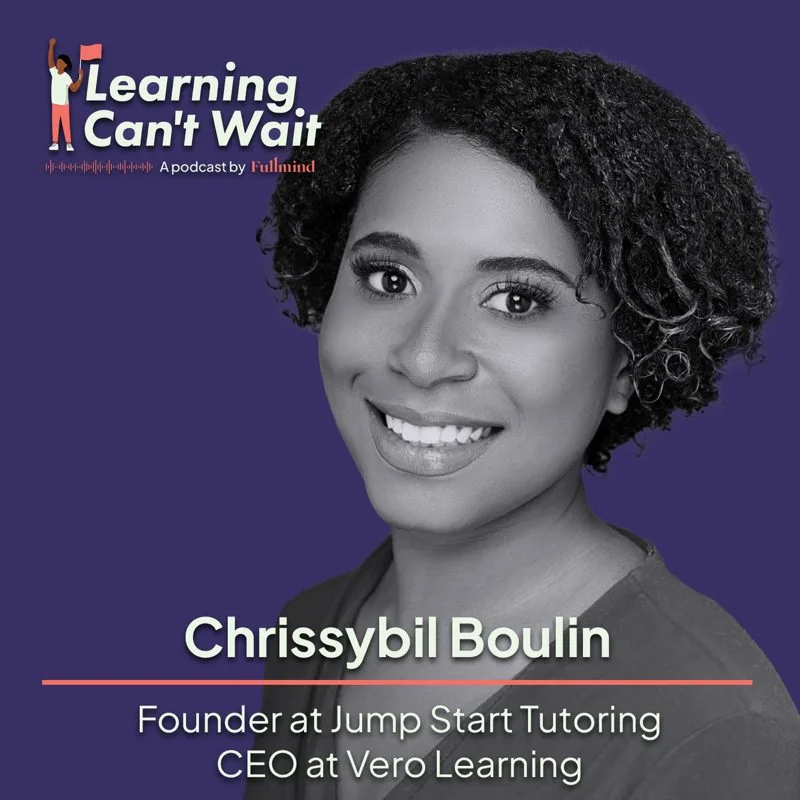
Learning Can’t Wait · Episode 80
Chrissybil Boulin: Career Guidance, Economic Mobility, Entrepreneurship
- Chrissybil Boulin, Visionary force behind Jump Start Tutoring and the CEO of Vero Learning
 Hosted by Hayley Spira-Bauer, Chief Academic Officer at Fullmind
Listen now
Chrissybil Boulin: Career Guidance, Economic Mobility, Entrepreneurship
Episode summary
Chrissybil Boulin, CEO and founder of Jumpstart Tutoring and Vero Learning, shares how growing up between New York and Haiti and being waitlisted at Duke over an SAT score led her to build an SAT curriculum, earn a perfect score, and launch a tutoring company with major district contracts. Pandemic-era calls from lost 18-year-olds revealed that most seniors were unready for college or career decisions, inspiring Vero Learning, a pre-employment screening and career SWOT platform with an Office Depot partnership. She advises teens to breathe and keep building skills.
Key takeaways
- Being waitlisted at Duke over an SAT score exposed how family resources shape opportunity and launched her business
- Jumpstart grew from free SAT talks at libraries to contracts with the fifth and sixth largest US districts
- 80% of surveyed seniors were unready for college or career decisions; 60% had fewer than five adult conversations about next steps
- Vero Learning's pre-employment screening produces a career SWOT report with links to training modules
- Corporate pilots like Office Depot help reverse-engineer what successful early-career employees look like
About this episode
In this week's installment of the Learning Can't Wait Podcast, host Hayley Spira-Bauer engages in a captivating dialogue with Chrissybil Boulin, the visionary force behind Jump Start Tutoring and the CEO of Vero Learning.
Tune in to this enlightening exchange as Chrissybil shares her journey, revealing how a setback—failure to gain admission into her desired college—propelled her into the realm of entrepreneurship, ultimately impacting the lives of countless students. Chrissybil delves into her transformative initiatives, which empower young minds with invaluable career guidance and facilitate seamless job placements. She also explains why a focus on self discovery is essential for kids to understand what they’re good at and what they need to improve.
Produced by Fullmind
Episode notes
In this week's installment of the Learning Can't Wait Podcast, host Hayley Spira-Bauer engages in a captivating dialogue with Chrissybil Boulin, the visionary force behind Jump Start Tutoring and the CEO of Vero Learning.
Tune in to this enlightening exchange as Chrissybil shares her journey, revealing how a setback—failure to gain admission into her desired college—propelled her into the realm of entrepreneurship, ultimately impacting the lives of countless students. Chrissybil delves into her transformative initiatives, which empower young minds with invaluable career guidance and facilitate seamless job placements. She also explains why a focus on self discovery is essential for kids to understand what they’re good at and what they need to improve.
Full transcript
Transcript generated from the recording; minor errors may remain.
Hayley Spira-Bauer: Welcome back everybody to the Learning Can't Wait. Podcast I am so excited to be here with someone who, I truly believe. Has taken every measure to transform this space. We have Chrissybil Boulin as our guest today on the podcast she is the CEO and founder of Jumpstart Tutoring and Vero Learning. Welcome.
Chrissybil Boulin: Hi, thank you so much, Hayley, for having me on today. I am equally inspired by all the incredible work you're doing in this space, and I just want to say hello to you and to your beautiful audience.
Hayley Spira-Bauer: I think it's important for us to note that we met each other at an event, New York EdTech Week, both hoping to enter a room without success, knowing what was inside, but naturally got to talking and realized one in one of your organizations we share a space a little bit and do some of the similar work. But in your newest organization I have so much to learn, and so I am eager and excited to interview you today, as I think both myself and our listeners are going to be really inspired by what you have to share. Thank you so much for having me, of course. So we're going to start off with my typical first question. You could get as deep as you feel comfortable getting. But can you share how you came to be the personal and professional version of yourself, please?
Chrissybil Boulin: I love that question, because I think that both aspects of who we are personal and professional are important and ideally, they are working together and not against each other. So I could start off by saying that I went to the University of Cambridge, which is, is kinda cool and eventually started my first business with $500 and ended up making the Forbes list for helping students. And and those things are cool. But they're not really what defined who I am, and I think they're just kind of headliner stories. But when I think about what's defined, who I've become, I really think it's the sum of my identity and my experiences, and so growing up with a single mom that immigrated to the US From Haiti, and having to navigate the education system with a parent that didn't grow up in it, and doesn't really understand all the intricacies or backpacking to over 50 countries, mostly on my own you know, throughout college, and thereafter. I think some of these moments define me in greater ways than than just my education have and so I'd love to dig in more about anything that you find interesting.
Hayley Spira-Bauer: I mean, there's a lot there, right? Thank you, first of all, for your vulnerability and sharing some history of your experiences, both at home and in a worldly capacity. What made you? I mean, you started with $500 in your pot, you said, and you built out this incredible tutoring company. Why, tutoring? What? What led you there?
Chrissybil Boulin: Yeah. So I was definitely always a nerd. I'll tell you that. But I think it was, but I think it was curiosity. I think curiosity made me care about education, and so I was born in New York. But my mom and dad were both born in Haiti, and my mom immigrated to the US Fairly young when she was in her twenties. But my father decided to live in Haiti and decided not to come to the US With her, and he's a doctor there, and any time that I've gone back every one just tells me how incredible he's been, and that he saves the life of his someone's aunt, or cousin, or sister or mom. So he was definitely doing great work, and continues to there, but growing up, it was hard for me not to have him around, so every summer I'd go to Haiti, and even though I'm American, I've spent, you know, years of my life really, spending time in that space. And so understanding the intricacies of what it's like to live without running water. Electricity, or seeing my friends not going off to school or not having a toothbrush, as things that I completely took for granted every day just made me wonder like, why is life so different for them? And I remember vividly once going one of the best days of my life literally waking up early, going to the beach with my dad going horseback riding drinking coconut water. Just a beautiful day, and and very different than my life in the US With a single parent always working, going to school where no one really has time to play with you. And on our way back home. As we were watching the sunset, I saw a young child chasing after my dad's car, and I saw him crying as my dad sped off, and I I'd never see anything like that in the US. And so I remember asking him like, Why is this kid, you know, chasing after your car. And he basically tried to explain to me that he was too poor.He was too poor to afford a childhood.and intristically just. Little me knew that that was not right. I'm like, what do you mean?Everyone deserves to be a kid. And so that curiosity, I think, really fueled my love for education made me wanna learn as much as I could. I started tutoring at the age of 12. I found out that I loved sharing that love for education with others. I was recommended as a peer tutor, and continue to do it throughout college. And until starting my first business and fast forward to 18 year old. Me? President of 3 clubs. 4.8 GPA. Dream is to go to Duke. Still remember the day that I received a small letter in the mail. I knew that I didn't get in. And as I read through the letter and said that I was wait listed, and I was so heartbroken. And I spoke with the Admissions counselor, and found out that it was because of my SAT score. It was good, but it wasn't good enough for Duke, and I think that was the first time that I realized that my mom, not growing up in the US Being an immigrant and also being a single parent that didn't have access to thousands of dollars for tutoring my background essentially put me at a disadvantage, and I really hated that feeling. And so I decided to create an SAT curriculum I transferred from Florida State to Emory University. After getting a perfect score, and I helped about a hundred other kids get into Ivy League or Top 20 schools, and I think that was the first time I realized that education could be more than just a side hobby, it could actually become my career. And so, inspired by that, eventually made my way to Cambridge, where I had an incredible experience, and I was really inspired by social entrepreneurs. I got offered a job opportunity in France and turned it down. And it was gonna be working for the OECD, which, as a young economist, was like incredible opportunity but I really wanted to measure the impact I had in the world. I didn't wanna wait 20 years to see if the things I worked I worked on mattered. So I moved back in with my mom after turning down that job and start Jumpstart with literally $500 in a dream. And today we've served thousands of kids and we've had an incredible ride. It's been incredible to see. Mostly kids from lower income backgrounds have their dream of going to college come through. And our SAT prep is something that we're really well known, for we have among the highest increases in the State of Florida, and we've made the Forbes list for helping kids save millions. And yeah, it's it's been an incredible journey to see how my failure didn't not going to. Duke actually ended up helping thousands of kids along the way
Hayley Spira-Bauer: Story. I mean, that is, that is the definition of inspirational both from us, like you want to make the world a better place, and that is so cool, and the work that you've put in, and the way you've approached the challenges that you personally have faced really, truly incredible. And I appreciate so deeply when a founder like yourself forego so many other things to make the world better. That is the definition of self sacrifice. It's not easy. It's not necessarily fair. Right? But it is so important, and it's great that you're able to look back and measure the incredible impact your work has had. I am curious. You know, businesses are not easy to run. What what has it been like? Especially in the in the education space? What has it been like to go from being a very successful tutor with very clear impact to running a business. What lessons have you learned along the way that you can impart on others.
Chrissybil Boulin: Yeah. So I never studied business. No one in my family owned a business. And going to college. I had no idea that this is something I wanted to pursue. And I think that's why. Now, I'm really, really passionate about making sure that students have access to career guidance and job placement, just because I know that although I went to Emory and I was doing really well there. I remember in my junior year thinking after studying political science, that man. I don't really think I want to become a lawyer or politician.and I'm already almost done with my undergrad degree. What am I gonna do now. And so I think that even stumbling upon entrepreneurship was was happened because I focused on building life skills. And II focused a lot on the type of life I wanted to live, and as someone who had been backpacking to 50 plus countries, just the idea of like not being able to have summers off was like, not okay, to be honest. Oh, my goodness, right? And so just looking at the some of my experiences and the people that inspired me at Cambridge. I thought I was gonna go off and and become a bureaucrat and become an economist, and I may one day decide to do some of those things. But the people that really inspired me the most were social entrepreneurs, people that had grit and resilience and took big risk. And even those that made millions of dollars helping millions of people. I'm like, Wow, like these people are my heroes. And just eventually decided to go down that path. Not having any formal experience, I think transferable skills were like a huge part of making it like things that people take for granted, but being able to communicate well, being able to to write a proposal being willing to leverage my network. So I started off by giving free talks about SAT prep, which I'd become an expert in to schools and parents and libraries, and one parent turned into 10 turned into 20 and and really Jumpstart. The focus was always to have it become a lifestyle business, and it's only recently, after winning contracts with the fifth and sixth largest school districts in the US. That we're starting to think about how we can. How we can scale while still keeping that one on one touch, but I think it takes a lot of grit. There are days where you don't know what you're gonna do next. You've planned out a perfect curriculum. You have all your tutors lined up. You're ready. You've got your checklist for a program. And someone literally just doesn't pick up their phone or doesn't text you. And you're freaking out. And everything is not in your control. There are so many dis different aspects of self development that it's gonna take in order to think about things like marketing and hiring and firing and content, and operations and sales. It's never ending in some ways. I think, probably one of the hardest paths that someone can take, but also just so fulfilling and rewarding. I started Jumpstart right after Cambridge. And so I've technically never really had a job like I've always worked for myself. And I provided job opportunities. Although part time for hundreds of people and many of them have decided to stick with with teaching as a result. And so it's been messy. It's been hard. It's been scary. But with a lot of resilience. There's been a lot of achievement and reward and impact that goes beyond me. And I think, seeing your dream come true and literally take on a life of its own where someone's like, Hey, I know Jumpstart or my cousin went through that program and they got into their dream school. Definitely makes it worthwhile
Hayley Spira-Bauer: Such chills. Listening to that. That is like, yeah, it's work. I mean, you're, I think, one thing for folks to realize, not to put down other types of businesses. But you're in the service. Space and Service. Space is tough. There's like a whole bunch of categories, finance and operations. It's not delivering something that's, you know, pre-built and just can be replicated time and time again and implemented. You have to deal with people, I mean, I can speak to this, not because I founded a business I haven't but because I live in. I live in a similar space now. And you and I even bonded in the hallway over one of our shared a space where we are both a provider. Have you heard back from them? Yes, I mean when when we talk about resilience, I mean, it's real and grit. A lot of people would have given up so many times and so. But you haven't. And and not even you, haven't you? You decided to try all again? You had another good idea, I really, when when I met you and heard, Oh, I'm starting a new business I saw I've started a new business. I don't want to say you're starting new business, and then you told me about it, which I have. I don't even know if you have competitors. Tell tell us all about Vero Learning, cause I'm so I'm like amazed by all of this.
Chrissybil Boulin: Yes, so you and I. We met at New York EdTech Week, and I moved to New York in September because we were accepted into the Techstars economic mobility accelerator and for those of you that may or may not know about Techstars, it's considered the largest precede funder in the world. They've got this idea that great ideas and businesses can be grown from anywhere. And so, instead of just focusing in on like Silicon Valley, they provide startup funding for businesses across sectors across the US And even in different countries. And so I was really excited to get accepted into the economic mobility cohort because all of my classmates or business mates, etc. Cohort mates. They were working on ideas that were making the world a better place. And so one classmate has a PE business that provides integrative help for students that have not really gone outside or who are experiencing challenges with their physical health, and we've got businesses that are helping millennials take charge of their finance or gig workers. You know, be be able to apply for loans, and so to go into a cohort and just have incredible people that are working on amazing things every day. Inspiring you is amazing. But we were accepted for Vero Learning, and Vero Learning is a career guidance and job placement platform that helps young adults without college degrees figure out what they want to achieve next. So during the pandemic we started getting calls from 18 year olds, and they were asking us if we could provide them with free SAT tutoring, and it was confusing. Because typically we've gotta force kids into tutoring, especially SAT like there. Not calling us and banging on our doors. And so, after, like 10 or 12 calls like this. We figured that we needed to do some research and find out what was going on, and so, after doing customer discovery, we found out that 80% of the high school seniors that we spoke with were not ready to make college or career decisions. And if that wasn't shocking enough. A majority of those students had less than 5 conversations with any adult in their lives about their next steps. And so, if you think about LinkedIn, or Indeed, or ZipRecruiter. It's completely unhelpful for a kid that doesn't know what are my strengths and weaknesses? What are employers looking for? And how do I bridge that gap? And so that's where we came up with the idea for Vero Learning, focusing on career guidance and job placement. So let's say you are a 16 to 21 year old, and you're trying to figure out what your next step should be. You can come onto verolearning.com, and you access our pre employment screening. And it's a series of many assessments that all focus on helping a student understand their natural competencies, their aptitudes, their skill sets their experiences after they complete the pre employment screening. It generates what we're calling a career SWOT report. And it's very, very cool because it analyzes all of these data points. And just like it says, it's career SWOT report. It provides students with first, a list of the core skills and competencies that employers are looking for especially in early career roles across industries. And then it lets them know where their strengths lie, where their weaknesses are their opportunities and their threats. What's really cool about it is that it provides next step recommendations which right now links them to continued training programs in the areas that we've identified as a weakness or as a threat. And so if you're a guidance counselor, and you've got tons of kids to work with, or a career coach, you can access this SWOT report to understand where your students currently stand and to really provide them with guidance. To take those next steps. We've also created transferable skills, modules. And I know you asked me like, what are the things that have shaped me? And you know, these courses really focus on these things like understanding yourself, understanding others, understanding how to navigate conflict, how to manage your time, how to problem, solve how to adapt to difficult situations. And so we assess where students you're at. And then we help sharpen those skills. And we've had successful pilots in New York City with over 90% of the students that we've piloted saying they recommended to a friend and 80% feeling more confident about where they stand in their next steps. Which is really cool, and we just announced our first corporate partnership with Office Depot. And so we are looking to identify what are the ideal characteristics of early career employees and retail and provide a pipeline for students that are coming through a platform, and in the future we'll have more and more companies that we can match students and their skill sets with to open job opportunities that could be a good fit.
Hayley Spira-Bauer: It's so cool. I just, you know.so many people, II think. Sorry. Let me back up. I think that there is a characteristic of entrepreneurs that is not something that you can teach. I think this like natural. And again, I wouldn't qualify myself as an entrepreneur. So like I say this with the utmost reverence. Entrepreneurs see the world differently. They see problems as opportunities in a way that is so incredible to me. Hearing you recognize that those phone calls coming in from 18 year olds as a chance to build something new that would be beneficial to transform this this particular generations. Future opportunities is amazing. And now to hear that you just landed your first corporate partnership with Office Depot. It's a realization of another dream that it sounds like. Where do you see? Like? What? What if you had your biggest pie in the sky dream with Vero Learning. Where? Where is it? Where does it go?
Chrissybil Boulin: Yeah, thank you so much. It's a tool that I wish existed. When I was a kid struggling to find my path. And when you hear that 25% of kids are dropping out of college within the first year, and less than half of the kids that start end up finishing or not even using their degree. We realize that they're, you know, our system's broken. And we've really got to find ways to engage students, whether college is their dream or not. And so where I see Vero Learning in the next 10 years is as a pathway that all high school students across the US Know that they can access when, if and when they decide, college is not the best path for them. II don't wanna to receive phone calls from 18 year olds whose lives are just beginning telling me that they think it's over.I want kids to feel that there's optionality.I hope that we can also help end the stigma by producing data that shows that kids that are trained, based on skills can perform as well and sometimes even better than students that have formal degrees. And some of that data is already being done. But we'd like to add to that body of research. And we'd like to be the one stop shop solution. For corporations that either provide high pay or provide opportunities from within for employees to go from associate to managerial to executive level and really are gonna support economic mobility. And so we'd we'd like to serve 5 million students. And we're looking at school districts and NGOs and nonprofits across the board that serve Gen Z. And we're telling them we're here, and you know, we wanna be their support system as students for transitioning that very, very confusing, tricky, but essential time in their lives.
Hayley Spira-Bauer: I'm thinking back to a conversation I had with a college access specialist recently, and a really good friend of mine, Dr. Kaycee Brock, and I'm thinking about a conversation we had even 2 years ago regarding good fits. Not every college is a good fit for every kid. Right? I'm wondering what would make a good fit like, what are you looking for in your corporate partners? That makes a good fit for a graduate of Vero Learning.
Chrissybil Boulin: Yeah. So we think that career exploration is important, not just for kids that aren't going to college. And so there's there's definitely use case for students in general. The average student is changing their major 3 to 5 times in college, and so that I think that tells us that we have to do a better job while they're still in secondary school to really expose them to different career pathways. And so I think before we can, even men talk about a good fit, we first have to focus on self discovery. And I think that's the part that's really been missing from education and and also on the HR end. And I think it's one of those things where we can keep tossing the potato around like it's your job to do. It is your job to do. It's your job to do it. But essentially, no one's doing it. And our kids are really suffering as a result. And so I think self discovery is number one help kids understand? What are they good at? Usually we take for granted the things that come easy to us. And so sometimes we need someone to really affirm those skills. What are the things that we wanted that I need to improve? And then really matching their alignment and their experiences with different job opportunities that are out there that they could be compatible with, I think, is the first step. And so internships, apprenticeships. I think, are super appropriate. But we've gotta start with that self understanding and and really, even just focusing on the transferable skills that they're gonna need across the board like being able to communicate or articulate themselves well, or being able to think critically. Because if you think about it, the jobs of the future probably don't. We don't have classes for them today. Right? We're not teaching about them in universities and so helping kids understand who they are, helping them understand opportunities that are available to them and helping them build the transferable skills that will allow them to navigate our ever-changing world, I think, are the best things we can do.
Hayley Spira-Bauer: You know, a lot of people talk about this work you're naming here as a real opportunity for mentorship.
Chrissybil Boulin: And how mentorship can help kids develop that obviously, mentorship is very hard at scale. Right?
Hayley Spira-Bauer: Do you incorporate any mentorship into the Vero Learning process? And if not. Is it because of scale? Or is there another reason like it's hard to is because it's hard to scale. Or is there another reason why it's not currently incorporated?
Chrissybil Boulin: No, I mean, we've we've just launched. So every all of work that we've done. We've done this since November, and so we, I think we've we're moving really fast for the little bit of time that that we've been around. Thank you. It needs to happen. So let's just get to it. But I think that the reason why we're partnering with corporations and not just schools at this stage. And we're looking for corporate pilots is so that we can identify what are the ideal characteristics of employees in different sectors. It's going to look different, we imagine, in retail than it would maybe in healthcare or in tech or in manufacturing. And so being able to get data from employees that are early in their careers that are successful, that are happy, I think, can give us insight and allow us to do some reverse engineering as we're thinking about suggesting career pathways. For for our students.
Hayley Spira-Bauer: That's awesome. II don't think I realized that you all launched just so recently. It's like you share. It sounds like these are things that have been built for so long, which I mean, as a complete compliment. We've we've been thinking about it for a long time. But but yeah, I think the types of companies we want to work with are companies that that want to provide career pathways to students that care about counseling and guidance. And so with, in the case of Office Depot, as we've mentioned to them, you know. Hey? We know you're having a hard time recruiting from colleges, but most young people probably think of you as just like a first job. But they don't realize that tons and tons of your VPs actually started off as associates.
Chrissybil Boulin: And so how can we help you tell that story better about career progression. And so, you know, they're open to ideas like providing sessions where maybe some of our students can can listen to someone that's a VP that start off as an associate. And so I think, with technologies, even though it is hard to kind of scale individualized guidance. I think with technology, there are ways that we can provide students with opportunities to hear success stories. And our goal is really to collect all this data and use AI to predict to create predictive algorithms that help students find career pathways that match them with jobs and hopefully in the future can help them move from like an associate level to an executive level. Maybe we can say, here's your 10 year map, and here are the steps you need to take along the way. Or here's what most people that have gone from associate to executive level have done. And you should consider. And so we're hoping that we can be more than just the first stop shop for early careers, but that in the future we can actually use AI to provide career coaching and guidance throughout the life cycle of a student's journey.
Hayley Spira-Bauer: That's powerful. I appreciate the recognition about what you know. We don't know what we don't know. You know, like kids don't know what they don't know, especially when you name the the statistic that you know.
Chrissybil Boulin: 80% of kids, I believe it was have spoken of less than 5 adults about their future path that had responded to your survey. Can you correct me on that? Because I'm I know I'm I'm but sharing it here. So yes, 80% of kids said that they weren't ready in their senior year to make college or career decisions. And over 60% of the kids we surveyed said they had less than 5 conversations with any adult about what they were gonna do next. That's that's mind-blowing.
Hayley Spira-Bauer: Thank you for correcting me there. I definitely messed that up. But yeah, that is, that is really. Oh, man, it's it's it's disheartening. And actually again, going back to that episode that I just referred to with. The conversation with Dr. Kaycee Brock. You know there's no in high schools. There's no standard for college and for counseling. It's like it's very localized, as is everything in education is one of my biggest, not the same, even within a district. And so you probably even at at the level where you might expect it with within a high school system, you might not have
Chrissybil Boulin: An adult in the building who who is required to talk to a child about their path. It's just yeah. It's crazy. Cause you you think right? Like we are in 2024 like, how is this possible?
Hayley Spira-Bauer: Yes. It definitely sounds mean. I I'm I'm excited to actually introduce you to after this call, because I think you all get along very, very well, and have a lot to talk about. But that's, you know, a conversation for you 2 offline while we're still together. I'm curious, you know. I ask all of my guests as my final question, what advice you would give an educator starting their career today? But I actually think I want to shift that and ask what advice you would give a 16 year old who's still in high school and unsure about their path today.
Chrissybil Boulin: I really like that? That's a great question. Well, first breathe, I think when you're that age we don't realize that high school has been such a big part of their lives. That you know, a 16 year old, you might feel like this. Is this is all that will ever exist for you. But I promise you that life is only gonna get better. And you're gonna move on to greater things.You don't need to have it all figured out today.The most important thing that you can do is really focus on bettering yourself and and your skill sets providing yourself with opportunities. So if there are different clubs at school like, if there's a band club that you've been interested in, or a coding club or robotics club like, take on those opportunities to really experience yourself and to be around people that have interesting insights. Try out for internship and apprenticeship programs that might be interesting to you, or even shadowing someone in a space. That you think is cool. I definitely think pre employment screenings are helpful so that you get an idea of the skills employers are looking for, and where you currently scan where you currently stand. And don't be afraid to ask advice of people who are already there. So if you wanna become a nurse or a doctor or lawyer, and you know someone that's currently doing it like, don't be afraid to ask them for advice and ask them to tell you how different things might be in reality than what they expected when they started their career. But don't freak out. Things are gonna work out. Continue to develop your skills, use your resources to look for people around you and know that your experiences and the development of your skills, and your hard work is really gonna take you far.
Hayley Spira-Bauer: Mic Drop, I mean, I wanna I want to give up every 16 year old in the US and have them listen to that like starting with, take a deep breath. This is, yeah, really great advice. Thank you so much for sharing that. And thank you so much for being on the podcast. Today. I am so glad we bumped into each other in the hallway of that conference. I'm inspired by your work, and and just really grateful. You shared your time with our guests here today
Chrissybil Boulin: As I am by you. Thank you so much for inviting me.
Hayley Spira-Bauer: And thank you. Everybody who's tuned in today.