
Learning Can’t Wait · Episode 98
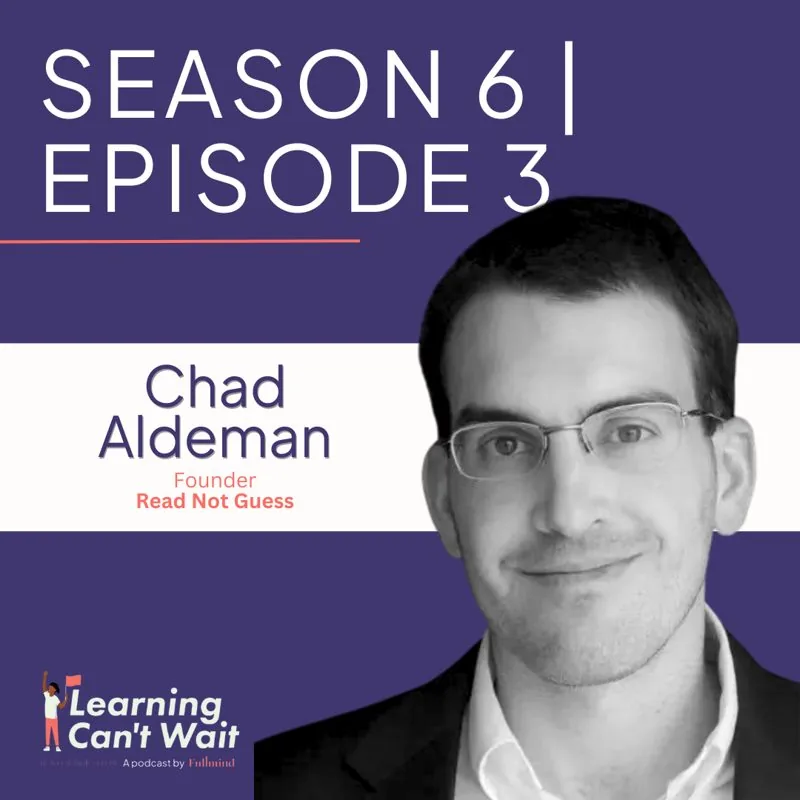
Chad Aldeman: Teacher Shortage, Educator Retention, Read Not Guess
- Chad Aldeman
 Hosted by Hayley Spira-Bauer, Chief Academic Officer at Fullmind
Listen now
Chad Aldeman: Teacher Shortage, Educator Retention, Read Not Guess
Episode summary
Chad Aldeman, school finance expert, columnist for The 74, and founder of Read Not Guess, uses data to cut through the teacher shortage debate. He explains that the US has more teachers per student than before the pandemic, that shortages are concentrated in specific states, subjects, and schools, and that federal relief money temporarily inflated hiring. He questions whether licensure tests and other entry barriers predict effectiveness, outlines state policy levers like reciprocity and staffing ratios, and describes Read Not Guess, his parent-facing phonics program.
Key takeaways
- Nationally there are more teachers per student than pre-pandemic; shortages are regional and subject-specific
- Florida, Louisiana, and Alaska stood out as states with fewer teachers than before the pandemic
- Special education and STEM remain the hardest areas to hire and retain
- Entry barriers like licensure tests screen people without predicting classroom effectiveness
- Parents can support early reading with simple five-to-ten-minute phonics lessons
About this episode
In our latest episode of the Learning Can't Wait podcast, our host Hayley Spira-Bauer is joined by Chad Aldeman, founder of Read Not Guess, as they unpack two massive topics; the national teacher shortage crisis and preparing educators in an effective way. Chad shares his perspective on training, recruitment, and retention and potential ways to take them to a higher level. Learn about boosting teacher pay, improving support and development, and using tech to make life easier for educators. Plus, find out how community support can make a huge difference.
Whether you’re in education or just passionate about supporting teachers, this episode gives you an idea of what can be done to make our schools better for everyone.
Additional Resources:
The Condition of Education 2022 - US Department of Education
Recruitment and Retention - Education Week
The National Center for Teacher Quality (NCTQ) - NCTQ
Produced by Fullmind
Episode notes
The "Learning Can't Wait" podcast recently featured Chad Alderman, a school finance expert and columnist for The 74 Million, who delved into the complexities of the current teacher shortage in the United States. Alderman's insights, particularly on the nuanced nature of this issue, provide a valuable perspective that challenges the dominant narratives often portrayed in the media. In this blog post, we explore the key takeaways from his discussion, including the role of policy, the impact of teacher preparation programs, and the significance of regional disparities in understanding the teacher shortage.
Curious how your district can address teacher shortages with smart, localized strategies? Schedule a free consultation today and learn how Fullmind supports schools with certified educators, flexible staffing models, and data-driven solutions tailored to your region’s unique needs.
The Misconception of a National Teacher Shortage
Alderman's data-driven approach helps clarify a common misconception: despite widespread reports of a teacher shortage, the actual number of teachers has increased since the pandemic. This is contrasted with a slight decline in student enrollment, leading to a more favorable student-teacher ratio in many regions. However, Alderman emphasizes that this does not mean there are no shortages—it simply means that the issue is more localized and subject-specific than the broad term "shortage" might suggest.
- Increase in Teacher Numbers: Contrary to popular belief, there are more teachers now than pre-pandemic.
- Localized Shortages: Specific regions (e.g., Florida, Louisiana, Alaska) and subjects (e.g., special education, STEM) are experiencing more significant shortages.
- National vs. Local Narrative: The teacher shortage narrative often fails to capture the localized nature of the issue, leading to misconceptions.
Policy Levers and Their Impact on Teacher Supply
Alderman highlights several policy levers that significantly impact teacher supply, including certification requirements, reciprocity agreements between states, and the structure of teacher preparation programs. He argues that some of these barriers to entry may not be as effective in ensuring teacher quality as intended. For example, alternative certification programs, like Teach for America, have shown that teachers from non-traditional backgrounds can perform as well as, if not better than, their traditionally certified counterparts.
- Certification Requirements: States with high barriers to entry may struggle more with teacher supply, and these barriers do not necessarily correlate with teacher effectiveness.
- Alternative Certification: Programs like Teach for America demonstrate that alternative pathways can yield effective teachers.
- Reciprocity Agreements: States that lack agreements for recognizing out-of-state teaching credentials may face additional hiring challenges.
The Role of Teacher Preparation Programs
During the podcast, Alderman discusses his own experience with teacher preparation programs, noting that his initial training did not meet his expectations for rigor. This observation aligns with broader concerns about the adequacy of teacher preparation programs in equipping new teachers with the skills necessary to be effective in the classroom. Alderman suggests that focusing more on student outcomes and practical teaching skills could improve these programs.
- Rigor of Preparation Programs: There is a need for greater focus on student outcomes in teacher preparation programs.
- Focus on Practical Skills: Emphasizing practical, in-classroom skills over theoretical knowledge may better prepare teachers for success.
- Mindsets Over Skills: Alderman and other educational leaders agree that a teacher’s mindset and belief in student potential are critical factors in their effectiveness.
Addressing the Challenges with Data-Driven Solutions
One of Alderman’s key strengths is his use of data to bring clarity to complex issues. His work in analyzing teacher supply and demand highlights the importance of using accurate, localized data to inform policy decisions. By focusing on data-driven insights, educators and policymakers can better understand the specific needs of different districts and tailor their approaches accordingly.
- Data-Driven Decision-Making: Accurate, localized data is essential for understanding and addressing teacher supply challenges.
- Tailored Approaches: One-size-fits-all solutions are ineffective; policies should be tailored to the specific needs of districts.
- The Importance of Nuance: Understanding the nuanced nature of teacher shortages can lead to more effective and targeted solutions.
Conclusion
Chad Alderman’s insights into the teacher shortage issue reveal the complexity behind the headlines. By focusing on data and understanding the specific needs of different regions, we can move beyond simplistic narratives and develop more effective policies to address the real challenges faced by schools across the country. Whether through rethinking certification requirements, enhancing teacher preparation programs, or using data to inform policy, there are multiple avenues for improving teacher supply and ensuring that all students have access to quality education.
Full transcript
Transcript generated from the recording; minor errors may remain.
Hayley Spira-Bauer: Welcome back to the Learning Can't Wait podcast. I am always excited about recording an episode, but this one feels particularly fun for me. I have a guest today that is someone whose work I am consistently consuming and I'm excited to pick their brain in real time with you all. As listeners, we have Chad Aldeman, a school finance expert columnist for The 74 and the founder of Read Not Guess. Welcome Chad.
Chad Aldeman: Thanks for having me. Yeah,
Hayley Spira-Bauer: Thank you so much for spending your time with me. I know that my team is especially fond of your writing as well as I frequently share your pieces. The work is so relevant to what I do and I'm so excited to learn from you and share your story today.
Chad Aldeman: Thanks for having me. I'm excited to be here.
Hayley Spira-Bauer: So Chad, I always ask our guests the same first question, I'm excited to hear yours, your answer actually, which is how did you come to be the personal and professional version of yourself?
Chad Aldeman: Good question. I have been interested in education for a long time, starting with probably I trace it back to I read Jonathan Kozol's Savage Inequalities book back in high school and that's when I decided that's what I wanted to do with my life was to commit to education and I went into a college of education program, didn't love that aspect and sort of the training wasn't as rigorous as I wanted and so it wasn't a good fit for me, but I decided to still stay in education, so I went into education policy and I've been on a journey since then mostly in the nonprofit space. I also did a stint at the US Department of Education and I would say my unique values to the field are ability and interest in doing data work, so finding new angles using oftentimes very simple statistics of counting of how many people and the medians and modes and things like that. And sort of injecting new data points into the conversation of trying to find truth as much as we can and keep working towards improving kids' educational outcomes from the outside. Again, I am outside of the space. I haven't been a teacher or worked in a school district, but I feel like there's enough research and value from the outside that can help improve things from that angle as well.
Hayley Spira-Bauer: I really appreciate your naming here that you're looking to find truth one, you asked me when we first met, what part of your writing really stuck out to me and I would say that over the past year I feel like you really centered the public conversation around the teacher shortage or teacher vacancy crisis using numbers to illuminate what I felt like the media was making. Very polarizing. Yes, there's a crisis. No, there's not a crisis you really drilled down. So I'm excited to dig into that in just a moment. I also though want to touch on for a second, a comment you made here about the training for becoming a teacher that you had started wasn't as rigorous as you had desired in your work today, do you still look at the rigor in teacher preparatory programs and if so, how do you feel about it in your perspective and the vantage point you have?
Chad Aldeman: Yeah, so I'm going to answer this in two ways. One is to your first point about truth, I really value nuance and both in the way that I speak as well as the media that I can consume, I'm always looking for what's the kernel of truth. So on the teacher preparation front, I can't prove a lot of what I'm about to say, but I just feel like it's not as focused on student outcomes as what I would like and I see this as a parent as well when my kids' schools just aren't as focused on the core aspects of education in the same way that I am. And I realized that maybe I am more academic focused than others and schools are serving lots of different purposes and roles, so I can't quite prove that it's just sort of like the way that I approach the world is trying to focus. I think schools have unique aspect and unique role in helping kids learn to read and do math and prepare them for college and employment and sometimes I feel like they're not necessarily as focused on their core work as they could be, and that's again, more of a conjecture from Chad's seat than anything I can definitively prove.
Hayley Spira-Bauer: I appreciate all the caveats here about the statement you make. I know that this has been part of public discourse for a while, the questioning of our teacher preparatory programs. I also have heard some recent interviews with you where you talk about alternative certifications. I myself am an alternatively certified teacher. I was trained and certified through Teach For America in a lot of years ago. At this point, the audience who hasn't heard your other podcasts and senior your writing about alternative certification, how does that play into the conversation about teachers being ready to focus on the right things in classrooms?
[05:00] **Chad Aldeman:** Yeah, this is another sort of evolution in my own thinking over time, it seems logical that a well-prepared teacher is going to be a better teacher and by well-prepared, I mean someone who takes classes in pedagogy and content and they really want to be there and the evidence on preparation is not nearly as strong as the logic and the evidence suggests that teachers who come in through alternative routes like Teach For America are as good if not better than other beginning teachers in their first year. Some of the research on TFA has compared them to veterans and TFA looks as good at helping kids learn to read and do math as other veteran teachers are. And so there's something about preparation that's not about the program, it's something about the candidates themselves who have been screened and selected that want to be there and have motivation and drive and want to succeed, that it's hard to measure. ([06:42](https://www.google.com/url?sa=E&q=https%3A%2F%2Fwww.rev.com%2Ftranscript-editor%2Fshared%2FuZfvWU3I8VzhJgxLNdWRZn5bdTeVnSmBNdCAI5P006iIgPwboBj3Vg3IdyTrABnLXWqgZs7SwJFN3D3OV4sqxLsp5Yw%3FloadFrom%3DDocumentDeeplink%26ts%3D402.71)): We can't really necessarily measure that from the outset, but there's something about the candidates who are able to be successful. We also talk a lot in education of traditional versus alternative and emergency certifications. We've learned a lot during the pandemic about states that made changes to their, they waived their traditional licensure tests and the teachers who came in were about the same as teachers who took those tests. And so that suggests to me that some of our barriers to entry into the teaching profession are not necessarily high quality valid ones. They're more about screening people than they are actually effectiveness in the classroom. And I think that there's a lot more that we can learn there and I think we should be a lot more humble about setting barriers to entry at the front end rather than observing people once they come in and seeing how effective they are.We just know a lot more about someone after they've taught for a year than anything we can look at before they come into the classroom.
Hayley Spira-Bauer: I have the good fortune of getting to interview a lot of smart people. I consider this the best part of my job and I've had a couple of different school leaders and superintendents on the podcast say specifically almost verbatim that they don't actually worry about what skills their teachers know when they start. They worry more about their mindsets and their belief in children's ability to achieve regardless of circumstance or situation, which I think does connect to what you're saying here about the preparatory program itself may not be as impactful as the person and their drive and desire and passion and willingness, which I think speaks volumes to the future of this career in a lot of ways.
Chad Aldeman: Yeah, totally. I mean there's research on this as well that the mindsets are a big factor and sort of the grit on the teacher's side and willingness to look for solutions and to believe that all children can be successful and finding ways to make that happen. Now can I stop? Are you hearing any background noise? Sorry, my wife is talking on the phone in the background. Okay,
Hayley Spira-Bauer: Not at all. You're all set. Okay, so speaking about barriers to entry begs the question if there are too many barriers to teachers or potential teachers becoming teachers, what's really going on with our teacher shortage? I know you've written a ton about this and as I said at the top of this interview, it is some of the work that I most admire or I admire the most of that you've written about. Let's talk about where are we right now as a nation? It's 2024, 2025 school year. Where are we with teacher shortages and how alarmed are you?
Chad Aldeman: Yeah, the shortage word gets thrown around a lot and one thing I'll say just at the outset is that most people think of shortage and they think fewer teachers, but that's actually not true.We have more teachers than we had pre pandemic, and because we have fewer students in public schools, that means the ratios have changed and so we have more teachers per student than we did going into the pandemic.So just raw, big national numbers. There are more teachers in public schools than there used to be and I think that's helpful framing when we start talking about the shortage conversation. Obviously that varies. There are some states where that's not necessarily true. When I looked at this for The 74 using national numbers, some of the states that had fewer teachers were Florida and I believe Louisiana and Alaska actually stood out as places where they actually do have fewer teachers and they did pre pandemic. ([10:49](https://www.google.com/url?sa=E&q=https%3A%2F%2Fwww.rev.com%2Ftranscript-editor%2Fshared%2F1hzqoTsxbwfUGBf6R3RY9xptaVJAToQt-byQvKipK9Ll2egOnrSkaYJ4X6ZrvjSx00ROTGwR4VHdpMeJdwm4iLLShVA%3FloadFrom%3DDocumentDeeplink%26ts%3D649.89)): And so those places do have a shortage. The rest of the country though for the most part does not. And so they have these different staffing ratios and then that starts to get into these questions of why did we have all these districts and state leaders and media talking about shortage? And it goes into a couple things that are all interconnected. One, the supply of new teachers is down from, it was 10 or 15 years ago, it bottomed out around 20 10, 20 12 and then fell, sorry, it started falling around that time and bottomed out around 20 18, 20 19. And there's been a slight uptick since then, which I think people often in the media forget and they sort of assume that everything that's happening now is the blame for this decades long trend. ([11:43](https://www.google.com/url?sa=E&q=https%3A%2F%2Fwww.rev.com%2Ftranscript-editor%2Fshared%2FhsOakfQoENL_SK9gnJS_st3RSfyWA21s3v8RXiF7QceeVi-C7jyDMDEttirFewXVWbD_IXlSh9TS7gRePIJq1UqOLj4%3FloadFrom%3DDocumentDeeplink%26ts%3D703.86)): The other thing is that districts got a lot more money with the federal relief, the ESSER money and that infusion of money let them hire more people and so there were a lot more districts that were trying to hire more people. And so these two trends have sort of merged against each other. And then the last thing is that it's always harder to hire in certain schools and in certain subjects than it is in others. And so special education and STEM fields in particular tend to be hard to hire in and hard to keep people in and those got harder during the last couple years than they did. The last thing I'll say is on the terms of trajectory, we've been having this debate for the last few years in this conversation. The high level numbers suggest that 2022, the fall of 2022 was sort of the peak of this shortage narrative and there are now fewer job openings in 2023. There are fewer in 2024, so it's going to be less in the short term, it's going to be less now, it's going to be even less going forward because the federal relief money is drying up and district hiring needs will go down and they have gone down, they'll keep going down this fall as well as in the next fall as well. I think it's safe to say
[13:00] **Hayley Spira-Bauer:** You touch on quite a few points here both about the regionalization of some of the crises level vacancies that schools are facing versus the nationalization of it, which was a key standout discussion point for me or truth seeking as you say for me during the 2022 dialogue that occurred, you've actually had the unique fortune of approaching the education sector from a couple of different vantage points. I'm curious how you think policy plays into what we're looking at today and if you think there's an opportunity to address this issue from a policy standpoint.
Chad Aldeman: Definitely, and there's a lot of different policy levers that are at play here. So lemme start from the entry point of teacher preparation of the types of decisions and the barriers to entry that states have chosen to erect. So whether that's a licensure test, just having one in the first place. The second is where you set your cut score on that test. The other thing is whether you have as a state have alternative routes to preparation and letting people in come in through things like TFA or other types of programs. There are a lot of grow your own type programs that are growing over the last couple of years, which is a neat innovation. So if you as a state make it set a really high bar to entry, it's going to be hard to become a teacher if you don't have good reciprocity for other states, it's going to be hard for people to come in from other states and it's just going to be hard to get people in and some will defend this, some policy makers will say, we're just trying to raise the bar on the teaching profession. ([14:57](https://www.google.com/url?sa=E&q=https%3A%2F%2Fwww.rev.com%2Ftranscript-editor%2Fshared%2FiqpFEB6NG2MArb3JiD2HKNz4q-6nNYAQ5vuPKGCWIut93hOC0LOXPtHKMEfPvmvChFErkO2ZTWHi5n6rhTdgdVpv2qM%3FloadFrom%3DDocumentDeeplink%26ts%3D897.26)): The problem is that a lot of those things are not necessarily indicative of teacher quality. So we've talked a little bit about the certification tests already. The reciprocity is another one of if a teacher is successful in state X, they're probably going to be successful in state Y. And particularly over the last 10 or 15 years we've had a convergence of state standards. So it's not like those are going to be wildly out of alignment. So I think that's another one is the sort of reciprocity is an easy one the states could look at. And then the other decisions are around staffing ratios. So in the actual schools themselves, what are the ratios that a state is looking for? We have wildly different staffing ratios across the country in parts, parts of the northeast they might have staffing teacher ratios of to one, so 12 students for every one teacher. ([15:54](https://www.google.com/url?sa=E&q=https%3A%2F%2Fwww.rev.com%2Ftranscript-editor%2Fshared%2FSjDyWGsm9gwtv1LiN57CZKfV5M24HqC4hVb6fC--ywSl5CQuA-PdpoEFiyLT21OD9w8QNJ-zvnsloNkOetEMtmO6UXY%3FloadFrom%3DDocumentDeeplink%26ts%3D954.68)): There are parts of the west where it's much more common to have those ratios at 20 or 22 to one, and so that means just different levels of demand for teachers in those states as well. And so it's just very different staffing and staffing models in schools in Utah and Idaho and Arizona than there are in Vermont and Connecticut, Massachusetts. There's also questions about master's degrees as well. So nearly all teachers in Massachusetts and New York and Connecticut have master's degrees. It's much less common for a teacher to have a master's degree in a place like Oklahoma. And so that has ramifications for how we think about teachers and their sort of pool we're pulling from as a state, if you expect them to get a master's degree, they're going to have to stay in school longer. They might have to get more debt before they become a teacher and then they want higher pay because they have a master's degree and they might have student loans that you might have to forgive. So all of those are different decisions that state policy makers need to think about.
[17:00] **Hayley Spira-Bauer:** You touched here on the localization of education in our country, and this is a topic I feel so strongly about, hinders our ability to be maximally effective. Even you're talking state to state, but there's also differences district to district towns that touch each other within districts. There can be very personalized decision-making at the principal building level and it really boggles my mind. I mean it seems to be the American way, this rugged individualism, but when you look at the challenges we face from a 30,000 foot level, it definitely makes me itch my head and question how important that is when the sacrifice or the impact is what we're seeing. Yeah,
Chad Aldeman: Can I just say that this is one of my personal hobby orders is this sort of nationalization of education policy. I think it's really doing a disservice to what's going on out there in the country because if you're a national reporter for a national media outlet and you're writing and cobbling together an anecdote from Arizona and one from Florida and one from Oklahoma, that's not telling the truth of what's going on across the country. When 13,000 school districts and a hundred thousand schools, they do things very differently and whether that's the state level is easier to describe just because the data's there. But you're absolutely right that within a state there's all kinds of differences as well.
Hayley Spira-Bauer: I'm going to bear my soul a bit here, but in 2022 when the media wars were going on about whether or not there was a teacher shortage, I really wanted to call a bunch of outlets. I think I might've actually called a bunch of outlets and been like, I served hundreds of schools that are facing this problem in my full-time job at Fullmind. We are a partner to help them when they don't have an entire math department. You can't tell me that your reporting is accurately describing the conditions that we're seeing in our partners that are in crisis. And so when you are writing came out and really spoke to this issue being regionalized and not new for communities that have been historically oppressed and systemically marginalized for decades and centuries, it really spoke to me and it gave me a lot of peace because I felt a little bit out of control as I read the stories every day that weren't telling accurate information about what was happening in certain places. Of course, if you try to paint with broad strokes, you're going to get it wrong for some people and some communities that are really impacted.
Chad Aldeman: Yeah, this is one of my media critiques of the education sector isthe nationalization of stories is unhelpful.It's also unhelpful to frame it all as challenge or not as challenges but as problems when if they were looking of more of a solutions mindset to say how are districts dealing with their challenges and looking for the types of solutions you're talking about, I think we'd have a much healthier conversation of, districts can be creative and they can look for different ways to staff their schools and serve students in different ways and I feel like don't have enough of that out there in the world right now.
[20:00] **Hayley Spira-Bauer:** Absolutely. I think you just brought up the idea of a deficit model versus an asset model, which is a perfect segue to talk about, you called it your pet project, but I'm not quite sure if it's a pet project, the Read Not Guess that you have put out into the world, which for me really speaks to one, a conversation that's happening across the United States about literacy instruction, but two, and I hope I'm making the connection clear here while I say this, the way that we currently approach parents and caregivers and what they don't know how to do or what they can't do. So first tell everybody a little bit about Read Not Guess and hopefully my questions will illuminate what I meant by that statement in just a moment.
Chad Aldeman: Yeah, thanks for asking. So Read Not Guess is a program I started during the pandemic a couple of years ago and I started it as a summer program and it's designed for parents to work with their children on early literacy skills and I've now been working on it. So there's several different levels, but essentially it helps gives parents five to 10 minute lessons they can work on with their child of things like sounding out words and learning how different letters correspond to sounds. And so there's different levels, but there's the level one is a basics for kids who really are just starting out. I have up to what I am running right now, it's called My Daily Decodable program and it focuses on one sound per day and it has kids read some isolated words using that sound and then read a short passage, usually about a hundred word passage, focusing on that sound, but also giving them practice on other sounds we've been working on. So again, it's a parent focused effort I would say there wasn't a other product like it out there on the market. There are apps that parents could just give their kid. There are really complicated programs that if a parent wanted to teach their child to read, there are books and programs for that. What I wanted to do is more of a supplement. So parents who just wanted to be involved in their kid's education, here's a simple way to provide some easy instructions for parents to do that.
Hayley Spira-Bauer: A common conversation that I have in my personal life is friends of mine who are like, well, I'm not a teacher. I don't know what Hayley about, making sure my kid knows letter name, letter sound, how to decode, how to blend and segment. I feel like I'm at a disadvantage. And so when you told me about Read Not Guess, I was like, oh, well this takes away the advantage I have as a parent who has taught kindergarten, first grade, second grade, so on and so forth, and really puts the ability to affect change within a parent's hand using research-based practices. And I love that.
Chad Aldeman: Yeah. The other thing that I noticed is there's a lot of materials out there for teachers in the science of reading and it is breaking down research in ways for parents or for teachers. There's not a lot translating that into practical tools for parents. And so that's what I'm trying to do with reading. I guess it's written at about a fifth grade level, so it's very simple and clear and it doesn't use a new sort of system. There are some reading programs out there that require you to learn what the red dot means and all these slashes and the schwa and all those types of things. I don't use any of that. I'm speaking to a normal parent and trying to give them a very practical, have your kid read these words and here's how to blend the sounds into words. And again, working on very simple sounds and taking it down to the most granular level as possible.
Hayley Spira-Bauer: You began working on this before Sold a Story came out in the public. I'm curious how many of your friends and loved ones sent you that podcast when it went live?
Chad Aldeman: Yeah, it's been a huge sort of tailwind for all the work that I'm doing. It's raised awareness for a lot more parents that otherwise weren't attuned into what their kids were doing. And I put myself in this boat. So let me say that is I've been working in education my whole professional career, but it wasn't until my son came home from the pandemic and I noticed that he couldn't sound out words. If he came to a challenging word, he would look up to the ceiling and sort of think about what it could be and guess. And I knew that was wrong and I knew that that wasn't the right way to read. So I worked with him as a parent, but then I started thinking about what other sort of tools I could help other parents with. And so that's how I came up with Read Not Guess. And yeah, there's been an incredible surge of interest because of the Sold a Story podcast and it reflects a lot of my own experience with my children too. And
[25:00] **Hayley Spira-Bauer:** Not for nothing. I mean parents, busy humans, caregivers are busy humans. They may be holding one or many jobs. They may be caring for people in addition to their children and they might be maintaining a home. They may be. The expectation is that we should be able to trust our schools to educate our children as best as possible. And I think that this really shook a lot of my generation, your generation's parents and caregivers into questioning what was happening in the four walls of the school that their children attend. In addition to people sending me Sold a Story constantly for months, I then had people sending me their curriculum website from their district all over the US saying, Hayley, can you vet this for me? Can you tell me what's the content? And Chad, not for nothing. My own school district still uses some of the disgraced curriculum. We'll see what happens this year. I've been asking a lot of questions that has been shown to be ineffective in teaching queuing systems versus explicit direct phonics and phonemics instruction. So it really roused a lot of, well-meaning and concern. Guardian parent, caregiver worry about what their children were learning in school.
Chad Aldeman: Yeah, soul, the story has been fantastic. It's opened a lot of doors. Speaking personally, my own district used to teach three-cueing, and so that's where my son got it. I know exactly where he got it. And I remember going into a lesson where it was a celebration of the children's reading superpowers and one of them was picture power, look at the picture and then guess at the words. And that is not how kids actually need to learn how to read. So if there are any parents out there listening, make sure that your kids are not guessing that they know and have the skills to look at the letters on the page and if they need to use their finger to track it and they try to sound out words. Obviously English is a funny language and there are lots of different irregularities, but at the start being level, they should be practicing how to sound out words. ([28:14](https://www.google.com/url?sa=E&q=https%3A%2F%2Fwww.rev.com%2Ftranscript-editor%2Fshared%2FCKa3bVlw_DPUdofn49x6hXsEIxFVKh8087bZWgppTfJ77Dk2AWRGExzPDOLnVAJZpJ3PpIcPlbwRe6XcS2YXS5zCW3E%3FloadFrom%3DDocumentDeeplink%26ts%3D1694.31)): Yeah, absolutely. It also goes back to how we started this conversation of teacher preparation programs are not necessarily grounded in the fundamentals of core schooling, aspects of teaching kids how to read. And there's a lot of preparation programs that still believe in this sort of teachers should develop their own curriculum or think about how to teach kids how to read. There's actually a lot of science behind it. And the preparation programs, in my opinion, should be teaching future teachers how to do those things and how to implement them in their classrooms. And we would have better reading outcomes if we had more emphasis on that. Again, as a personal hobby or we don't know how many districts are out there or teacher preparation programs out there that aren't doing that. There's an organization called NCTQ, which is trying to look at syllabi and other materials that are being taught in teacher preparation programs. So that would be the place to look. And I also give a lot of credit to Sold a Story for encouraging more policymakers to start digging into this question. And they've passed a lot of promising laws out there of pushing more in the direction of science, of reading.
Hayley Spira-Bauer: Well, to note, as I named you, had started this project before, Sold a Story, so you were yet again ahead of the curve. Chad, as my final question, I asked my guests what advice you would give a teacher starting their career. We've talked a lot about policymakers and media, but let's drill down to that teacher in the classroom who is just starting out. What would you tell 'em?
Chad Aldeman: I would say a couple things. So not every parent's going to be like me and focused on academics, but I would encourage teachers to remember they're there because they have a certain value add of they can teach and they're there to teach kids things and content. I think that's important. I think we've lost a little focus in education on teaching kids content and things, whether that's handwriting or how to draw or how to do math. And I see this with my own kids. They think they can Google answers and that's not necessarily the best way to learn. They need to know facts about the world and dates and history and science. And so those are really important. The other things, it would be just more about professional, like finding a support network. So teachers tend to feel more supported and they get better when they have other adults that they work with. And so finding the right environments where you get feedback on your practice and you exchange notes with your colleagues about how to use the curriculum well and how to take what is in the curriculum and deliver it for kids. So there's a lot out there. Those are sort of the ways I would think about it.
[30:00] **Hayley Spira-Bauer:** Incredible. Chad, I think it's very clear from this conversation and the others that we may have had that I'm a huge fan of the work that you do and really grateful for, as you called it, the truth seeking that you apply to so many big questions about ensuring every child has an incredible education as they deserve. Thank you so much for spending some time with me and our listeners and sharing your wisdom and your ideas. I'm really grateful to have had you on the podcast today.
Chad Aldeman: Thanks for having me. It's been great to have the conversation and hope we can stay in touch.
Hayley Spira-Bauer: Thank you. And thank you to everybody for tuning in. I.