Learning Can’t Wait · Episode 128
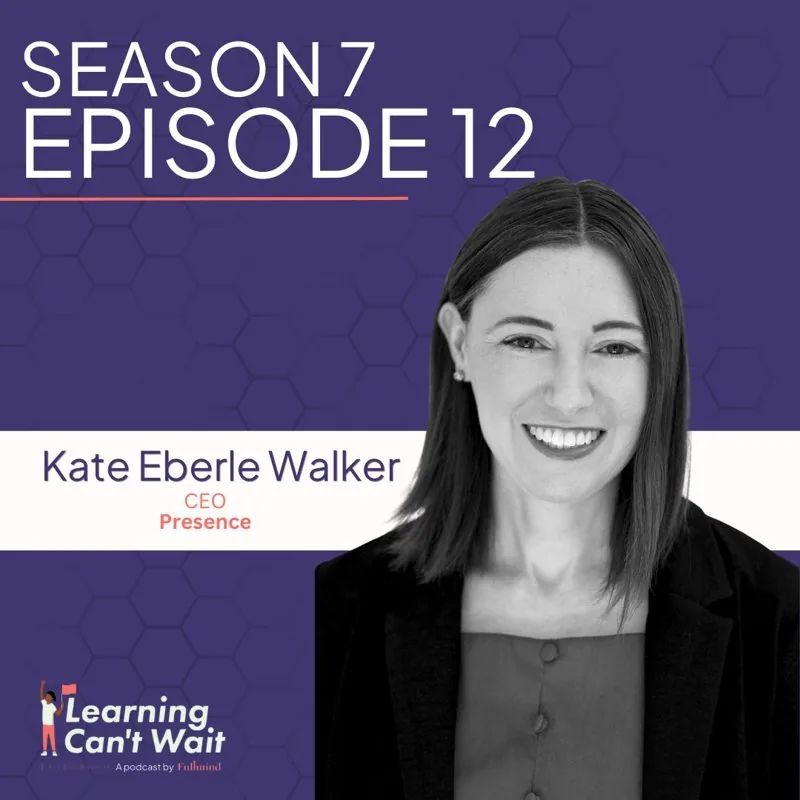
Kate Eberle Walker: Presence, Teletherapy for Students, Remote Evaluations
- Kate Eberle Walker
 Hosted by Hayley Spira-Bauer, Chief Academic Officer at Fullmind
Listen now
Kate Eberle Walker: Presence, Teletherapy for Students, Remote Evaluations
Episode summary
Kate Eberle Walker, CEO of Presence, explains how the company delivers speech, occupational, psychological, and mental health services and evaluations to schools through its own teletherapy platform. She describes how the pandemic forced trial of remote services but also eroded trust, and how Presence rebuilt it by going back into school buildings to set up spaces and relationships. She makes the case for remote evaluations done with validated protocols, bilingual evaluators, a partnership with Move This World for tiered mental health support, and optimism about educators navigating funding uncertainty.
Key takeaways
- Teletherapy began as a rural access solution; post-pandemic workforce shortages make it relevant everywhere
- Doing remote services well starts with in-person setup and relationships in the building
- Remote evaluations with validated protocols, multiple cameras, and an on-site aide clear backlogs
- Getting every student evaluated by an expert early is the biggest unlock for learning
- Tiered partnerships move schools from reactive crisis response to proactive mental health support
About this episode
In this episode of Learning Can’t Wait, Hayley Spira-Bauer sits down with Kate Eberle Walker, CEO of Presence, to explore how teletherapy is transforming education. Kate dives into the power of remote evaluations, the importance of early intervention, and how Presence is tackling the nationwide backlog of assessments.
We also discuss a game-changing partnership with Move This World that’s simplifying mental health services for schools, ensuring students get the right support when they need it. Plus, Kate shares her insights on navigating the ever-changing education landscape and why she’s optimistic about the future.
If you’re curious about the evolving role of technology in education, the impact of teletherapy, and how schools can better serve every student—this episode is for you! Tune in for an inspiring conversation about innovation, equity, and what’s next in virtual learning. 🚀
Episode notes
Imagine a school with a long waitlist of students needing evaluations for speech therapy, occupational therapy, or mental health support. The district doesn’t have enough specialists, and students are left waiting—sometimes for months—before they receive the help they need. This is the reality for many schools across the country, but it doesn’t have to be. In this episode of Learning Can't Wait, Presence CEO Kate Eberle Walker shares how remote evaluations and teletherapy are changing the game, making critical services more accessible and efficient for students everywhere.
If your school or district is struggling to keep up with evaluations or fill critical support roles, Fullmind can help. We provide virtual access to state-certified speech therapists, mental health professionals, and special education experts—so every student gets the timely support they deserve. Learn more about how Fullmind can help you clear your evaluation backlog and support student success.
The Power of Early Evaluations
Evaluations play a crucial role in identifying student needs documented in IEP plans, from speech disabilities to cognitive challenges and mental health risks. Virtual special education teachers and specialists like Walker are passionate about this work, emphasizing how early intervention can dramatically alter a student's learning trajectory.
"The biggest unlock that we can bring to schools and students is getting every student evaluated by an expert to understand where they're at," she says. "Once we identify specific needs, implementing online speech therapy for schools becomes the natural next step."
Presence conducts evaluations across speech therapy, occupational therapy, mental health, and psychology, ensuring that students receive timely assessments. These evaluations are not just about identifying special education needs—they also help determine eligibility for gifted and talented programs, early childhood interventions, and targeted mental health support. When evaluations identify occupational therapy needs, schools can seamlessly transition to virtual occupational therapy services and other appropriate interventions, setting students up for long-term success.
Can Remote Evaluations Really Work?
For some, the idea of remote evaluations still raises questions. Can a virtual assessment truly capture the nuances of a student's needs? According to Walker, the answer is a resounding yes—when done correctly and supported by comprehensive virtual school counseling resources.
Presence has spent over a decade refining its approach to remote evaluations, conducting clinical research and testing to ensure the validity of virtual assessments compared to in-person ones. The key lies in using multiple camera angles, trained on-site aides, and strict adherence to validated assessment protocols that complement comprehensive student support programs. These measures ensure that remote evaluations are just as effective as those conducted in person.
And the impact? Schools partnering with Presence can significantly reduce backlogs, ensuring that students aren't left waiting for critical support. As Walker explains, once schools implement the right setup and training, they can provide timely evaluations that open the door to essential services for students while empowering educators with innovative tools.
Addressing the Mental Health Crisis in Schools
Beyond special education, mental health is a growing concern in schools. Many districts struggle to transition from reactive approaches—only addressing mental health crises after they occur—to proactive strategies that support students before problems escalate.
Walker highlights Presence’s partnership with Move This World, a company specializing in tier-one and tier-two mental health support within an MTSS (Multi-Tiered System of Supports) framework. This collaboration helps schools implement a structured approach to mental health services.
While Move This World focuses on broad mental health education for staff and students, Presence provides tier-two and tier-three interventions for students who need more individualized support. This partnership simplifies the process for schools, eliminating the need to piece together multiple vendors and ensuring that students receive the right level of care at the right time.
Overcoming Geographic and Staffing Barriers
One of the biggest advantages of teletherapy and remote evaluations is that they remove geographic barriers to student services. Schools in rural areas or districts with specialist shortages often struggle to provide the necessary support for students with unique needs.
“Geography should not be destiny,” says Walker, emphasizing that a student’s location should not determine their access to critical services.
Presence also specializes in bilingual evaluations, ensuring that language barriers don’t prevent students from receiving appropriate assessments and support. By leveraging remote specialists with the right skill sets, schools can better serve diverse student populations.
The Future of Virtual Education and Therapy
With the landscape of education constantly evolving, Walker encourages new educators and therapists entering the virtual space to embrace technology fully. From AI-driven tools to VR-powered learning experiences, the future of teletherapy and remote education is full of potential.
For schools, administrators, and educators looking to expand access to special education and mental health services, teletherapy offers an effective, scalable solution. By investing in the right technology and partnerships, schools can break down barriers, reduce wait times, and ensure that every student gets the support they need—when they need it most.
Full transcript
Transcript generated from the recording; minor errors may remain.
Hayley Spira-Bauer: Welcome to the Learning Can't Wait podcast of Fullmind. At Fullmind, our vision is to ensure every child has access to an exceptional education. Each episode, we will be joined by Pathfinders within and around the education space who are bringing about transformational change. On behalf of deserving students, I'm your host, Hayley Spira-Bauer. Welcome back everybody to the Learning Can't Wait podcast. I am so honored to introduce today's guest, someone that I have been aiming to meet and interview for a very long time. It is Kate Eberle Walker, the CEO of Presence. Welcome, Kate.
Kate Eberle Walker: Thank you. I'm very happy to be here.
Hayley Spira-Bauer: I'm so excited that we have this time together today. You and I work in a very similar sphere of education and edtech, and I think that I'm eager to learn from you what you've built and excited for the audience to hear as well, just how thoughtful and how creative you've been in building out a product that helps so many students. So should we dive right in?
Kate Eberle Walker: Yes. Yes, please.
Hayley Spira-Bauer: Kate, can you tell us how you came to be the personal and professional version of yourself?
Kate Eberle Walker: Yourself? Yes. Well, I have professionally worked in education for decades at this point, and I started out, I had an amazing first job in education. I worked at Kaplan for almost 10 years, traveling the world, meeting companies that were potential acquisitions or investments to build out Kaplan's global portfolio. And I got to really study all of these different types of education businesses and education markets, and formed over time a lot of opinions about what was needed in education, what were the right ways to do things, to not sacrifice quality for growth. And that over time for me, pushed me more and more into the realm of EdTech and really thinking about how to use technology to address the needs of students by bringing them experts, bringing them the educators, and getting people in the right place at the right time. I think that's been a through line for me in my career from Kaplan, I went to be the CEO of the Princeton Review and Tutor.com, and then ultimately here to Presence, which I know we're going to talk about. And all of these companies are taking thousands of wonderful people who work in education and who want to connect with kids and want to help them and support them. And we're using technology to bring them together and get them to those kids wherever they may be. And that idea has been really for me, it's taken me from one company to the next and from one opportunity to the next, and it's become my thing that I'm passionate about and why I work in this field.
Hayley Spira-Bauer: You really did my work for me here. You identified the through line in your career and what has driven you forward. Let's talk a little bit more about what you said here about technology. So for those people that are living under a rock and unfamiliar with Presence, what is Presence doing with technology to reach students and help them academically and social emotionally?
Kate Eberle Walker: So at Presence, we are a teletherapy and telepractice provider, so we have our own platform that we've built specifically for serving kids in schools to meet a variety of needs. A lot of the students that we work with are in special education programs on IEPs and they have a need for therapy supports or for evaluations. So we work with school psychologists with speech language pathologists, occupational therapists and mental health and behavioral professionals to provide various services and evaluations. And it's all done through our platform so that it's being done in an environment that's designed to be engaging for students, that's designed to facilitate the work for the clinicians, to make it easy for them to document what they're doing, plan what they're doing, and so that it's all safe and secure and private and all the things that we know are important to get the right kind of therapeutic engagement.
Hayley Spira-Bauer: I made a joke about folks living under a rock, but truly Presence has become a leader in the remote special education and mental health services space. The pandemic definitely left people with either a bad taste in their mouth because they thought that emergency remote learning was virtual learning or telehealth as you explained, or with a lot more enthusiasm for the potential of technology. I'm curious now that we're four years out of that initial shock to the system, how you see schools and systems embracing or rejecting these types of services with telehealth post pandemic.
[05:00] **Kate Eberle Walker:** This is a big question and it's been so interesting. I mean, I think I joined Presence by the way in 20 19, 1 year before the Pandemic.
Hayley Spira-Bauer: What luck.
Kate Eberle Walker: I know, I know. Excuse me. And when I came in that first year, teletherapy Telepractice was really was this new kind of edgy concept still, and there was a lot of unfamiliarity with it, a lot of questions about, can you really do that? Does that really work? What would that even be like? Right? And that whole first year, I remember saying many times to the team,if we could just get everyone to try it once, then they'd see and they'd understand, and then the pandemic came along and actually forced that trial.And it was a be careful what you wish for moment for us at Presence, because we did then in 2020 through 2021, really see that almost everyone in schools did try some form of online learning, online therapy, everything was being done online for that period, and it was so much so fast and it was so variable in quality and preparation that we then really came out of the pandemic and had a dip, I think, in trust and belief in remote online service solutions in schools. ([06:56](https://www.google.com/url?sa=E&q=https%3A%2F%2Fwww.rev.com%2Ftranscript-editor%2Fshared%2FHoF35GCfm_eQomlYGNTosN27_amy00o60zsFTyvywJBV94g06H1zAc1k1K_2dvXtfDFtA1ttGGQr_468T-ue0w677Vc%3FloadFrom%3DDocumentDeeplink%26ts%3D416.33)): I think that was true in a lot of parts of education and definitely for special education services. We were then facing something different, which would be school boards, just sort of making a blanket declaration of we will have no online services period. Having special education directors say, we really struggled with remote speech therapy and we don't want to do it anymore. And that all was this new hurdle to overcome and all over again sort of say, well, let's talk about what your services were and what your experience was and give us a chance to show you how it can be great and how it can be different. And so I think four years later, as these things do, that wave is coming back to where there's more opportunity again and more interest, more acceptance. I think because another real impact of the pandemic was workforce shifts and the need is greater than it ever was. ([08:11](https://www.google.com/url?sa=E&q=https%3A%2F%2Fwww.rev.com%2Ftranscript-editor%2Fshared%2FSZVIET3cOEzByR5leJP8-jYKxOnvXuB4JiObxwymK6aOk4fIT6aiUtyxLZY3JjjwWazvYTp90zPGjn_36CWxP-zCKYU%3FloadFrom%3DDocumentDeeplink%26ts%3D491.21)): When we started bringing Teletherapy as an option for schools pre pandemic, it was really primarily a solution that was needed in more remote or rural districts where they just didn't have enough of the right types of experts to bring them into their schools. So they were from the start, really interested in trying Teletherapy to get access to those professionals. Well, post pandemic, there are shortages and challenges, hiring and attracting the workforce to come into the schools, really, really in all types of markets. And I know you experienced this too in your work, and so that opened it up again to more people being willing to try and see that teletherapy when done well, can be a really important part of the solution to get these kids served.
Hayley Spira-Bauer: You highlighted what I think is the central piece to this, which is that emergency remote learning wasn't something we all had time to plan for and organize ourselves around and embed the right structures to ensure everyone's success. It was a crisis that we all responded to. What I find today to be so true, and I'm curious, your thoughts, and you touched on this a little bit, but what I find today to be true with partners and with prospects that are considering using telehealth or virtual learning as an option is that when you're able to build something together and you're able to show how impactful the work can be, then trust gets established. So I'm curious, one, how you feel about that, and then two, how does President, do you ever get that confusion? How does Presence ensure quality and effectiveness in its remote services to help establish that trust?
[10:00] **Kate Eberle Walker:** Yeah, so I mean, I wholeheartedly agree with you that get to the right outcomes. There's got to be collaboration and trust. With services like ours and the partners we're working with at the district, what we found was necessary, and I believe will always be a part of how we serve and how we bring teletherapy into schools. What we found is we had to actually go a little analog and we needed to go in person to our schools. We needed to remember coming out of Covid in the pandemic. Not only were schools closed for a phase, but schools were closed to visitors too. Things that we did earlier in our time at Presence of going and doing an onsite setup of the therapy rooms and the therapy equipment. Those things had been pulled away during the pandemic when really outside visitors weren't able to go into schools. ([11:07](https://www.google.com/url?sa=E&q=https%3A%2F%2Fwww.rev.com%2Ftranscript-editor%2Fshared%2FTeXtizmOtIcyGvZxV_YKdkCxwrXqj6WzAAqqJbi95-gnK_dBanGDwkP-7J3E_CKhyzHgt_ri3bwzUlKUWfe5N4KnQyc%3FloadFrom%3DDocumentDeeplink%26ts%3D667.35)): And we had to remember which we really started bringing back in a big way a couple of school years ago. We need to remember, wait to do this well,to do remote, well, you need to start by having some in-person connections.We need to go see what the layout is in these school buildings. We need to see the space that they've set aside and we need to help set up for what we know are the best practices to establish the right environment for the student to receive this therapy. Our clinicians may be remote, but this student is going to experience the service in the building, in the classroom. We're collaborating with the onsite staff to bring that student to the right place at the right time to fit into the day's schedule and so on. It's a big collaboration, and it matters for us to pay attention to what's happening physically in the buildings to make sure that the remote service fits in the right way. It's a different way of thinking about hybrid. I mean, I think in a lot of ways, different parts of online service or online education have come to a belief that hybrid can be the best version, and for us, it's really about some of these coordination and setup points when we go and do them in person and establish those relationships and that trust, it can carry through and really, really impact the quality of how that service is going to go throughout the year.
Hayley Spira-Bauer: So many good valuable points there about how to ensure effective implementation and strong relationships. I became obsessed a couple years ago with implementation science and the research to practice gap. There's so many proof points in research about various types of intervention, and the reality is high dosage tutoring is one I know. Well, the reality is because implementation varies so greatly, when you can try to control for every piece of that implementation, whether it be the technology as you named or in your case platform and the tools you're using for assessment, you can ensure a better outcome. So I appreciate you naming somewhat implicitly there that in order to ensure Presence success with students in the classroom, one of the things you found is you have to control for as much as you can in the environment where the kid is going to be learning because that is the definition of how you improve outcomes.
Kate Eberle Walker: Yes. Yeah, it matters so much, and it's so interesting from our vantage point to think about that and to think about how we're going to impact that child's environment remotely and what we need to do to do that. Well, if they, they're connecting with us from a brick and mortar public school or perhaps from a virtual school where they're learning from home. There are multiple types of environments that we're going to be working with, and we've got to be really thoughtful about how what we can do to improve what's happening on the other side of the screen.
Hayley Spira-Bauer: One question that I think a lot of skeptics might have is how Presence is able to conduct evaluations remotely. Can you talk a little bit about how you do this and why your belief about the impact that remote evaluations can have on unlocking the student's full potential?
Kate Eberle Walker: So evaluations are a big part of the work that we're doing at Presence, and so this can be an initial evaluation of a child to determine if they have a cognitive or behavioral need, if they have a speech disability, if they qualify for an IEP. So we we're doing those initial evaluations across OT, speech, mental health psychology, and then we'll also do reevaluations. We'll do screenings for various mental health needs. Evaluations are a big part of what we're doing. To me, I'm very passionate about this area. I think that it is super important. I think it's the biggest unlock that we can bring to schools and to students isget every student that you possibly can evaluated by an expert to understand where they're at.A lot of what we're doing, as I said, is for special education, is for IEP qualification, but we are also doing a lot of gifted and talented evaluations and identification of potential in those areas. Early childhood evaluations, mental health evaluations. Does this child, are they showing risk signs? Do they need to spend some time one-on-one with a mental health professional? All of these directions that a student may need to go in to get a little more support that can unlock so much in their learning trajectory from there. And the sooner we get these evaluations done in their lifetime, the more successful they can be in school in the long run. So I know that's not what you asked me, but I just had to say first.
[15:00] **Hayley Spira-Bauer:** No, it's okay. I love when we get on our soapbox about our topics we're passionate about because passion, it's so authentic to why you're doing this work. So did you
Kate Eberle Walker: Want to add more? Well, so then I'll talk about the remote perspective because there are still questions in some areas, different levels of comfort in doing that. Can you really do that evaluation appropriately when the evaluator is not physically in the room with the child? And so we have done over the past decade, a lot of innovation work in this area of remote evaluation, a lot of clinical testing to demonstrate valid equivalency of administering assessments, especially the psychological assessments, administering them remotely versus onsite. We do it. There's a way to do it. There's a right way to do it. There's a validated way to do it. We're very big on following these protocols. It typically requires more than one camera view. It typically requires an aide being on site who's able to take clear direction from the remote therapist. You've got to do it right, but we know how to do that. ([17:57](https://www.google.com/url?sa=E&q=https%3A%2F%2Fwww.rev.com%2Ftranscript-editor%2Fshared%2FNonPBx2hYB0IWz0OuW4ziZ_6NJqm9vwnwD_BUDSoaLmLp7wqiB7wv_4C789DqJ_0yCWhs0-jd5_Gwg020XRNcoylNVk%3FloadFrom%3DDocumentDeeplink%26ts%3D1077.21)): And with that, you can get a lot more evaluation completed on time, on track. This is an area that many, many districts across the country just have backlogs and they're working through 'em as best they can, but there are often delays, and that's where we see our partners bring us in and we get it set up in the right way, and then we can help them work through those backlogs and just get more of these kids to where they ultimately need to go. So I think it's something that I hope more and more schools become open to because I think that once you invest that initial time to do the proper setup, to do the proper training of your local team, you can really, really, really accomplish so much more for these kids.
Hayley Spira-Bauer: Geography should not be destiny, right? Because they're in a region that maybe doesn't have access to providers or because they're in a place where they are backlogged as you need, it expands and unlocks so much more potential for schools and to reach students. I
Kate Eberle Walker: Does. And sometimes it's a particular skillset. We do a lot of bilingual evaluations, for example, which makes sense. I mean, not every school location is necessarily going to have enough need for a particular bilingual capability to hire a full-time staff member, but when you have a need for that specific skillset, you want to get it right. Of
Hayley Spira-Bauer: Course. Of course. Can you talk a little bit more about the mental health side of things? I know that Presence has a new partnership. We've entered into a new partnership to simplify mental health services in schools. Can you tell me more about that?
Kate Eberle Walker: Yes. So when it comes to mental health, what we noticed from our work with schools was that it was feeling like it was overwhelming for us and for schools to figure out what to do for students, where to get started. And there are a lot of different layers to implementing a mental health strategy, and there's not a lot of clarity yet in terms of funding and regulation and what's required, recommended, and where do those funds come from. It's very, very variable across district, across state. So that's the context. So with that, we really wanted to tackle well, what could we offer that would be helpful for these school teams that know they want to do something, know they want to start to get proactive on mental health instead of reactive, which is just the reality of where a lot of us still are is in that reactive mode of a crisis happens, and then you activate mental health to try to address it and helping staff to be able to see and identify the subset of students who may need more of an intervention. ([21:06](https://www.google.com/url?sa=E&q=https%3A%2F%2Fwww.rev.com%2Ftranscript-editor%2Fshared%2FSsy17b0ra6vjWPpIljWUSoO_MfMo7cn9uE6zL1xOfbbWzadB-KPlbIRdRAuwDrFzuvibtIu5Jhypda4n_FGbb-s2cW4%3FloadFrom%3DDocumentDeeplink%26ts%3D1266.55)): So as we did it, we realized, well, we only have one piece of that puzzle here at Presence. We have these therapists who are ready and able to engage with and support that subset of students who do need something more, but how do we make sure that the right students get to us and get to our therapists? So that led us to our partnership with Move This World. And what Move this World is doing is in an MTSS framework, they're doing the tier one and some of the tier two and then able to pass us at Presence who do the tier two, tier three. So they're doing the broad content and education for staff and for students on what language, what approaches can we use in the day-to-day to understand and over time to strengthen our mental health. So they do that, and then through that work, they can help a school sort of funnel, so to speak, through the subset of those kids that do need something more. And that's where Presence, that's where we can come in and be there with the right experts. So I think as we've started to bring this to schools, I think it feels like it's really doing what we wanted, which is it's helping put more shape and form to here's a way that we can tackle this together and not leave schools sort of left to their own devices to try to piece together this service, that service, this software, that vendor, to try to bring an integrated solution forward.
[22:00] **Hayley Spira-Bauer:** That is really exciting, and I love to see the evolution of various organizations helping kids and how they collaborate. One big question today is the uncertainty of the education system in the us. I'm curious your thoughts about what's going on right now at the federal level, the state level, the local level, and how are you approaching the uncertainty?
Kate Eberle Walker: Yeah, it's obviously a big topic and all of us who are working in the space are to some degree trying to prepare for how we can keep on doing fundamentally what we're all trying to do, which is support these kids, get them the services they need, get them the people who they need and be ready to do that if the sources of the funding move or move or shift. And I think to some degree, at least in my years of working in education, there's always some of this that we are grappling with. I mean, I look at the roles that these administrators and what they need to do in their budgeting to make sure that they're lining up all of the resources that they need or as much of the resources as they possibly can to serve their kids and pulling and matching the funding from the right places. ([24:19](https://www.google.com/url?sa=E&q=https%3A%2F%2Fwww.rev.com%2Ftranscript-editor%2Fshared%2FnkSrKbKQgGaAssiU6ur0b45u4UPTXuCUMsuY-e6GTwKuRzbd2-xAIpJZnCPmTZ8mN8WeLEFSeWInK_6rU6LGEu2AeWk%3FloadFrom%3DDocumentDeeplink%26ts%3D1459.67)): I think that's always been a complicated thing, a challenging thing, but something that I really have a lot of respect and admiration for how that problem solving does happen in schools all over the country. And I think that it's going to continue to be that way, and I think that changes likely will be coming in how the funding is directed and what happens at the state and local level versus what happens at the federal level. But my hope, I am feeling optimistic at this point. My hope is that that's something, the movement of the funds is something that I think everyone who works in education that I've seen is really good at figuring that out and figuring out how to get the right supports in place for kids. And I'm hopeful from what we're seeing so far that we're all still going to be able to do that.
[25:00] **Hayley Spira-Bauer:** I appreciate the emphasis on the skilled nature of the folks making these decisions. I haven't heard that perspective when I've asked this question recently, even out to general with friends who work in the space, and I appreciate that is a really valid and valuable point in this conversation, and you can never predict the future. So let's just live in the moment and do what's best for kids today so that the future is set up for success.
Kate Eberle Walker: Absolutely. I mean, I just know K-12 leaders are administrators or people who, they get it done, they figure out how to do what they need to do for their kids.
Hayley Spira-Bauer: Absolutely. So Kate, my final question for you is what advice would you give an educator starting their career in the virtual space today?
Kate Eberle Walker: I think the advice I would give is to really embrace technology and all of the amazing things it can do to facilitate your work, to enable it, to superpower it, to strengthen the outcomes you're able to deliver. I think there are so many cool, innovative tools, and one of the nice things about sitting where I sit at Presence with a platform licenses and brings in a lot of content and tools from other education companies as I get to see all of these really cool innovations that are leveraging AI, that are leveraging VR. And I think that for someone coming in today, they're in a great position because they're coming into a tech enabled world and able to really embrace it from the start. And I think that there are so many great tools that can just really enhance their work that I think this is kind of a moment to be really coming into it with that sort of virtual ethos from the start and that openness to how you can use all these tools to make your core work that much stronger.
Hayley Spira-Bauer: Amazing. Kate, it has been such a pleasure finally meeting you and getting to interview here. Thank you so much for sharing about the work you are dedicated to and the passion you have for this space.
Kate Eberle Walker: Thank you. So great talking with you. I appreciate your time
Hayley Spira-Bauer: And thank you everybody who tuned in today. Thanks for listening to the Learning Can't Wait podcast. If you like what you heard, please rate, review and share this episode. Be the first to know when we have a new episode by subscribing wherever you listen to podcasts. If you'd like to be a guest on the show or have a suggestion for an episode, email us at podcast Fullmind Learning.