
Learning Can’t Wait · Episode 112
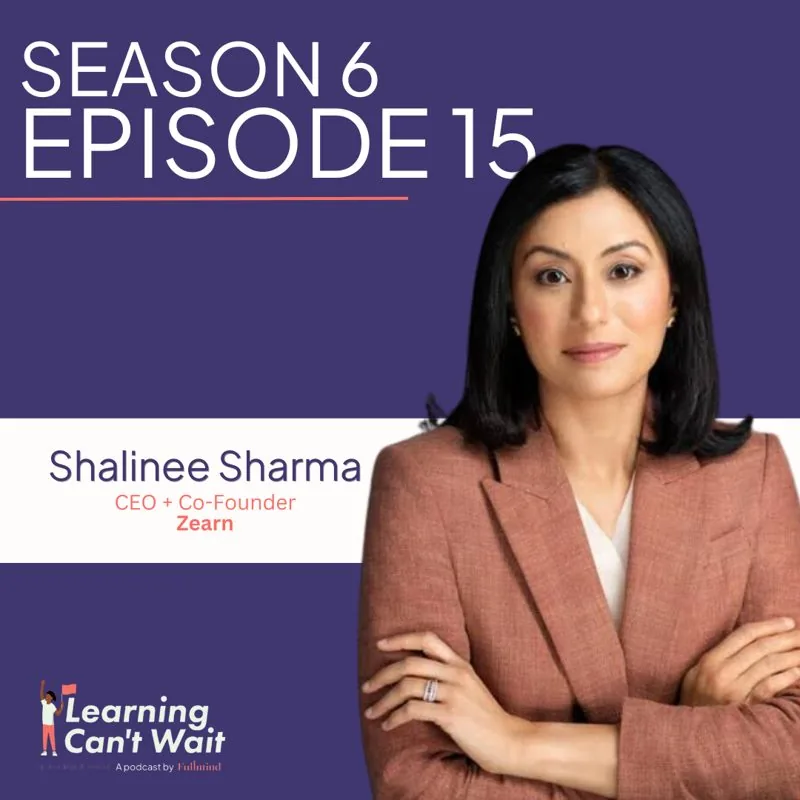
Shalinee Sharma: Math Minds, Zearn, Math Education, Numeracy
- Shalinee Sharma
 Hosted by Hayley Spira-Bauer, Chief Academic Officer at Fullmind
Listen now
Shalinee Sharma: Math Minds, Zearn, Math Education, Numeracy
Episode summary
Shalinee Sharma, co-founder and CEO of Zearn and author of Math Mind, argues that numeracy deserves the same urgency as literacy. She shares her own story of falling behind in middle school math, walks through a cookie-plate proof of why any number times zero is zero, and explains why conceptual understanding and memorization belong together. Citing research on novices and experts, she challenges the belief that math is for the fast, and closes with a teacher playbook: believe in yourself, make pictures, make practice fun.
Key takeaways
- Every kid falls behind in math at some point, and every kid can catch up with support and belief
- Conceptual understanding and procedural fluency are not opposites; strong math learners need both
- Speed is not mastery; experts read problems slowly and carefully, novices rush
- Teachers and parents should first decide they are math people before asking students to believe
- Practice has to be fun, through games, money, measuring, and patterns, so kids sit long enough to learn
About this episode
How can we spark a love for math and challenge the myth of the “math person”? In this episode, Hayley Spira-Bauer interviews Co-Founder and CEO of Zearn, Shalinee Sharma to discuss how mindset, persistence, and fun can transform math learning. Shalinee shares research on how American and Japanese students approach problem-solving and explains why experts succeed by working slower, not faster. Together, they unpack how traditional teaching can hinder math learning and explore strategies to help students embrace challenges and deepen their understanding.
Focusing on Shalinee’s four pillars of math education, the conversation highlights making math fun and visual. From using games and money to engaging with real-world scenarios, Shalinee emphasizes sparking curiosity to build “math minds.” Hayley shares personal stories about teaching and the parallels between fostering a love for literacy and numeracy. This episode offers actionable insights for parents and educators looking to make math a source of joy and lifelong curiosity.
Read Shalinee’s book: Math Mind: The Simple Plan to Loving Math
Episode notes
Math often gets a bad reputation. For some, it’s a source of stress, with memories of timed tests and rigid formulas. For others, it’s an intriguing puzzle to solve. But what if we could redefine math education for everyone, making it less about speed and more about creativity, thoughtfulness, and discovery? Shanilee Sharma, Co-founder and CEO of Zearn, explores this transformative idea on the latest episode of the Learning Can’t Wait podcast.
If your school or district is seeking new ways to boost student engagement and confidence in math, Fullmind can connect you with state-certified, online-trained math educators who specialize in making math meaningful, interactive, and fun for every learner.
Sharma challenges the conventional focus on speed in math, emphasizing instead the importance of patience and deep thinking. Research shows that experts approach math problems by first thoroughly understanding them, while novices tend to jump straight to calculations, often missing key insights. When educators and parents shift the focus from getting answers quickly to truly exploring problems, they open the door for students to engage in meaningful problem-solving that builds critical thinking skills. Implementing these changes effectively often requires collaborative approaches to educational improvement where schools share successful strategies and resources.
Why Mindset is the Key to Math Success
One of the most important aspects of math education is fostering a positive and resilient mindset. Many students feel they aren't "good at math," and this belief often stems from early experiences where they felt they didn't meet expectations fast enough. This challenge has become even more pressing given the significant learning gaps from pandemic math learning recovery. Instead of creating a race to the answer, educators and parents can help students see math as a process of exploration. Every mistake becomes a chance to learn, and every challenge is an opportunity to grow.
Sharma highlights the value of teaching math in ways that align with how children naturally think. For younger students, this might involve visual tools, hands-on activities, or even games that encourage curiosity. For older students, it could mean connecting math concepts to real-world applications that feel relevant and engaging. When students see math as more than numbers on a page, they are more likely to invest in understanding and appreciating its value. This approach reflects broader personalized learning strategies that recognize each student's unique needs and learning style. For those who need additional help mastering these concepts, supplemental instruction programs can provide the targeted support necessary to build confidence and skills.
Making Math Fun and Relatable
Math doesn't have to feel intimidating or disconnected from everyday life. Parents and teachers can make math enjoyable by integrating it into practical, real-life contexts. For instance, parents can use coins to teach basic arithmetic, explore fractions by cooking together, or highlight geometry in everyday objects like furniture or buildings. Teachers can foster engagement by presenting problems through stories or scenarios that allow students to imagine themselves solving real-world challenges. These strategies work even better when educators embrace collaborative approaches to educational improvement, sharing successful techniques across classrooms and schools.
Fun is a crucial ingredient in learning. When math is approached with a sense of play, children are more likely to stay curious and engaged long enough to master the material. Games, puzzles, and interactive learning platforms like Zearn can all contribute to making math feel more approachable and rewarding.
Building Lifelong Problem-Solving Skills
Ultimately, math education should do more than teach students to calculate. It should prepare them to think critically, adapt to new situations, and tackle challenges with confidence. By helping students see the beauty and logic in math, we equip them with tools that go beyond the classroom. These skills—patience, persistence, and creativity—are invaluable in any field or career.
Parents and educators have the power to transform how children experience math. By focusing on understanding rather than speed, embracing mistakes as learning opportunities, and making math fun and relevant, they can inspire a lifelong love of problem-solving. The benefits extend far beyond math itself, nurturing skills that will serve students throughout their lives.
Dive deeper into these strategies and learn how to redefine math education by tuning into the full episode of the Learning Can’t Wait podcast featuring Shanilee Sharma. Together, we can create a future where every child sees math as a subject to enjoy and explore.
Full transcript
Transcript generated from the recording; minor errors may remain.
Hayley Spira-Bauer: Welcome back everybody to the Learning Can't Wait podcast. We have someone on today's episode who is a true education hero of mine. We have Shalinee Sharma, the co-founders, and CEO of Zearn and author of the recent book Math Mind. Shalinee, welcome.
Shalinee Sharma: Thank you. I'm so excited to be here. Here. Thanks, Hayley.
Hayley Spira-Bauer: It's not for lack of being interested that you haven't appeared on this podcast just yet, but I'm super excited because your recent release of the book Math Mind has catapulted a lot of conversation around some really big topics in education. We've gotten a lot of attention recently on literacy, but this book has, I think, propelled some of the dialogue around math in a direction that's really important, and I'm excited to dive into that in a few minutes with you.
Shalinee Sharma: I cannot wait to talk about numeracy and how it should have equal footing with literacy.
Hayley Spira-Bauer: Well, let's start off by having this standard first question, how did you come to be the personal and professional version of yourself?
Shalinee Sharma: It is a winding path that brings me to where I am today. So the first thing, you might stereotype me because I work in math education and I co-founded and run a software company because of the norms we have around mathematics. You might think, oh, she's a math prodigy. She's not like me. Well, I'll start by saying I fell apart all through middle school math barely scraped through. And so I'm one of the rare stories of a kid who fell behind in math and caught up. But along that winding path amongst other things, I worked at Bain & Company for more than a decade, and then I had a group of dear teacher friends who were just some of the most interesting and creative and hardworking teachers in New York City who wanted to play in this world of education technology. And so they came to me with these amazing questions that I fell in love with that became the questions that animate the work of Zearn. ([02:13](https://www.google.com/url?sa=E&q=https%3A%2F%2Fwww.rev.com%2Ftranscript-editor%2Fshared%2FUwKhloq-cOht8ZaXtUZf6R1DDiVm5xgA1B-428QX6Ud9e46imbVIZ2mf45T2nP6LSjPpDBvF6-Z5iN4-ch4dD4iEfto%3FloadFrom%3DDocumentDeeplink%26ts%3D133.32)): And those questions were, what if we put the best learning content up online for free? Could we democratize access to an excellent education? Could we do that next step in the work of really the vision of America? And another question was, can we make math learning in a way such that all kids can learn and love math? And so these are the questions that we still work on At Zearn I fell in love with these questions when they were articulated to me 12 years ago and jumped in as what would be the arms and legs of my teacher, co-founders who have generated the creative direction and the ideas of Zearn since on that winding journey, which I'm happy to jump in more and share about my traumatic and heroic middle school experiences navigating through mathematics and a teacher who changed the course of my life. But what I would just say is while those were the questions I fell in love with what pushes me forward now, why I wrote the book, what my work is as I continue to lead the work of Zearn is that in all that work we've learned really one startling piece of information that we have to tell everybody. ([03:34](https://www.google.com/url?sa=E&q=https%3A%2F%2Fwww.rev.com%2Ftranscript-editor%2Fshared%2FWFjNll-OxsnWtUj1_i-k3ADeMRhgsaABAUZ_tJPcqixvl8YAfD1VineTXCVSonjZj7M5hYEaBveSPwTcGU7mYipnIHI%3FloadFrom%3DDocumentDeeplink%26ts%3D214.93)): And that is thatevery kid falls behind in math at some point, but with the right support and belief, every kid can catch up and succeed.And when we see these kids that we decide are math kids, which is a really kind of a toxic label, that's the norm. We don't have reading kids, we don't have a subset of kids special enough that we designate to teach them to read, but we do orient to mathematics even in our own self definition that way. But when we step back and say, oh wait, those kids got the right supports and have the belief that's why they are like that, then all of a sudden we really have to step back and sort of explode those labels. And so I think that's really what my personal and professional self is now. So yeah, I'll pause there and
Hayley Spira-Bauer: Yeah, I'd love to take a minute to just reflect on the statement you made about this teacher that helped lift you out of the darkness of middle school. And I will say you do a beautiful job in the book of describing that experience and speaking to how it transformed your self-identity and your path. So many people on this podcast, so many people that listen to this podcast, excuse me, our educators and they themselves have similar stories. And yet not only did it change your trajectory, but it really changed the trajectory of so many as you developed a system of thought and sort of a theory, a working theory of action about how we can approach the problems that many students face when they don't identify or they're labeled as not being a math kid. Can you tell a little bit more dive in as much as I do want to spend time on that teacher because I know those stories are so important, can you dive in a little bit more onto the foundation of Zearn and in 2012 what those questions, those big grappling questions were and how that led to the incredible product we see today?
[05:00] **Shalinee Sharma:** Sure. And then when we do all that, what I would love to do is let's also do a math problem to bring that to life together in a way that you would find fun. Because one thing that's dangerous is we talk so much about math, but we don't do the math and bring it to life. We actually, we keep math scary. So let's kind of do that
Hayley Spira-Bauer: As the kids say, if I wore an aura ring, I wonder how much my aura points would be up when you mentioned let's do a math problem. And I added in together, together collaborative,
Shalinee Sharma: I love it, right? And I tried to smile. So yeah, part of this experience, we also have to do it. So I think these animating questions when we started Zearn were things like, I remember asking, I need the manual of how, what is the full research base, the manual, the exact information of how we teach mathematics so that all kids can succeed? Where is that manual? Another question was where is the documentation of what is going on in Singapore and Japan? Obviously these societies have many other differences other than their math outcomes. So I'm not trying to simplify whatsoever, but once you are sitting inside of a math classroom in Singapore or Japan or Estonia, any one of these countries that are very interesting to look at, where's the detailed documentation? Also, could I watch a thousand hours of math classes? Has someone sat and wrote it a thousand hours of fourth grade mathematics in Japan? ([07:25](https://www.google.com/url?sa=E&q=https%3A%2F%2Fwww.rev.com%2Ftranscript-editor%2Fshared%2FkDjTWUI_mh5hRX64K38Mpoz5KjTv6NfC3Xz3ggiOAGlXYaG8qBHw0kiyBc2mDttZ99uvqhXugrXfTSn_Tym7gjxmVMM%3FloadFrom%3DDocumentDeeplink%26ts%3D445.07)): Can we watch it? Because fourth grade is like an important year when we measure NAEP. So we have a lot of information about our fourth grade and what does, what does not happen? These were kinds of the questions that were animating us at the beginning. Other questions were, and these continue to be by the way, questions that animate us. Another question that animated us was when a child struggles in mathematics and that emotional experience of getting questions wrong, feeling as if they're not going to be successful, what are the supports that adults can provide to have that experience be that's still part of it, but become normal, not a sign that you should give up. So how do we normalize problem solving? When you solve a problem, you make mistakes, then you keep going. What are other cultures doing? Also, what are the best classrooms in America doing so that these are all these questions that we continue to work on and engage with.
Hayley Spira-Bauer: I have to tell you, I have a really unique experience that made this content really come to life, which is that in my seventh year of teaching, I founded an elementary school with a bunch of really smart folks in New York and we adopted Japanese math curricula for the kindergartners. And up until that point in my first and second year of teaching, I did teach math in my middle years between that I only taught reading, but I went back to teach kindergarten and I taught math and it was the first time I learned what numeracy was and I had to deeply study the Japanese math curriculum. It was brought over by a bunch of really brilliant folks, including Dr. Koda Yida and a bunch of other of his colleagues to teach us for weeks how to teach Japanese math or teach math in the fashion of Japanese learning. And it was mind blowing to me to the point of studying other cultures and seeing what makes them successful. Obviously there are other elements you have to disaggregate. I just couldn't believe that it was the third year I be teaching math to about the same age group, but I'd never thought or learned about the importance of numeracy.
Shalinee Sharma: If you're open to it, I think that's the best jumping off point for your listeners if we play math problem together.
[10:00] **Hayley Spira-Bauer:** Yes, let's do
Shalinee Sharma: It. Okay, so this is a math question that whenever I get a chance to ask if let's say I get to talk to a tenured professor of a STEM field at an Ivy League university, like somebody very fancy, I'll ask this question and the majority do not know the answer, and we're going to play with this problem and show that any 8-year-old can get to this answer. ([10:30](https://www.google.com/url?sa=E&q=https%3A%2F%2Fwww.rev.com%2Ftranscript-editor%2Fshared%2FZ20kZo-9YymVowrANYCS_YgoJVT1Zf_jYvhIO0lU52WBCgEaY77t_mCAzQLhU_4HP-sEXNyg-qZ2y3iKYk3wsh7iJCY%3FloadFrom%3DDocumentDeeplink%26ts%3D630.27)): And so the question is what is the axiomatic proof? So I'm going to use a lot of math language right now and then turn it into regular language. What's the axiomatic proof that n times zero is always zero? Now let's just say that in everyday language, tell me, prove to me that three times zero is zero. So when I asked this question, even myself in my thirties and when I worked before Bain, before Zearn, pardon me, I worked at Bain & Company where I cut large data sets and I had a stem job, and if you asked me in my twenties or thirties, I would've said, it's just a rule and math has rules. And so you just memorize those rules. And so any number times zero is zero. That's a rule. Now, I would also say that in memorizing that rule, I sometimes felt anxious because three raised to the zero power is one, but three times zero is zero. ([11:39](https://www.google.com/url?sa=E&q=https%3A%2F%2Fwww.rev.com%2Ftranscript-editor%2Fshared%2FK_fTeKJLgkVBM5Jc6a-TxkYLj_Us-oSKlqMrcSwM07IN0o5N9bkFRevB5uVb7F7opLc0OKUtkcQL2YbwJ9I79ssIz6Q%3FloadFrom%3DDocumentDeeplink%26ts%3D699.72)): And so I would sometimes be sitting and doing some calculations for, let's say I was taking a test and I didn't know which rule it was, and then I would sit for a minute and then get a little bit stressed out that I'm going to get everything wrong and it would take me off my contemplative path of whatever the problem I was working on. So even that memorization, even though I had memorized it and never understood it, it wasn't like a great scaffold for me. And it was actually in the work that as you share of learning Japanese math or in our work of building Zearn, and I came to see that instead we could present the axioms and they're easier and we think axioms are harder, but they're easier. So let's do this axiom. So first of all, do you know this axiom of why any number times zero is zero?
Hayley Spira-Bauer: Well, I read your book, so I a little bit of a leg up that I know the answer here, but I have an 8-year-old and we have actually had a conversation about numbers multiplied by zero so I can live and breathe this. I'm sorry to spoil the fun, but I had read the book, I knew the example. I didn't know the axiom. I didn't know when I was reading why anything times zero and I grappled with it before I read ahead because I wanted to see if I could figure it out and I couldn't.
Shalinee Sharma: So perhaps there are some people who will sit and grapple with it and derive axioms and that that's wonderful, but those are not the only people who get to play with axioms. The rest of us can all know them too. And they're beautiful, right? They're as beautiful as a sunset or poetry. They're an absolute thing of wonder. So the axiom, let's, if we play with it from the book is imagine we have three plates and on each plate there are three cookies. Another way of saying that is three times three is nine, three plates on each plate, there are three cookies in total, we have nine cookies. If we take two cookies off each plate, my 13-year-old twin boys, your 8-year-old, the two of us, we eat those and now we have three plates and each plate has one cookie. Well then three times one is three. ([13:54](https://www.google.com/url?sa=E&q=https%3A%2F%2Fwww.rev.com%2Ftranscript-editor%2Fshared%2FqLXlThJzrLdNN2_MvdyYC1ijZlmekiTPfE0_wZF7SPhzUo91-mlR25C2YqhMH820EmNnrCcBtG5u5p31iYmCkC-aBfU%3FloadFrom%3DDocumentDeeplink%26ts%3D834.94)): And finally, if those final, those three cookies get eaten as well. Now we have three plates. We have zero cookies on each plate. And so three times zero is zero. If we had eight plates, eight times zero is zero. If we had a hundred plates, a hundred times zero is zero. And so for me now, if I am doing mathematics myself, let's say I'm doing some work at my desk and I'm doing my own mathematics, I don't have this, oh my gosh, that rule or that rule that I don't understand, I know it. I also have confidence in myself. I'm not going to get shut down partway through because I can go back to that axiom and it clicks into the brain in a different way because it clicks into our intuition. And so you can't forget it. It's not rote memorization and it just makes things a lot more fun.
Hayley Spira-Bauer: You've touched on two of the major pillars from this both belief and this one, which is understand, not memorize. And I have to tell you, my life changed significantly once I had kids and had to help them with their homework. When I taught and I taught students what you're saying here, understand, not memorize, I could rally them, I could get them excited about figuring out the math behind the math, right? The curiosity. And while my husband and I are two biggest values at home are building empathy and curiosity in our children, my son still battles me, mama. I just want to memorize the facts. I just want to memorize. He's in multiplication fact era, but now as a parent, I have to really slow down with him even after a long workday and we get out the bear counters, we get out the food in our pantry or the dinner that we're having and we have to bring it to the concrete so that we can see and understand not just memorize. Do you have a problem? Actually, I know the answer to this, but I'm going to ask it for the audience. Do you have a problem with the memorization of multiplication facts as schools teach it today?
[15:00] **Shalinee Sharma:** So I would say memorization is essential, and actually one of the sad things is that we in this country will often put conceptual understanding and memorization as if they are counter to each other. Now, I'm as scarce, but I was so lucky that I got to actually go to Japan and see classrooms in Japan. I also spent a week in Singapore and saw math classrooms in Singapore. Those were the two highlights of my life in terms of actually getting to see what was really there instead of just always reading about it. And the automaticity these children demonstrate is much higher than what our students have, but that isn't at the trade-off of conceptual understanding. So it's just both. That is also what if you look at the evidence base in math teaching and learning, the evidence base is that it's both conceptual understanding and procedural fluency are both. ([17:01](https://www.google.com/url?sa=E&q=https%3A%2F%2Fwww.rev.com%2Ftranscript-editor%2Fshared%2FnQ-57LQznuiV92F7klErvNeKn7QxpYSLxMkGte3VcuZXpzmplaQKYhvtU54_NXx4jeTlgcXa_Md8-_K9jaeS7uxuE80%3FloadFrom%3DDocumentDeeplink%26ts%3D1021.97)): And the last thing I'd say is that when you don't have automaticity, what will happen is you'll hit essentially maybe a speed bump or a wall, even worse than a speed bump because you won't be able to learn the new information because your working memory will get overloaded. There's only so much you can learn at once. Now, that's my perspective on memorization. However, what I would say that is concerning that I can see sometimes in classrooms and what we can see at scale from American children are two things that relate to memorization. One is that math is for the speedy. And because I'm slow, I'm dumb at math ([17:49](https://www.google.com/url?sa=E&q=https%3A%2F%2Fwww.rev.com%2Ftranscript-editor%2Fshared%2FYaNvV_-gylyLkwGNlCPMeuSmLoJP64Oo9_DF9PlP9Nrh5UFyQq36NWP0Ce3ha0qlohWAT-Bvt6F4X_H9gU-dVgzn3Zk%3FloadFrom%3DDocumentDeeplink%26ts%3D1069.11)): When we have really strong evidence that that's not the case, there's a brilliant experiment I want to share that I feel like every child should hear on slow versus fast. So memorization is wonderful, but being fast at math are not the only children who need to learn mathematics or who are sort of math kids. They're not designated. And you see children, particularly, there's different researchers like Jim Stigler from UCLA and others who've done side by side of American students versus Japanese students. And American students will sit with a problem that is very challenging for one minute, first graders, one minute, get up, leave. Japanese children will sit with that same problem for 30 plus minutes. And when you ask the American children, why are you not sitting longer? That problem is for someone else. I'm supposed to be able to finish the problem in a minute. ([18:49](https://www.google.com/url?sa=E&q=https%3A%2F%2Fwww.rev.com%2Ftranscript-editor%2Fshared%2FiDSm7bh2RT5178EDXQgnemCVc5mrNCH4cBv7Ftb1hWQ7oGROhDHTbLv_0W9RLPnhxAqtsHb9a_l1YXGv15HvQKjmheE%3FloadFrom%3DDocumentDeeplink%26ts%3D1129.47)): So what we can't teach children by accident when we focus on multiplication tables is that math is for the fast because it's not. There's a most wonderful study that the current president of Dartmouth University did. Her name is Sian Beilock, and she basically, she wasn't trying to actually, she didn't expect, this was an counterintuitive finding, she didn't expect to find this, but what she was looking at was the difference between expertise and novices. And she wanted to see what was the difference between experts and novices in terms of accuracy and speed. And so what she did was she found freshmen students who were students of physics, and they had completed one course in physics. They were novices and she matched them head to head with graduate students and professors of physics. So those were her experts. And then she gave each group a problem set of physics problems that were only actually at the physics 1 0 1 level, the novice level. ([19:55](https://www.google.com/url?sa=E&q=https%3A%2F%2Fwww.rev.com%2Ftranscript-editor%2Fshared%2F9B0SNyGyOqzy5MlcSCTW3SNa8TVop6XIzw7quUH2hKcBpgpBjUGLnDcf34PWRHun9wsusL7_sL4Tvn2DD-PeQpdVhik%3FloadFrom%3DDocumentDeeplink%26ts%3D1195.44)): And what she predicted before she ran the experiment was that the experts would be both quicker and more accurate. So she was like, these people, the experts will blow through this and they'll get it right and the novices will go more slowly and get it wrong. Also, what she found when she ran the study was unexpected, which is that the novices went more quickly, the experts went more slowly, the experts had near a hundred percent accuracy, if not a hundred percent, the novice's accuracy was very poor, and then they clicked in one level. What was the difference in the speeds? Well, the novices quickly set up the problem, read it quick, read it once, quickly set up the problem, quickly blazed through the calculations. The experts read the problem multiple times, methodically set it up, blaze through the calculations. And so what the novices were doing is they were always going fast. They had learned the wrong thing about math becausesometimes math is fast and sometimes math is slow. And you need both schema, both mindsets, both sets of tools to be a strong problem solver.So that would be my worry about multiplication.
[20:00] **Hayley Spira-Bauer:** I feel like we should show this to every third grade teacher in America. They should read your book. I mean, that's part of it. It's such a valid point and it's so telling when you illuminate it with that example from the novice and experts. And I could see it in my own son really, really clearly as I watch him live and breathe in, have a front row seat to his mathematical growth. I know you have four pillars that you really talk about. The next one's adaptability. I'm actually going to jump over it for the sake of time and jump into practice is fun. And the reason I'm going to do that is I have another fun anecdote for you about my career and why I really think I deeply connect to this book, which is that in the middle years between when I was teaching math, I taught reading to fifth graders at a charter school in Harlem. ([22:06](https://www.google.com/url?sa=E&q=https%3A%2F%2Fwww.rev.com%2Ftranscript-editor%2Fshared%2Fug_TE99f387Q-b62c87IEgEfdiQH0Vlupu_TZpeHuJek4XvBTl3EUzL1H3ZzxWjW_Gys7QE8D03WAw2L58Sd4SYmog8%3FloadFrom%3DDocumentDeeplink%26ts%3D1326.37)): And I was hired and in my interview, my principal, Dr. Sam Frago, who I still talk to and is still in education, he said to me, well, I want you to help the kids learn to read who don't know how to read. As kids were coming in different reading levels from all over New York City, your actual job is to get kids to fall in love with reading. Love that. And that has stuck with me to this day, to the point that, oh, it's going to make me cry. But some of my former students just got into college this week and one of them texted me that I instilled a love of reading in her and that helped put her on the path to be where she is today. And so I connect so deeply to the idea and the mindset that math has to be fun because once you stoke that fire, I know from my experience with teaching, reading and helping kids to fall in love with reading, the rest comes easy. Then you have the ability to sit longer and try and fail and know that failure is part of it. So can you take us through how you landed on this tenant? That practice has to be fun.
Shalinee Sharma: I mean, you just shared it in a nutshell, but what I'd say is there's no other way through. You cannot just endure. There is no other way through. Nobody can achieve excellence or what we would want proficiency, or another word you use, which I love is numeracy by just enduring. So there's no other path. Look how we are with literacy. So with regard to literacy, every kid in America has got to be able to read. Nobody would dispute that. And when kids can't read in America at scale, we are super upset with the adults. Look at these incompetent adults. We, why would they do this to children when can't do math at scale, we say, but maybe they have another passion. They could also have another passion. There's unrelated thought. There's a reason that isn't us. It's not our fault. That's right. It's the kid's fault. So that's super scary. But I'd say one more thing where numeracy is not on equal footing and the most important thing we have to reflect on, which is that even if we expect math outcomes, we expect it through enduring just muscle through it. ([24:36](https://www.google.com/url?sa=E&q=https%3A%2F%2Fwww.rev.com%2Ftranscript-editor%2Fshared%2F-1qz87x2BS-U_8a3Bytn8OgKXfd2v3PS8_Pdfe7CwN_Kd8O_IYjCrPS4Qht1zfDKxm-wCpO7jFSl0jnxPQxWWzVymAc%3FloadFrom%3DDocumentDeeplink%26ts%3D1476.11)): But why wouldn't, if numeracy is going to be on the equal footing of literacy, what is your hope for your child, for your 8-year-old? What's my hope? For example, I loved Narnia when I was a kid, when I was in third grade at the book fair, I bought the lion, the witch and the wardrobe and with the money parents gave me, and then I just read Narnia over and over. I just read the whole series and I read it so many times and I was so sad that it was over and I read it again. And so I hoped that my children, when they hit third grade, I wrapped up third grade twin boys. I got bought two copies. I wrapped them and I was like, you guys are, this is my favorite book and I want you to book it because it was so visceral for me, that desire for love that I had. ([25:21](https://www.google.com/url?sa=E&q=https%3A%2F%2Fwww.rev.com%2Ftranscript-editor%2Fshared%2FtIWznAWy10z9TaqvqT8a4m3nv6laiyfeJNQ7o3utbrNLVhmF5k-nD33wIzNbNc1CEeobrnnXdkJVaTGf4NimEw8fsGo%3FloadFrom%3DDocumentDeeplink%26ts%3D1521.44)): And neither of them would read Narnia. There're books weird, mom, we don't love it. They love, but Narnia didn't, but not what you loved. I put too much into that. And they were kind of like, you need to slow down, mom. So actually for numeracy, we have to have the same hope. We have to not just want kids to be proficient, we have to have them love parts of mathematics. Now, just like reading is so vast. So you could enjoy a nonfiction text about baseball probabilities. You could love Narnia, you could love, it's so you could love a personal narrative. You could love so many things. Actually math is so fast, and so you don't have to love all of it. If you think tri is the pit, no worries, that's fine. But there's so many ways we can access love. I think about if your 8-year-old is just fired up by multiplication tables, how would you stoke that? ([26:17](https://www.google.com/url?sa=E&q=https%3A%2F%2Fwww.rev.com%2Ftranscript-editor%2Fshared%2FfToFnGhPfx3jobhaxBC4QxLyUaiRGb-Cb-0b-25IlrR9kamQ-bWFjfBs49Tm_Grl8o3C_XPF0E4rDH4HI6kH9MHNjQ0%3FloadFrom%3DDocumentDeeplink%26ts%3D1577.15)): Love patterns. So three times eight, eight times 3 24 divided by 8 24 divided by three. Just like all the ways you can play with. And there's nothing wrong with competitions and all these normal things stoke enjoyment. But at the end of the day, to build a math mind, to build a reading mind, as you said perfectly, you have to just sit there, you have to sit with it. There's a certain amount of time on task, the brain actually changes, right? We've learned that the neural pathways connect the brain reconfigures. That takes a certain amount of time. What is going to get you to sit in that chair and do that work and spend that time? You have to have some fun and fun. Fun can look like so many things, but it's games, it's patterns, it's areas of interest. I mean
[27:00] **Hayley Spira-Bauer:** Money. You give this example in the book, I always say Dog Man is the gateway drug to reading for a lot of little boys. I have two little boys myself, I could prove it. So is Diary of a Wimpy Kid. But I would say my gateway drug in my house to playing with math has been money. Even as little kids collecting coins, counting the coins, not even knowing the value of the coins, but just playing with them, looking at the size of the coin. That has been our gateway. And you talk about that in the book a little bit. It's one of many, many examples, but an effective one I've seen up hand firsthand
Shalinee Sharma: And other ones that are gateways similar to money, especially if you give kids money and tell them to go buy something. Oh yeah. So you take the stakes way up. But gateway like that is measuring, give them both tapes. You just nick your five-year-old, you give him a measuring tape and that's it. And he'll measure everything. And then you're, oh, if he got one for Hanukkah
Hayley Spira-Bauer: And he gave out calculators at his birthday party this year, I kid you not. I let my nerd flag fly. There is no hiding the level of nerdiness I bring to my home and my life. I
Shalinee Sharma: Love that. I love that. But just measuring, they just measure every single thing in the entire house and you're like, okay, just stop measuring. So there are just different ways to spark this fun, but it just has to be part of it. And it comes to, I would end with we're so abundant in our hope and expectations for kids with literacy. We have so much abundance in our hearts and then that manifests and that abundance is every kid's going to be able to read. And reading is amazing. Reading our stories, well actually, so is problem solving. We were put on earth to problem solve. So what is mathematics? Mathematics is problem solving. Mathematics is games. There's a lot of fun there too. It doesn't mean that at home we're doing long division worksheets with no remainder. That isn't necessarily, by the way, we may need to practice that as well, but that's not every dimension of practice. And if we don't infuse the fun, you're not going to get what you just said at the outset. You're not going to get the child to sit long enough to build the math mind
Hayley Spira-Bauer: Hearing you speak. There's such knowledge and expertise, but there's also such passion. And I watched a recent interview with you and Angela Duckworth, and I know that the two of you both separately and somewhat together have such alignment on so many topics. Who, by the way, I studied under her at Penn. So watching this movement behind her work is so incredible to me. Can you, I'm bringing up Dr. Duckworth because I really want to ask my final question, but bring in this idea of what we can tell teachers, right? There's so much about her work and your work that really speaks to almost a playbook, like you said, for teaching math with teachers. That was your first question. It's kind of my last question. What would you put in that playbook for teachers if you were writing just a playbook for them right now?
[30:00] **Shalinee Sharma:** What I would start with for teachers is helping yourself, and I would also say this for parents, but spending a little bit of time yourself deciding you are a math person and making space for that. So that means defining what is a math person. I was speaking, I was on a panel with a group of teachers and we were speaking to families at a school school and this mom asked, she said, but my son knows I'm not a math person.
Hayley Spira-Bauer: That's your first
Shalinee Sharma: Problem. Yeah, exactly. But she said, I want to change that. What do I say to my son to mom? And I love that question. There's such a challenging and interesting question. And so I said back to her, I said, let's workshop it. I don't know, but let's have this whole group right now. Try something out together. And what we workshopped as a group, I would offer to all of your listeners, which is, well, I love challenges. I'm a person who loves challenges. They are so fun. Math presents lots of challenges. And by syllogism, I love math. Now there are lots of parts of math that I didn't get to learn in this awesome way. You are getting to learn it. And so I'm just on the ride with you because for me, I'm getting a second chance at math. And so that's an example of what this mom is going to say to her 10-year-old, that's awesome. I love that. So let's all make space for ourselves, right? Let's all give math a second chance. Math is about challenges. We didn't get to learn it perfectly. I learned N times zero is zero with solidness in my forties. So it's okay, we can can forgive ourselves, we can participate and we can make space for ourselves.If we don't make space for ourselves in the world of math, are we really going to succeed making space for our students? That seems unlikely.([32:45](https://www.google.com/url?sa=E&q=https%3A%2F%2Fwww.rev.com%2Ftranscript-editor%2Fshared%2F6QKGdliUOr56WJ1971-5OzPZwqz4aI-Q4l53qDKf1Cp5UkoUzyCZ_O5D1-gzYwWMawdAG9B_1UCACaN-jd8qhS33EXM%3FloadFrom%3DDocumentDeeplink%26ts%3D1965.14)): That's what I mean when I say believe. I don't think that one can simply just believe in your students if there's not the space to take a moment to believe in yourself. The second thing I'd say for teachers is there are not going to be silver bullets, but you are going to get offered many. But it's actually quite a complicated thing to build a math mind. And there are lots of steps and parts of it, but there are not silver bullets. I think that's also true in reading. And I think that's also true in many dimensions of the kind of work we try to do in school. ([33:29](https://www.google.com/url?sa=E&q=https%3A%2F%2Fwww.rev.com%2Ftranscript-editor%2Fshared%2FR03DetPRMhxVbV0KGG7J4Ma9MPlCllwpnUk4kdKoiCmszjzvAiACrN25IYn-DoiK5kTK8VBqp1D-Y0OuiMuA0SpoBx4%3FloadFrom%3DDocumentDeeplink%26ts%3D2009.78)): What I would say is that if you were only going to take away two things in what you wanted to do in your classroom, which is make sure that you understand the picture of what's going on. If you're teaching, let's say you're in fourth grade or fifth grade and we're working on division of fractions, what does that even mean? Why would you divide something by a fraction? I don't even understand that. To divided by one half when it's just presented like that symbolically in its pure abstraction. It actually doesn't even make, it makes no sense to me. ([34:09](https://www.google.com/url?sa=E&q=https%3A%2F%2Fwww.rev.com%2Ftranscript-editor%2Fshared%2FV_8z62fGomFD-9eMlGPlQ9pMZzusKJGo_a50-KZZBGp1Moor9he6lVtWL5ZlX6O-VKm0x05JX1kUdij6OAyieF3tbV4%3FloadFrom%3DDocumentDeeplink%26ts%3D2049.05)): But when you say, I have two cookies and are very big and there are four little children here, and it wouldn't be reasonable to give such a big cookie to a little kid. So I'm going to have two cookies and I'm going to divide them by half. These cookies are too big. And guess how many cookies I have? Four or pieces. I don't have four cookies. I have four pieces. So two divided by one half. Try your best to make a movie in your mind. Make a picture. Help your students make a picture. Don't leave them with, how do you divide by fractions? Well, you flip the sign to a multiplication sign and then you flip the numerator and the denominator and it's two times two. And that's four. That's wonderful. By the way, that's an algorithm and it always works. And so that's spectacular. But we can't surrender our intuition because with it, we certainly can't build a math mind and it's just no fun. So just use pictures, make a movie in your mind. And then the last tip I would say for educators is what we just talked about, which is we got to make the practice fun. Board games, games with money at school. What are the ways we can appeal to the fun so that children will sit long enough? That would be, those would be my tips.
[35:00] **Hayley Spira-Bauer:** This has been such a pleasure to have you on this podcast to talk about, not just your book, not just work at Zearn, but also your ethos and how you came to be in this way. I feel so honored you spent your time with us today. Thank you Shalinee for coming on the podcast. Thank
Shalinee Sharma: You. Thanks for the awesome questions. Lots of
Hayley Spira-Bauer: Fun. Lots of fun. And I have a lot of good stories that we could tell on the next time you come on. More stories from the classroom that connect to this work. And I look forward to having all our listeners enjoy today's episode.
Shalinee Sharma: Thank you. Thanks for your time, Hayley.
Hayley Spira-Bauer: Thank you.