
Learning Can’t Wait · Episode 120
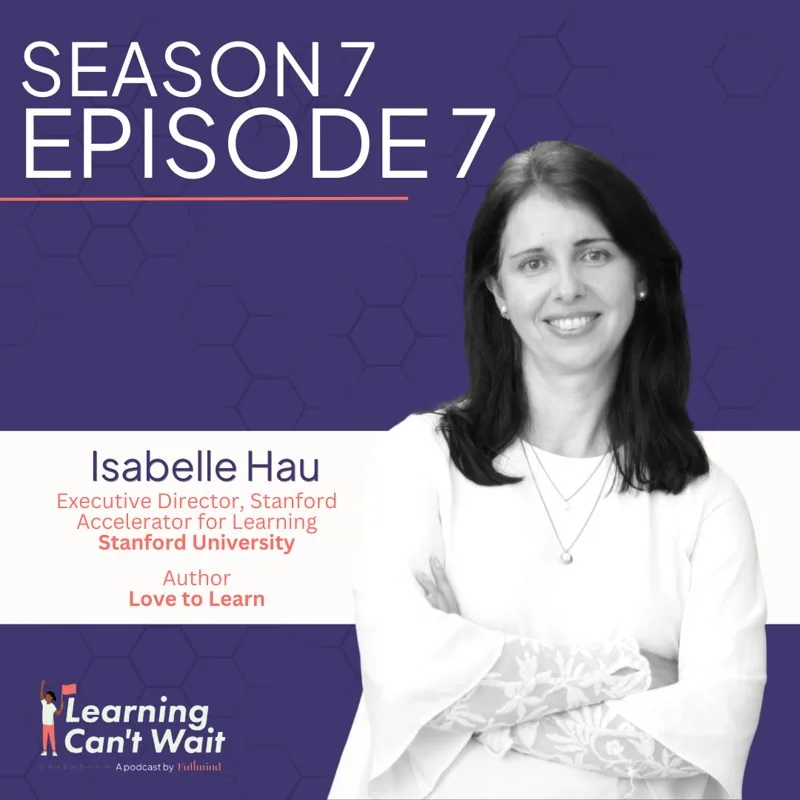
Isabelle Hau: Love to Learn, AI in Education, Play in Education
- Isabelle Hau, Renowned education innovator and author
 Hosted by Hayley Spira-Bauer, Chief Academic Officer at Fullmind
Listen now
Isabelle Hau: Love to Learn, AI in Education, Play in Education
Episode summary
Isabelle Hau, executive director of the Stanford Accelerator for Learning and author of Love to Learn, explains why nurturing relationships are the foundation of brain development: a million synaptic connections per second, built through serve-and-return interactions, and a 14% return on early investment per the Heckman equation. She describes relational pedagogy and guided play, the relationship-centered Mississippi Miracle, LENA conversational-turn coaching in Alabama, and her concern about AI companions displacing human connection. She urges parents to limit junk tech, protect device-free time, and choose low-turnover early learning settings.
Key takeaways
- Humans are born with billions of unconnected neurons; relationships wire the brain in the earliest years
- Early investment yields about a 14% return, better than the stock market, per Nobel laureate James Heckman
- Guided play and relational pedagogy drive better academic outcomes, not just social ones
- Mississippi's gains came from science of reading, teacher development, early intervention, and strong relationships
- AI companions feel humanlike to 90% of users and displace human relationships; favor relational tech over junk tech
About this episode
How is technology shaping the way we learn and connect? In this thought-provoking episode of Learning Can’t Wait, host Hayley Spira-Bauer sits down with renowned education innovator and author Isabelle Hau to explore the evolving role of AI, relationships, and play in education.
Isabelle shares groundbreaking research on AI companions and their impact on human interaction, both promising and concerning. She also highlights the importance of relational technology, the risks of “junk tech,” and how modern parenting and playdates are shifting in unexpected ways. Plus, she reveals a fascinating insight from her experience on Sesame Street and the surprising power of co-viewing with children.
Whether you're an educator, parent, or anyone passionate about fostering a lifelong love of learning, this episode is packed with insights you won’t want to miss!
Episode notes
In a recent episode of the Learning Can’t Wait Podcast episode with Isabelle Hau, host Hayley Spira-Bauer sat down with education innovator Isabelle Hau—author of Love to Learn and Executive Director at the Stanford Accelerator for Learning—to explore a force that has long been the bedrock of effective education: human connection. The conversation delved into how love, play, and genuine relationships transform learning, why technology cannot replace the warmth of human interaction, and what this means for classrooms and families today. Hau shares insights drawn from research and real-life examples, making it clear that our innate need for connection fuels every learning experience.
If you’re looking to cultivate a culture of connection and care in your school or classroom, Fullmind can help. Our certified virtual educators are trained to build meaningful relationships and spark engagement, bringing the warmth of human connection to every lesson—online or in-person.
Why Human Connections Are Essential for Learning
Learning is far more than the absorption of facts—it’s an inherently social process. Research shows that when students feel genuinely cared for by teachers and peers, their engagement and academic performance improve dramatically. Studies featured by sources like The Education Hub reveal that fostering a positive classroom climate—where every student is known and valued—can dramatically narrow achievement gaps. When students feel welcomed and understood, they are more motivated to take risks, ask questions, and truly absorb new information.
Furthermore, educators have long recognized that a supportive adult in a child’s life can make all the difference. As highlighted in the article on Greater Good Magazine, even a single caring relationship can boost a student’s resilience, drive, and long-term success. Whether it’s a teacher who takes the time to learn every student’s name or a parent who sets aside moments for one-on-one connection, these bonds provide the emotional safety net essential for deep learning.
The Science of Social Learning: Our Brain on Connection
Modern neuroscience underscores the power of social connection. According to modern neuroscience research, when learners interact with caring adults and peers, their brains actually synchronize—engaging the prefrontal cortex more fully and enhancing memory, attention, and reasoning. These “serve-and-return” interactions, where a caregiver’s response to a child’s cues sparks a cascade of neural connections, are fundamental in early childhood development.
When students experience warmth and validation, their brains release hormones like oxytocin and dopamine, creating a safe environment for learning. Conversely, social isolation or chronic stress from unsupportive relationships can impair cognitive function. This research makes it clear: human connection isn’t just a “nice-to-have”—it’s the catalyst that unlocks our full learning potential.
Love as a Foundation for Learning
In education, love isn’t merely an emotion; it’s a critical foundation for academic and personal growth. Isabelle Hau explains in Love to Learn that when children receive consistent affection and support, their brains develop stronger neural pathways. A classroom that operates like a family, where students are encouraged and mistakes are seen as opportunities for growth, nurtures both the heart and the mind.
A striking statistic shared by Hau shows that when students have at least one stable, caring adult in their lives, they’re more likely to overcome academic challenges. This idea is echoed by educators who argue that “love is a literacy”—a skill as important as reading or math. Investing in these relationships can yield dramatic improvements in engagement and learning outcomes, proving that the best lessons are often those delivered with empathy and care.
Learning Through Play and Joyful Connection
Play is not just a break from structured learning—it’s a powerful mechanism for building relationships and fostering creativity. Isabelle Hau emphasizes that play, whether unstructured or guided, builds social-emotional skills and enhances cognitive development. As seen in initiatives highlighted by the Starting Early newsletter, playful interactions encourage children to experiment, communicate, and connect in ways that traditional instruction simply cannot match.
When educators incorporate play into the curriculum, they create an environment where learning happens naturally. Children who engage in play learn cooperation, negotiation, and problem-solving. These skills are essential for both academic success and lifelong interpersonal relationships. In classrooms where play is valued, students often show increased motivation, improved behavior, and deeper understanding of the material.
Technology and Learning: Tool or Barrier to Connection?
In today’s digital age, the question arises: Can technology replicate the nuances of human interaction? The answer is complex. On the one hand, technology has the power to personalize learning and provide instant feedback. On the other, as discussed in the Stanford Report, overreliance on screens can reduce the opportunity for genuine, face-to-face connection—a critical element for social and emotional development.
Isabelle Hau warns against the pitfalls of “junk tech,” which can distract learners and replace meaningful interactions. Instead, she champions the use of technology that enhances human connection—what she calls “relational technology.” For example, innovative educational apps should encourage collaboration and co-viewing experiences rather than isolating students behind individual screens. A study from the Ahlan Simsim Study has shown that children who learn alongside their parents or peers develop better emotional regulation and vocabulary than those who use technology alone.
Lessons from the Real World: Connection in Action
The transformative power of human connection is best illustrated through real-world examples:
The “Mississippi Miracle” in Literacy
Mississippi once ranked among the lowest in reading proficiency. By shifting focus from merely imparting knowledge to nurturing relationships, the state witnessed a dramatic turnaround. Leaders invested in proven reading strategies and, crucially, in the human element of education. The initiative—detailed in Mississippi’s Reading Revolution—demonstrated that when teachers, students, and parents work together in a supportive environment, even the most struggling communities can achieve remarkable academic gains.
The Power of Co-Viewing
Another vivid example comes from the world of children’s media. Studies indicate that when parents engage in co-viewing—watching and discussing content together—the learning benefits multiply. This approach transforms passive screen time into an interactive, enriching experience. As Isabelle Hau notes, the simple act of a parent watching alongside a child can spark dialogue and deepen understanding, underscoring that technology works best when it fosters human connection.
Conclusion: Putting Connection at the Center of Learning
Human connection is not a luxury in education—it’s the lifeblood of learning itself. Whether it’s a teacher who takes the time to nurture a student’s potential, a parent who makes room for co-learning, or a school that prioritizes relationships over rigid technology use, the evidence is clear: relationships make learning deeper, more engaging, and more effective.
As we navigate modern challenges—from integrating new technologies to recovering from the isolation of recent years—it is vital that we center our strategies on connection. By creating environments where every child feels seen, valued, and supported, we empower learners not just to succeed academically, but to thrive as compassionate, curious, and resilient individuals.
How have you experienced the transformative power of connection in learning? Share your thoughts and join the conversation—because, in education, no one should ever learn alone.
Full transcript
Transcript generated from the recording; minor errors may remain.
Hayley Spira-Bauer: Welcome to the Learning Can't Wait podcast of Fullmind. At Fullmind, our vision is to ensure every child has access to an exceptional education. Each episode, we will be joined by Pathfinders within and around the education space who are bringing about transformational change. On behalf of deserving students, I'm your host, Hayley Spira-Bauer. Welcome back, everybody to the Learning Can't Wait podcast. I am so honored to introduce today's guest. We have Isabelle Hau, author of Love to Learn, and executive director of the Stanford Accelerator for Learning. Isabelle, welcome.
Isabelle Hau: Thank you Hayley for having me on learning. Can't wait.
Hayley Spira-Bauer: I'm so excited that you're here. I am a huge of the work you're doing at the Stanford Accelerator for Learning, and I loved your book and I know that it's really going to resonate with a lot of people in this time when there's so much uncertainty and I'm so excited for you to tell everyone about it.
Isabelle Hau: Thank you. Yeah, thank you. I think the book speaks about something that is profoundly human that crosses across so many political lines and really relates to everyone, so I'm really delighted to share some of those critical messages.
Hayley Spira-Bauer: Amazing. Well, let's jump right in. So Isabelle, can you tell everybody how did you come to be the personal and professional version of yourself?
Isabelle Hau: Yeah, actually that relates back to the early years. For me, early childhood education in so many ways really transformed my own trajectory. So when I was a 3-year-old, my parents had me take a psychological test simply because I was late at everything. I was a late walker, late talker, so they were, I think these are something that we need to do more for differently. So they had the test came back and the outcome of that test is not exactly what parents would like to see. It essentially said that I had low academic aptitude, which means that my future would've been, and my ability to have lifelong success was of concern. So my parents continued to shower me with a lot of love and unenrolled me into a beautiful family childcare facility nearby, and that I can still feel the warmth of this amazing childcare provider, Mrs. Combs. We still actually a very close family, family friend after so many years. But really that experience literally changed my life, and that's actually why I am so passionate about the importance of the early years, certainly having seen it at a personal level, but also the belief that it can really change individual trajectories and is so critical for societies.
Hayley Spira-Bauer: There's a lot of attention right now in the funding space on early childhood, but it's taken a long time to get here. Why do you think that there's more attention right now on early childhood? What research should we be paying attention to? Why is it that we suddenly have woken up and said, oh, kids are actually awake and alive and plastic before age five? Because that seems newer in the literature.
Isabelle Hau: Yeah, I think we have been too two amazing sets of progress scientifically in the early years. One, it's in neuroscience and the other one is in economics. So on the neuroscience side, this is a body of research where 90% of the modern neuroscience has actually been compiled over the past 20 years simply because at this point we can actually look inside the human brains and do a lot of really extensive research doing fMRIs or other types of research inside the brain. So what it has led many scientists to conclude is thatwe humans are simply born billionaires.We have billions of neurons when we are born, but those neurons different from many other animal species are not connected with each other. So that process of what is called in academic language, synaptic connection, happens post birth for us humans different from many other animals, and those synaptic connections are formed through relationships, what scientists refer to as serve and return this process of a parent or an adult looking and responding to the cues of a little learner
[05:00] **Hayley Spira-Bauer:** Like the tennis match, like a tennis match, right, tennis
Isabelle Hau: Match, exactly. Tennis match of connections, a little voice, a little touch and eyesight. All those very simple cues lead to huge transformation in the brain. So 1 million synaptic connections per second are happening in the first few years of life. So this body of science has essentially dismissed an incorrect understanding that we start learning when kids start school at age five or six. In fact, not only we start learning when we are born, we learn the most by far in these earliest years of life. So that's on your neuroscientific side. On the economic side, also really interesting progress thanks to many amazing researchers, but including Nobel Prize recipient, Dr. James Heckman and Dr. Heckman has demonstrated something very simple and powerful, which is referred to as the Heckman equation, which shows that investing early is leads to huge societal benefits from an economic perspective. So it's shown that there is a 14% return on investment if you invest early rather than later, and that's actually better than investing in any stock market. So it's a huge benefit from a societal outcome. So those two pieces of neuroscience and the economics I think, which are new over the past 20, 30 years, have really profoundly changed our understanding of the importance of the earliest.
Hayley Spira-Bauer: Thanks for setting the stage there because I think it helps leap us into the book itself. How do you define a Love to Learn and what does it look like in practice?
Isabelle Hau: Yeah, so Love to Learn is so incredibly critical. Let me define it very simply. We know that nurturing relationships or love is foundational for the brain to develop. So much so that we have research that show that if a parent and the research that I'm thinking about was done on mothers, but it would apply equally on fathers or other caregivers, if a child has a nurturing relationship, literally the hippocampus is much bigger, much larger by about 10%. So it's a pretty meaningful difference. And the opposite is true. If a child is deprived from relationships, which has been observed in very sad situations like the Romanian orphanages in the 1980s, then the size of the brain and the activity in the brain and the later outcomes of those kids who have been deprived from love and loving relationships are much smaller. So very simple concept at it's core that we need Love to Learn. That's how our brains have been. We are wired for social relationships to be able to learn. And five,
Hayley Spira-Bauer: I think there's a lot of data in your book that points to the long-term implications of this Love to Learn, making sure love comes first before we learn, but what are you hoping that when readers from all different sectors consume your book, what are you hoping they take away from it? Let's talk about starting with maybe the education sphere first. What are you hoping that educators when they read this book are taking away from it to put into practice?
Isabelle Hau: Yeah, thank you. Because that's absolutely what I'm hoping actually that the book does. It's inspiring people to do more of what we already are doing and what we love doing. So all educators in my mind, or every educator that I've ever met, is a deeply relational person. Generally, educators join the education field because they love interacting with children, and we most of the time stay in the education field because of those relationships that they can establish. So the question is really how to build on that amazing innate talent that educators have and help them with relational pedagogy on showing that schools are relational hubs, showing that we have the time as well to take care of the little ones, ensuring that ratios, for example, are small enough so that educators can actually spend the time that they actually want to spend with the kids. So all those things are very, very tangible. The other piece is plays this magical element of, again, not only for human beings, but for all animal species. ([11:12](https://www.google.com/url?sa=E&q=https%3A%2F%2Fwww.rev.com%2Ftranscript-editor%2Fshared%2FP3FiYvf8b_xOlKyhJoe08g1NN8RDRunSogBjZVZWQywRr1gtqy0rNAcSSMbWENPBwErV5BvYqhc_grjRTweNJGQIrcA%3FloadFrom%3DDocumentDeeplink%26ts%3D672.33)): We need play to learn. We need play to learn how to interact with others. And so play in so many ways is learning. And there are different forms of play. The two main ones being free play and guided play gets a little bit more complicated, but broadly there are those two big categories and teachers can do both. They can let kids during recess or free periods with free play, let's interact with other little ones, but they can also adopt instruction in the form of guided play, such as playing with blocks to learn math concepts for example, as opposed to direct instruction. All those lead to connections in the classroom between little ones which drive better relationships, better connections, better love, and as a result, quite a learning.
[12:00] **Hayley Spira-Bauer:** I always love when there's someone really smart that gives permission to incorporate more play. It feels so taboo in our society how often we see classrooms devoid of social engagement in the form of play. And it is not what I believe as a practitioner, but also as a mom. And so I love when folks give me that permission. You, I always tell my friends, I'm not a flashcard mom. I'm a play with my kid's mom. I want to play the, there's board games, if you could see to my right, there's board games and puzzles and books all over the table next to me. That's how I want my house to look. I do the flashcards when the teachers tell me I have to for my boys, but in reality I want them to learn through those rich experiences. And so thank you for that permission.
Isabelle Hau: Oh, of course. Yeah, no, and guided play has a lot of evidence that it actually drives better learning, including recent research on math, for example, for young children. So absolutely it is a evidence-based practice that drives actually better learning outcomes from an academic and cognitive standpoint too. It also is very, very related to the practice of project based learning, which a lot of schools are also increasingly adopting, and that's also very, very connected to play and guided play activities, just different worlds and different types of, but how to follow the interests of a child and build on those through joyful activities that also drive social connections.
Hayley Spira-Bauer: Isabelle, you're talking about outcomes and we'd be remiss if we didn't talk about the recent NAEP data that was released and it talked a large part about, I'm not going to quote all the headlines. Some of them made me really feel sad for kids, but basically that our kids are not doing well, they're worse off than they were before the pandemic except for a bright spot in Mississippi. Can you talk about what we observed in Mississippi, the progress that they made and why they made it? It relates very much to the concept that you describe in this book.
Isabelle Hau: Yeah, it's actually and referred to as a Mississippi Miracle because Mississippi is obviously one of those states where often is shown as one of the lackluster states in children outcomes, but certainly not recently. So over the past 10 years or so, it's a state that has done three things but are very simple in many ways, but also very complicated and coordinated and very intentional that have led to incredible outcomes for many, many young children in that state. So number one, they adopted the science of reading, which made many states at this point have adopted two, they have invested in teacher development, so they have completely revamped the teacher training and really invested heavily in relationships and relational learning for teachers freely invested in early interventions and early assessment, especially for dyslexia and critical that and critically important for earlier reading. But more importantly around all of us, they have wrapped all of us into holistic learning with a huge focus on relationships between teachers and children. And in speaking recently with some of the teams in Mississippi with some of the team who implemented the Mississippi Miracle, it is really clear that this element of relational learning that so far to the science of learning was a critical driver of this miracle.
[15:00] **Hayley Spira-Bauer:** Putting the science behind a lot of the excuse the impact results behind both the science and the philosophy is always so exciting and all eyes should be on that Mississippi Miracle. Sometimes it feels like a miracle happens by accident, but this, as you said, is, was so intentional and really deserves the praise and attention from the rest of the education community as we look to raise students' capacity in other states and places.
Isabelle Hau: Yeah, I was also looking at an adjacent state recently, Alabama, where I was discussing with a nonprofit organization called Small Magic that has implemented, works with many families and communities in Birmingham, and they had, we have implemented this technology solution called LENA that tracks conversational turns. So the of conversations between a child and a parent or a caregiver and parents or caregiver gets this feedback. And essentially what we have shown is something really remarkable, which is that people using LENA technology are so encouraged to speak more that reading outcomes for those kids who had access to that solution were incredibly larger than those kids who didn't. So really encouraging to see that when parents or caregivers get feedback on, am I speaking enough? Am I reading enough to my child? They actually take action and change their behaviors. And those behaviors drives incredible impact for the little ones in terms of reading.
Hayley Spira-Bauer: What I really loved about that anecdote in your book is that I believe deeply that parents want the best for their children. And often school is in a place where many parents have positive associations and memories for a whole host of reasons. And we don't always know how best to support those families because it feels like school often has to be compliance driven. You have to come to this parent-teacher conference, your kid has to be at school at this time. And what I liked about the potential of the experiment you're talking about here is that it helps to form positive associations for families that may previously have had negative ones in how their parenting and their involvement in their kids' life have positive impacts on their long-term growth and development. Because ultimately our brains are wired where positive reinforcement helps us to continue good activity. I always did that in the classroom too, ensure that students were driven forward. I do it with my husband now. I do it with my kids and I like when people do it to me. We want to get that reinforcement to continue the behavior. And for me, it really spoke to the potential for families that have not always had positive experiences in school and maybe don't know how they personally impact their own kids' lives, how it could reverse that. And that could be a whole new future for them and their child, which I loved.
[20:00] **Isabelle Hau:** And actually, you make me think of a project, big project we have at Stanford Accelerator for Learning under the leadership of Dr. Phil Fisher, which is a project called FIND, let's say, video coaching of parent and child interaction, a little bit like baseball or another sport when you are video coached for your practice and your craft. Here, it's a little bit the same but for parenting or for adult interaction with a child. And it is focused on what you are saying, Hayley. It's focused on the positive, on the strengths of that interaction. And as a result of that, all things go up so there's greater on engagement between a child and a parent, quite a bonding, and then a lot of positive learning outcomes as a result of it's very simple feedback that's provided for the video. It's really interesting. Yeah,
Hayley Spira-Bauer: I mean, I am a little biased here because I studied under Martin Seligman at Penn, the father of positive psychology. So when I was an undergrad, this is what I was taught. I didn't know that it was a newer philosophy, and so I just brought it into my life. But now I am glad it's gaining traction. It is both neuroscience based and backed by data and explained in your book. But you actually touched on something that I'd love to jump into next, which is you started to talk about technology and in your book you have a section where you talk about technology and the future of let's say AI and how it might change these interactions between humans. Can you tell our listeners a little bit about what you talked about and what implications you think technology may have on the Love to Learn?
Isabelle Hau: Yeah, that's an area of huge transformation about relationships in my humble opinion and one that I think is deeply concerning. So I'm so glad that you're asking that very important question. So why now? This is not higher category that my researchers are calling intelligent social agents. There's a more common name of AI companions that's more commonly used, but this broad category is one where we have more and more tools that allow us to create an avatar or play with a social robot and have conversations with that machine. And we have done some testing on some of those at Stanford and other universities are also studying the effects of those machine interactions. But essentially the research that we have conducted at Stanford is very interesting, but also, again, very concerning, where 90% of people who are using those AI companions are confused and think that the interaction is humanlike. So it's almost like us as human and that research, by the way, was done on young adults. So if we think about the impact on children, it's likely to be even higher than 90%
Hayley Spira-Bauer: Worrisome.
Isabelle Hau: It is deeply worrisome. And what the research has shown and the research was done on this tool called Replika, is that they seems to be a slight beneficial impact on mental health, which is good news. So people who are using those platforms have less suicidal ideation. So that seems to be a good news. However, there is a displacement of human relationships, so people who are using those platforms are using them more and more and are essentially going less and less to humans to converse and play. And that's obviously deeply, deeply concerning for all the reasons that we both know and the importance of human social connections for all of us to thrive and learn.
[25:00] **Hayley Spira-Bauer:** There's so much to be excited about with the development of technology right now, but we also just have to be careful consumers of the excitement and the hype cycle as we think about what are the long-term implications. So I'm glad you called it out here. I'm curious, Isabelle, you've been known for your impact investing in the past on this front in the front of artificial intelligence and rapid proliferation of technology right now, what has you very excited with maybe less hesitation?
Isabelle Hau: So I'm excited about one big area, which is where technology can make us more connected. And there are lots of those tools that exist. For example, let me just pick one that's very tangible. I would never say let's not use FaceTime to connect with grandma or grandpa. That's great. Oh, thank gosh for it. That's beautiful use of technology. Now, if a child is mindlessly scroll through YouTube Shorts or other tools, that's not a great use of technology. Technology can actually connect us, and when it does, it's beautiful and it's extraordinary. And that's where I want all of us to be a lot more intentional about is technology, relational or not? If it's not relational, I considerate myself junk tech, andit's okay to have a little bit of junk food. So it's also okay to have a little bit of junk tech, but not too much.Ideally if we eat too much junk food, not great for our diet and for our health. Well, same thing with tech. If we have too much junk tech, not great. So however, if we have a lot of organic food and a lot of healthy nutrition, that's all good, we actually need it. Same for tech. If we can have relational tech and tech that connects us with others, it's all good.
Hayley Spira-Bauer: It helps set a good parameter for that in our heads, right, as parents, there's no playbook, there's no textbook to study for how to be a great parent. And even if there were, it would already be outdated. The one that I would've read when my eight and a half year old were born would no longer be relevant.
Isabelle Hau: You are so correct. Being a modern parent right now is so complicated. I've been reflecting a lot heavily on one area, which is play dates.
Hayley Spira-Bauer: Let me hear your thoughts because we we're in an evolving play date, age. I have an eight and a half year old and a five and a half year old, so I know what the five and a half year old, I know what's going on there. But the eight and a half year old is so tricky how the kids like to interact on play dates,
Isabelle Hau: But also how parents interact on play dates. Oh, yes. So I've observed that play dates are becoming more and more structured, which I'm actually quite deeply concerned about because play dates where this form of free play for children to interact with each other and make friends, but they are becoming more and more structured. So suddenly you have to have an entertainer, you need to have all these activity kits, you need to have these extravagant goodie bags. Anyway, all these things that are making those moments that used to be moments of serendipitous opportunities for connections and friendships because play dates have been shown to actually drive a greater number of friends and having a good close friend is one of the greatest predictor in the early years of long-term academic success, including academic motivation. So all of us is related and important. Just adding a little bit of the science here. Love it. So as play dates are becoming more and more structured, we may risk losing that opportunity for kids to engage in genuine human connections with other little ones.
Hayley Spira-Bauer: Yes. Thanks for calling that out. I hadn't thought about that perspective, and that is a very valuable one. Isabelle, you're also really well known for your famous appearance on Sesame Street. How was it meeting the characters, Grover on Sesame Street? How did that go?
[30:00] **Isabelle Hau:** So this was an incredible experience. I mean, Grover is the superstar, so having this opportunity to be in the Sesame Street studio with Grover and discussing the segment that we had run was on early childhood innovations. I mean, this was just magical and also frankly, connected to a childhood dream. I believe that
Hayley Spira-Bauer: I met someone from Sesame Street at a conference in October, and I think I fangirled and the woman's like, I'm not on the show. I'm like, no, but you work for it. Sesame Street is transformative. These characters are iconic. So I understand why it was your childhood dream too.
Isabelle Hau: Yes, there's actually one data from Sesame Street has done also, obviously a lot of experiments from a research perspective, and it's a show that has shown to be extremely beneficial from a social emotional as well as academic outcome standpoint. But it is one thing that has actually surprised me a lot. The mere fact of having an adult watch the show alongside a child has been shown to have meaningful benefit for that child outcomes, which essentially shows one very simple thing, which is that our brains are wired for social connections.
Hayley Spira-Bauer: And it's hard. I'll just make this comment, but it is without shame. So often parents are using television and technology for a break for themselves, and so this is that push for making it an interactive tennis match as much as possible. It's funny, my mom, when she would watch Sesame Street with my sons, she would talk to them constantly and they'd be like, Mimi, you're talking so much. But I knew why my mom was talking to them. They don't know that, but it can be hard, especially how frazzled and overwhelmed so many of us are right now. But this is a good push for that. So thanks for the gentle nudge there.
Isabelle Hau: Yeah, of course, co-viewing, all those elements are just, so this is where obviously relationships can happen and where our social brains are really firing up. So really critical. I would add actually one thing if you allow me, which is actually one other area of deep concern of mine, and I'm also guilty of it myself as a mom. So I'm not saying
Hayley Spira-Bauer: No shame here. No judgment.
Isabelle Hau: Yeah, it's listen,
Hayley Spira-Bauer: And we don't judge
Isabelle Hau: Exactly. Exactly. There's no judgment, but just an observation more, and for all of us, the average American adult American, we check our devices 205 times a day. That's a
Hayley Spira-Bauer: Lot.
Isabelle Hau: I might be even higher invest myself Anyway, I just, again, no judgment. Okay. But here is a concern is that when we do this in presence of a child, the scientific terms for it is, so there is the risk of an interference in relationships because we are checking our device so the child sees us and then maybe imitating us, or at least maybe thinking, okay, well that device is actually more important than I am.So the device almost becomes a first child, and that's a critical concern in terms of relational, all the benefits of relationships. So how can we as parents, unsure that any family time is truly relational time and we protect those special moments. It may not be every moment of the day, but some special time such as dinner or bedtime or bathtime, depending on what works best for people, for different families. But making sure that there is a very protected time for play and interactions away from any devices is critical.
[35:00] **Hayley Spira-Bauer:** Incredibly helpful to hear wildly. We are at our final question, but while you're doling out really helpful data science backed advice, I would love to hear what advice you would give a teacher starting your career today who is hoping to instill a Love to Learn in the students that they teach?
Isabelle Hau: Yeah, actually it's both advice for teachers, but also for parents with one thing that is really important in relationships, which is a time spent with a child. I've heard this from many, which is a frustration that they may have of being assigned to different classrooms when in fact being assigned to one classroom with a set of children is where they can actually establish those connections. So my advice to a teacher starting in their career is having this discussion maybe with their school principal or only learning environment administrator to ensure that this rotations across classrooms are avoided at all costs. And same advice for parents. My one clear advice for parents when choosing an early childhood environment is ensuring that teacher turnover is as low as possible because that's a clear sign that if it's low, relationships will be enhanced. And also it's a sign that teachers are happy to work in that environment.
Hayley Spira-Bauer: Incredible. Isabelle, thank you so much for sharing your time with us today. Your book was phenomenal. It is a wonderful read for various people who care, various types of people who care about instilling a Love to Learn in children across every sector. I'm so grateful you shared your time with us today.
Isabelle Hau: Hayley, thank you. And I've renamed your podcast Learning Can't Wait to Love to Learn Can't Wait.
Hayley Spira-Bauer: I love it. We have some synergy there even in our ideas, but also in our titles. Fantastic. And thank you everybody for tuning in today, so
Isabelle Hau: Enjoy the conversation. Thank you for having me.
Hayley Spira-Bauer: Thanks for listening to the Learning Can't Wait podcast. If you like what you heard, please rate, review and share this episode. Be the first to know when we have a new episode by subscribing wherever you listen to podcasts. If you'd like to be a guest on the show or have a suggestion for an episode, email us at podcast Fullmind Learning.