
Learning Can’t Wait · Episode 104
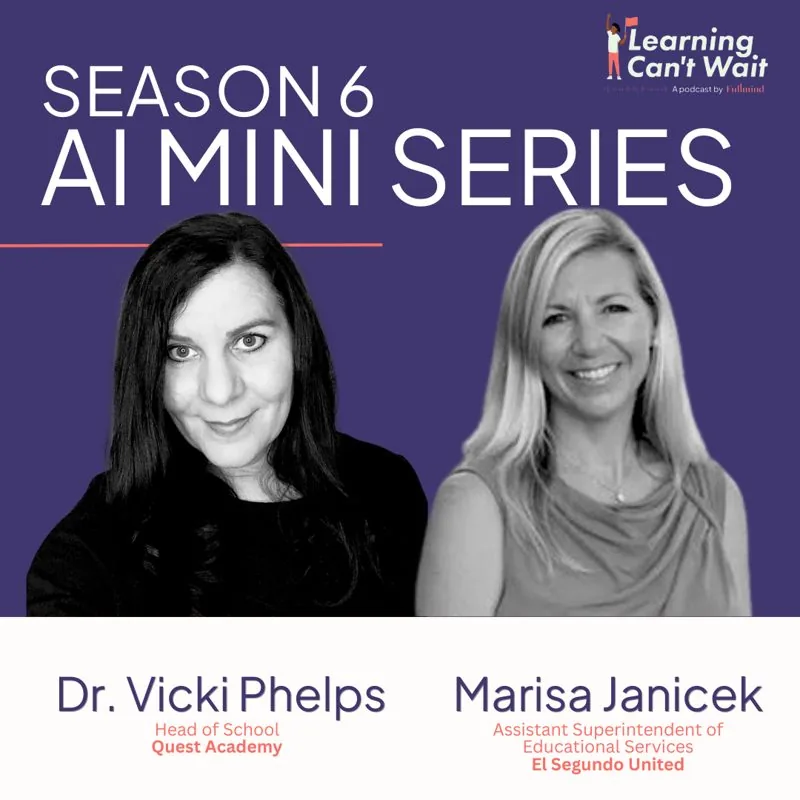
Dr. Vicki Phelps + Marisa Janicek: AI in Education, AI ethics, Technology Gap
- Dr. Vicki Phelps
- Marisa Janicek
 Hosted by Hayley Spira-Bauer, Chief Academic Officer at Fullmind
Listen now
Dr. Vicki Phelps + Marisa Janicek: AI in Education, AI ethics, Technology Gap
Episode summary
In the AI in Schools miniseries, Dr. Vicki Phelps of Quest Academy and Marisa Janicek of El Segundo Unified argue that AI and human connection are not a dichotomy. Marisa describes a kickoff event, community focus groups, two board policies, a teacher advisory team vetting tools like MagicSchool, and a student-led AI event. Vicki explains Quest's K-8 CSAI classes, a student whose AI cane for visually impaired people won Invention Convention nationally, and how gifted learners think from big idea to details. Both stress ethics, access gaps, and grace.
Key takeaways
- Fear drives AI pushback, but the human element is never going away; prepare students for ethical, responsible use
- Start with community: kickoff events, focus groups, board policies, and a lead-teacher advisory team
- Vet tools through FERPA and safety rules and pick a few well rather than throwing a smorgasbord at teachers
- AI output is a graphic organizer, not a finished product; teacher voice, feedback, and analysis sit on top
- The access gap worries both leaders; ISTE's free curriculum helps, but policy must ensure every student learns AI
About this episode
In this episode of Learning Can't Wait, we dive deep into the transformative role of artificial intelligence (AI) in education with Dr. Vicki Phelps and Marisa Janicek. Our guests explore how AI can enhance personalized learning, streamline teacher tasks, and foster more engaging classroom experiences. They address critical ethical considerations surrounding AI, such as data privacy and bias, while emphasizing the importance of maintaining equity in access to technology. As AI continues to evolve, Dr. Phelps and Janicek discuss the vital role of professional development for educators to effectively integrate these tools into their teaching practices. Join us for a thought-provoking conversation on balancing innovation with the essential human connection that teachers provide in the learning process.
Produced by Fullmind
Episode notes
As artificial intelligence (AI) becomes more integrated into the education system, the conversation shifts from "if" to "how" it should be used. In a recent Learning Can't Wait podcast episode, Hayley Spira-Bauer hosted two leaders in education—Dr. Vicki Phelps, Director of Schools at Quest Academy, and Marisa Janicek, Assistant Superintendent at El Segundo Unified School District. They discussed the evolving role of AI in the classroom, its potential benefits, and the ethical and equity issues that arise as it becomes more prevalent. Their insights provide a roadmap for schools looking to harness the power of AI while ensuring it remains a tool for positive change.
Fullmind supports schools and districts in implementing technology thoughtfully—offering live, certified virtual educators who integrate seamlessly with your existing team. Whether you're exploring AI-enhanced instruction, need help filling vacancies, or want to provide personalized learning at scale, Fullmind helps you build a future-ready school while keeping human connection at the center.
AI as a Tool in Education
A key theme from the discussion was the role of AI as a tool that can support, but not replace, teachers. While AI can handle tasks like lesson planning and data analysis, it does not replace the critical thinking, empathy, and engagement that human educators bring to the classroom. Teachers are not just content deliverers—they interpret and contextualize information, bringing lessons to life through their relationships with students. As AI handles more administrative tasks, teachers can focus on fostering deeper connections and more creative learning experiences.
Empowering Gifted Students with AI
AI has significant potential for personalized learning, particularly for gifted students who often need advanced content and unique instructional approaches. Dr. Phelps emphasized that AI can provide tailored educational resources that align with the way gifted students process and understand information. These students tend to think abstractly and benefit from AI’s ability to deliver complex, problem-solving content in a format that suits their learning style. However, it is important to remember that AI should complement, not replace, the teacher’s role in guiding students through this content. The technology may offer advanced material, but it is the teacher who understands the nuances of each student’s strengths and can adapt accordingly.
Personalizing Learning for All Students with AI
Beyond gifted learners, AI offers possibilities for differentiating instruction for all students. With AI, teachers can analyze student data to develop customized lesson plans that cater to individual learning styles and needs. This personalization is critical in classrooms where teachers face large groups of students and time constraints. However, educators need to be equipped with the right skills to use AI tools effectively. Professional development is essential for ensuring that teachers can make the most of AI, using it to enhance instruction rather than relying on it as a substitute.
Ethical Considerations and Critical Thinking with AI
The conversation also touched on the ethical considerations of incorporating AI into classrooms. Both Phelps and Cummings raised concerns about the potential for AI to generate inaccurate or biased information, underscoring the importance of teaching students to think critically about AI-generated content. Schools must make it a priority to educate students on how to responsibly use AI tools and to critically evaluate the information these tools provide.
The Equity Gap in AI Access
While AI holds great promise for enhancing education, there are concerns that it could exacerbate existing inequities. Not all schools or districts have the same access to technology, meaning that some students may be left behind as AI becomes more widely adopted. Ensuring equitable access to AI tools and resources is critical to preventing a widening digital divide. Schools need to invest in technology infrastructure and professional development to ensure that all students, regardless of background or location, can benefit from AI-enhanced learning.
Preparing Educators for the AI Driven Future
As AI continues to evolve, professional development for teachers is key to its successful integration into the classroom. Educators need not only training on how to use AI tools but also support in understanding AI’s broader implications for learning. Ongoing support and collaboration among teachers will help them effectively incorporate AI into their instruction, ensuring that they remain at the forefront of the learning process. By embracing AI as a tool for enhancing education, while also focusing on ethical, equitable practices, educators can ensure that AI supports rather than replaces their vital role in the classroom.
Moving Forward: A Balanced Approach to AI in Education
Incorporating AI into education offers exciting possibilities, but it is crucial to strike the right balance between innovation and maintaining the human element in teaching. AI can support personalized learning, streamline administrative tasks, and offer advanced content for students, but it cannot replace the unique value that teachers bring to the learning experience. As schools continue to explore AI’s potential, maintaining a focus on ethics, equity, and thoughtful implementation will be critical to ensuring that AI serves as a tool for empowerment rather than a source of division.
By investing in teacher training, addressing the equity gap, and fostering critical thinking, educators can harness the power of AI to create a more personalized and efficient learning environment, while still preserving the essential human connections that define effective education.
Full transcript
Transcript generated from the recording; minor errors may remain.
Hayley Spira-Bauer: Welcome back everybody to the Learning Can't Wait podcast and our special miniseries on AI in schools. I'm so excited. For today's panel, we have Dr. Vicki Phelps, the head of school for Quest Academy. Welcome Dr. Phelps.
Dr. Vicki Phelps: It's good to be here. Thank you for having me.
Hayley Spira-Bauer: Thank you so much for joining us, and we also have Marisa Janicek, the assistant Superintendent of educational services for El Segundo Unified. How are you, Marisa?
Marisa Janicek: So great. It's wonderful to be here with both of you talking about education and the exciting things on the horizon.
Hayley Spira-Bauer: I love that you phrase it that way because we are really talking both short-term and long-term in the conversation about AI in schools. And so that's framing this perfectly. But before we jump into that topic, I always love to get to know our guests a little bit more deeply. Dr. Phelps, we'll start with you. How did you come to be the personal and professional version of yourself?
Dr. Vicki Phelps: That's a really great question. As I think back even to my own educational experience, let me just lead by saying Quest Academy is an independent school for gifted learners in the Chicagoland area. And so gifted education is kind of where I've landed in this field. And a big piece of this is because of my own education teachers I had who were innovative in their own instructional practices that engaged me, that excited me, that kept me moving forward in the right direction versus maybe going down a path of not being as involved in school as what I should have. And because of the excitement that was instilled in me because of strong educators who were innovative in their thinking, it continued to drive me towards education and furthering my own education into the specialty of gifted education where through mentors and teachers and now building relationships and building capacity and others to continue with innovative instructional practices is really key to who I am and where I want to continue to go.
Hayley Spira-Bauer: Always love an introduction that involves great educators who inspired you on your journey. I know that I'm super excited to have your perspective on the panel today to speak about a really important population that doesn't get enough airtime on this podcast if I'm being very honest. And you probably feel that might be true across education. So excited for you to lend that important perspective in the conversation. Thank you for that thoughtful introduction, Marisa. Now your turn. How did you come to be the personal and professional version of yourself?
Marisa Janicek: Well, I'm still evolving as we all are. I would have to say in elementary school, I knew I wanted to be an educator. My mom and dad are both educators themselves who encouraged me to go elsewhere, but I saw what they did and I knew how important it was. I think along the way, I've had incredible teachers that really connected with me, made me feel special and that I could accomplish great things. I also had others that said, you're not fitting in this box particularly well, and maybe you need to go in different directions. So I think what I've learned is educators need to come from all walks of life. We need to have all different perspectives. Every single person has been in education at least part of their life, some of us all of our lives, and it's really important to really connect with individuals. I've had incredible administrator mentors that have shown me how much you have to give, but how much you have to give to yourself too to be a better person for everybody around. And I think who you surround yourself with in life, no matter what kind of field you're in, makes the difference. And I am grateful to be surrounded by incredibly talented, intelligent individuals here in El Segundo, but also across the nation now. I think the conversations have really broadened and that just excites me. I'm so excited to meet you, Vicki Hayley. I've loved getting to know you, so that's what really makes me continue to launch, do better all the time.
Hayley Spira-Bauer: Cynic on this topic, because I actually deeply believe that AI in education is an important evolution, but I have to note that both of you have spent your introduction talking about human connection and what I think is really interesting about this dialogue we have in education about AI versus not AI is there is somewhat of a dichotomy that maybe the media has painted or maybe the loudest speakers in the room have painted hitting human connection versus AI. How real do you think that dichotomy is? And if it's not one either or, what is it? Does anyone want to start off and take that first?
Marisa Janicek: I can start if you don't. I would just sayfear has played a big role in the AI rollout. The human element is never going away.Absolutely never. My husband is in entertainment and we talk about this almost nightly, about what it is. It is going to shift our world. There are impacts down the line, but the human element is critical for humanity and success. So there is absolutely no way that teachers are not going to be needed, that human relationships are not going to be critical. I think what it's going to take is for one, us really preparing our students and educators so that they know how to use it ethically, responsibly in a way that's productive, but keeps the human element together. But I also think it's innovative and fun and engaging, and I think that's the direction we're headed and it is exciting. We have to do things responsibly, but the human element is critical for any success in education and beyond.
Dr. Vicki Phelps: I'll just jump in and absolutely reiterate and agree with you on this. I think that human element is what bridges the gap between the human interaction or AI and brings it to human interaction and AI. And because of that bridge, that is how we grow our students' interpersonal skills as they are making true connections through artificial intelligence to the real world because this is the world that they are moving into. It's not going away, but there's even more of a responsibility for us to grow our students and understanding the importance of those interpersonal skills and psychosocial skills because how we incorporate and innovate and lead through modern technology, we still have to be able to make those connections because as humans, that's what we need and that's what is going to leave that lasting impact.
Hayley Spira-Bauer: So many rich points in there that I know we're going to dive deeper into as we talk, but what I appreciate about both of your responses here is that it's not either or it's both. And there's a way to approach this that both considers the student, the technology, the community. So let's dive into that. Can you describe for us, I know El Segundo as Vicki, as Marisa said earlier, we've met each other a few times at conferences and gotten to know each other quite well, and I know some innovative things that are happening in that district. Can you start us off? How has El Segundo Unified looking at or approaching integrating AI into school this year?
Marisa Janicek: Thank you, Hayley. I am so proud of the work we're doing. It truly started last year. We heard this is coming, we know what people are talking about, but there's a lot of unknowns. So what did we need to do? First, we really need to find out what our community is thinking and feeling. So we hosted a kickoff event saying, here's AI. Here's already what's happening. Kind of to eliminate some of the fear, but also to share it's, it's real, it's coming. We had a lot of community members attend and it was just to kind of share, this is what it is, this is some of the conversations that have been coming up, and then here's how we are going to engage you moving forward. So we hosted three community events after the kickoff where they were really more like focus groups. We had a presentation, again, just reiterating what it is, making sure they know we're safe, responsible, we're not rolling out things that are going to be dangerous to students or teachers. And then we got their input. What are they excited about? What are they scared of? How did they see it changing the future of their children or their classroom? Because educators were in the room, parents were in the room and students were in the room, and the students were my favorite part, to be honest. And then what we've done all along the way is we've had a lead teacher group. We're fortunate to be small in the sense that we have two elementaries, one middle and one high school, and an alternative high school. So we're able to get representatives from all of our schools, site administrators also to come together to say, what do we need to do to make sure that our teachers feel safe and the tools that they need to slowly enter into AI to support our students starting K-12 on digital citizenship in AI and everything. So it's been a really exciting journey. I missed a really key point for any district. You obviously need to have your school board behind you. We did a board study session and put two policies into place, and I have to say, without a supportive board, we would not be moving the way we're moving. They have been so supportive and understanding, and I guess just really wanting to see our students moving forward in a safe way and supporting our educators. So that has been our journey over the past year and this year we get to dive into our roadmap even more and continue to support our teachers. We have an AI instructional coach this year that will be helping. I know, I'm so excited. She's amazing. And she's going into the classroom working with our AI advisory team, but also helping run student clubs and start to get student voice and choice in there also. And then finally, we're going to be hosting a gigantic AI event in February for our community that will be led by our students and educators.
Hayley Spira-Bauer: Wow, that is very comprehensive. I mean, Vicki, you're sitting there, you're nodding your head with me. Talk about you have a different type of community, a different size community. Talk about what your approach is.
Dr. Vicki Phelps: So yes, those of you that might just be listening and not seeing me right now, I look like a bobblehead because I am literally shaking my head up and down as Marisa is speaking. Just a little more background on me, probably the first 20 years of my career, I was in public education, so teacher leadership, all of that type of thing. It's just recently that I've moved into the independent school arena, which Quest is an independent school for gifted learners. And so I come just understanding the difference between public and independent. And while I am in my second year as the executive director head of school for Quest, and I've come into a school that actually had embraced AI before ChatGPT was even a thing. So Microsoft actually came to our school several years ago and said, we know how to teach college level. We know how even in high school, but we don't know how to teach elementary school aged children about artificial intelligence. Your school looks like it would be a good fit for us. So we partnered with Microsoft and learned a great deal from them and really grew within our own instructional practices, but that leads us to where we are today. So Marisa was talking about the importance of support and that is integral. And in the beginning it might be finding those few that you work with the welcoming and they are there to support you as you move forward. But our school right now, we are in a position where we start, we're ages three through eighth grade, but starting in kindergarten, our students go to a class called CSAI, and it stands for Computer Science Artificial Intelligence. So they begin learning to code very early on in their elementary school experience once they go into middle school. We have what we call the CSAI Innovation Lab where students are really taking things to the next level, which I'm hoping I can share some examples of that as we go further into it. But at the very foundational aspects of our program here, it was having the support, the content expertise from people to continue to guide us in that roadmap to get to a place where we not only are teaching our students about computer science, artificial intelligence, but we're also comparing it to what they are authentically producing on their own. One of the stories we share quite often is we had control groups where students wrote a paper back in the early days of ChatGPT students wrote a paper and then they had one that was generated and there was a blind group on which paper was best, and it was the student generated paper that was stronger. And it continues to be part of our conversation of as things have evolved, this is a great way to organize ideas, but to get your own voice and to grow it and all of those aspects, it's a key piece of learning. And so yeah, basically we started kind of foundationally before it hit everything, and which has allowed us to continue to be very mindful of how we move forward. And really, I'll share one more example just here real quick. This last year, one of our eighth graders, there's a program called Invention Convention. Many public schools do it independent schools homeschoolers everybody, and we had the national winner for his use with artificial intelligence. He created a program called Blind Space that actually uses artificial intelligence to help visually impaired people. They wear an earpiece and there is a camera on their walking cane that literally tells them what is coming up, instead of just feeling there's a park bench coming up on your left, a dog approaching on your right. And so an eighth grader, somebody who has grown through understanding how to make an impact in our global world, and here he has received national award patents. He won the health and medical award, I mean awards out the wazoo, but the awards don't matter. It's the impact that he's making on the global world because he ethically and responsibly used artificial intelligence to make a difference in the world.
Hayley Spira-Bauer: Excitement is palpable. Both of your excitement is palpable. If I were a listener and I was skeptical, even just the anecdotes you shared about how you built consensus and how you went to the community and how the students are responding, that gives me joy to hear it. I feel like this is an appropriate time to share. I've been disclosing ever since I started using AI to help me with the podcast. Whenever I'm developing questions, I've been disclosing it that I use AI now to help me think of great questions for the podcast. And in my tone and in my voice, my tool has consumed some of my other podcasts. They know what my style's like and they use it to ensure that I'm asking thoughtful questions tailored to the expertise of the individual guests that I've invited on endless possibility. So how do you balance some of that excitement with caution for implementation? Marisa, you said that just a moment ago when you started your conversation that you wanted to make sure that you weren't just throwing tools into the school. I mean, the proliferation of tools right now is rapid. It's fast. How do you decide what's best for your community?
Marisa Janicek: Cut on for one second. So I think you asked how do we decide the tools? Is that right?
Hayley Spira-Bauer: Yeah. How do we decide what's best for your community? Since there's so many tools being developed on a daily basis, pretty much you have your pick of the litter, so to speak.
Marisa Janicek: Yes, and it's overwhelming if you go out there and ask educators. I mean, there's Facebook feeds, there's LinkedIn feeds, it is everywhere, and everyone is designing and coming up with great ideas. So Hayley, that is a billion dollar question right now. What we are doing is working with our AI advisory team of teachers, and we are working within what has been approved, goes through all of our FERPA and all of our safety regulation guidelines. As long as it meets all that criteria and is not duplicate of another material so that we can come together, learn very closely with MagicSchool. It's approved, it's aligned with education, and there are some other tools we're looking at, but right now, that's something we can all say, oh, this can help me as an educator and this can help me in my classroom, versus this could lead me down a path and then I'm in the hole for $10,000 in two years. So the cost is one thing. Finance is hard, especially in California schools, well, schools across the nation also, but our district is one of the lowest funded due to the funding model. And we have to very thoughtful in what we're putting into our classrooms. And then once we're having educators put time into something, we don't want to take it away. They work so hard and come up with the best, most creative use that we want to see into long-term use and support. So I think right now it's really our advisory team that works together to come up with the best products that we all agree upon and then all get behind and can support our teachers in learning how to use it and implement it safely and at their speed.
Dr. Vicki Phelps: I have to echo again what Marisa is saying. I think a huge piece of this is finding content area experts that really know their area of expertise and trust the guidance. One of the worst things that we can do to educators is just keep throwing things at them that, well, one of these will stick, right? But they don't even have a chance to really grow in their own craft. And by having identified an advisory panel or identified experts in this field, it not only continues to grow capacity in the educators who are also learning the approved programs, but is also then in turn, those educators are able to build capacity in the students they're working with. So first and foremost, it's not let's try everything. It's not a smorgasborg of everything. It's let's be intentional and learn something well and understand that it is ever changing, but how can we continue to also show adaptability flexibility as we continue to grow in our craft? And that I think is just really key.
Hayley Spira-Bauer: Two values that I hold very dear, or one value with two names, kind of adaptability and flexibility that is, I mean, I think there is nothing more important as an educator than that value because everything changes. Your children are changing, your community is changing, your school is changing at such a rapid pace. Let's talk a little bit though about the teachers. Vicki, you touched on that for a second. You talked a little bit about your teachers here and how they're embracing it and their approach to it. Are you finding that teachers are using some of the tools that are meant to expedite their planning and their grading? And if so, what has that looked like and what's the feedback that you're getting?
Dr. Vicki Phelps: I think there's twofold. One, I want to say first and foremost, this is maybe taking a little bit of an offshoot from what you just said, but I think it's incredibly important that there is dedicated planning time for and collaborative time for teachers. I know it's very difficult when as an administrator finding that common time, but that is key to making sure that teachers have the support and that collaboration opportunity to be able to grow in this. And as such, you start seeing more of that AI go even into their interdisciplinary instruction kind of covering all bases, which is a huge piece to your question, which is more in terms of how teachers are utilizing AI to support them in their own planning. Our teachers are pretty familiar with it here. We use it with our students regularly. So yes, I mean, is it used to maybe put together an initial slide deck or presentation for curriculum night maybe, but you still have your own voice that you go back. Is it used to draft an example to show students to have something written in a third grade perspective so that you can work with your students to say, how could we improve this piece of writing versus trying to write something yourself to mimic a third grader to use as a modeling tool within the classroom. So yeah, those are one of some of the ways that our teachers might use it, but I think the driving factor behind any usage of AI is knowing that it is not a one and done. It is a way to organize thoughts, whether they are images or text or a combination, but it's not a one and done. It's just a way, it's almost in a way kind of like a graphic organizer where some ideas are put down, but you still have to have your own knowledge analysis, evaluation, understanding of your content to be able to make it really demonstrate your expertise as you are sharing out information,
Hayley Spira-Bauer: Information. Such an important point there of the layer that goes atop AI adoption, that evaluative layer, that analysis layer, which to be fair, 15 years ago as educators when I was still in a school, we were all having the conversation about sources. When you use the internet, how do you know that the site you're using is a valid, unbiased, reputable site for sourcing information? Now we're having a similar conversation about the content we create via AI. It's all full circle it seems like. I want to talk a little bit about, you touched on the teachers for a second. I'm going to keep with you for a second. Dr. Phelps, I want to talk a little bit about the students. As you named your district, your community is serving gifted students. How does this population, this unique population, how might the implementation with AI look different? Or is it the same as we're seeing maybe in a general education setting or a special education setting?
Dr. Vicki Phelps: Right. First and foremost, I want to say that gifted students are everywhere. They're in every background, every ethnicity, every socioeconomic status. I mean, everything gifted students are everywhere. Inner city, suburban, rural, it doesn't matter. They are out there. And we're a very diverse community. So even if you're working in a general education classroom, the likelihood that you're going to have gifted students is pretty high, right? I mean, it's going to happen. One of the greatest maybe takeaways I would want people to understand about gifted learners, in a nutshell,gifted learners think from big idea down to the details, and that is actually flipped from a non-gifted learnerwhere they typically think from the facts and the details up to the big idea how we approach teaching our gifted learners is very much providing them with that big idea and then helping them. It's harder for them sometimes to go to those key pieces. And so how we introduce and how we support our gifted learners is a little bit different than in a general education setting. Likewise, we know that our gifted learners are going to really thrive when they have advanced content, when they have different advanced processing strategies and products that they can demonstrate their mastery of learning, and then also that they're provided with an opportunity to make deep conceptual connections outside of the content that they're learning. So even if we're talking about learning an AI program or how to use AI in an ethical responsible manner, we are still going to bring in an abstract concept for them to have to make that connection to, because it helps them even greater to be able to make that transfer of knowledge from one area to another. And it's a thread that kind of goes through everything, if that makes sense.
Hayley Spira-Bauer: No, it absolutely does. I haven't heard that definition of how gifted learners think as it goes to general education populations from big to small, and that was new to me. That was new to me. I always love watching new things on this podcast, and it makes a lot of sense what you're saying about how you're thinking about the introduction of AI. Marisa, I have a similar but related question for you, which is that students and the personalization of learning is something that I know educators today feel very strongly about ensuring we're meeting kids where they are. We're not teaching to the middle, much like the education of many of our youth, which was we just teach to the whole class and we don't get the personalization we need. How has AI and the introduction of the tools that you've been considering allowed for deeper personalization in your community?
Marisa Janicek: It's a great question and it is a great benefit. AI has been, but first I have to share, I was a bobblehead this time, Vicki, a hundred percent, because I agree with everything you said, especially about the educators and the content mastery and really knowing their craft and supporting them with PD. So I loved everything I had to say. I would say for teachers, if they are provided the support and time to understand the use of some of our AI tools, they can really differentiate lessons for small group meetings for individualized content editing feedback. There are many, many uses. But again, it goes back to what Vicki, and I think Hayley you said too, is it is a draft, it's a graphic organizer, it's a helpful tool, but the teacher's knowledge and mastery, it cannot be undone. So their voice will go into it, but the preparation to help meet different needs can be utilized and help teachers minimize their time that they're putting into that so they can really spend time with kids. It is a true gift, but again, the teachers need the professional development. They need to be able to understand how to use these tools and to continue to know how important their voice and knowledge is. I think one of the nice things we've been doing within El Segundo is we've been connecting our AI use to our graduate profile. So we have attributes within our graduate profile that we want every single student walking out of our, whatever grade they walk out of. We want them understanding that they have these skills in place to be a learner, a leader, a communicator, a thinker, and an individual. And so how do we connect AI with that, with creativity, with understanding? I can have a graphic organizer of a speech or a presentation, but I can't communicate that through AI. I have to know that I have to know how to put my voice into this to create it, to make it my special presentation that connects the dots, and then I can actually present it to others. Because I think we talked early in this podcast about how critical it is for our humans to have those soft skills, to be able to connect with others, to be able to share information, to be able to take information in a nice way. And so I think there are so many great uses that can really differentiate from small group to connecting to graduate profile, to really helping students learn competency in their pacing and not overburdening the teacher. Of course, teachers have so much already, but I think this will help 'em as long as they have the support and training that they need to be able to utilize the tools.
Dr. Vicki Phelps: Marisa, I just want to jump into to, you had mentioned how teachers use this to help provide feedback, and that's so integral. One of my research areas that I really love is motivation. What motivates students and how do students feel that they are feeling connected, that they are seen and valued and heard within the classroom? And some people might say, how does AI help somebody feel connected? But truly for my research, I've learned from students themselves sharing when teachers provide feedback that they feel that connection with the teacher. The teacher took the time to do more than good job or way to go, that they building a relationship through that feedback and think about the amount of time that saves teachers. Again, it's just a starting point, but then the teacher adds in that personalized piece on top of it. It's so impactful in building the relationships with our students that's going to help them take even greater risks in their learning. So I just have to hats off. Kudos to you. I mean, that was great. Feedback is so important.
Marisa Janicek: Thank you. I absolutely agree. And one of the greatest joys that has been a part of this journey with our AI advisory team is working with some of our English teachers who to flip it, were worried that students were just going to use this and they wouldn't be able to provide feedback because it wouldn't be the student's work. So we have had long, thoughtful conversations. Our teachers have really led these conversations about, well, we know our students and we know them because we'll be able to work with them on a more personalized level and we will be able to hear their voice. Yes, students are sometimes going to try things. I mean, when Google came out, we had to teach differently than how do you ask a question that Google can't answer? So now we just have to have assignments that really go deeper and are more meaningful and more engaging for our students. So I think this is a really big exciting turning point in education. We just have to ensure that we're providing all the support to our educators and being very clear about our communication on safety, ethics, bias, everything that people are worried about, they should be worried about if we're not handling it appropriately. But I really think that if educators work together with their community, hear student voices, educator voices and community voices, there's no stopping. It's exciting.
Hayley Spira-Bauer: These are the moments. This is like me being personal for a second, but these are the moments when I'm like, I really miss being in a building. I hear both of you share the stories of your communities and how you approach. I would say this is a challenge in some ways, right? It's an exciting challenge that holds a lot of promise, but it's a challenge. One, there's a lot of misconception. I had Amanda Bickerstaff of AI for Education on her episode went live last week, and she talked about how fear is rooted in misconception. And there's Marisa, you said this earlier yourself on the podcast. There's a lot of misconception. But then hearing how thoughtfully your two communities are approaching this challenge, the ways in which you're thinking about both short-term and long-term impact, that makes me think, oh goodness. I'd love to be back in a building, seeing this rolled out, being a part of it, finding the many ways that it can improve students' outcomes and improve the lives of teachers. Y'all are making me very excited.
Marisa Janicek: Come out anytime, Hayley, we'd love to have you.
Hayley Spira-Bauer: I was just going to ask you tell me about that week in February. Yeah, maybe I can.
Marisa Janicek: February 1st. February 1st. We were partnering with Chevron, and it's going to be a really great event that our students are going to lead, and these students are the ones that competed last year at ASU+GSV with maybe a week notice. And the competition itself was amazing, and our kids just, their thoughtfulness and their approach and how they tackled the competition was just so inspiring.
Hayley Spira-Bauer: There's something about students solving problems with tools that I think is the type of critical thinking that we need in this world, just continually thinking of problems and how to solve 'em. I love to hear it. I do want to take a moment and ask you both what sticking points, what struggles, what problems have you encountered over the past couple of years that you've been implementing AI in your buildings that you feel like we have to talk about to balance this conversation? What have you come across that has maybe required extra attention to move past?
Dr. Vicki Phelps: I'll jump in. I think especially with some of our novice users of AI before they've grown really in understanding how holistic using AI is in terms of not only knowing how to use the application, but the ethical considerations that need to come into play, the long and short term implications of using it. I mean, there's so many aspects to this, but I think there has to be a real focus on, it's not always sunshine and roses with when you plug something in that it's going to come out exactly as you want. One of the most simple ways to show this is if you were to ask AI how many Rs there are in strawberry, it will argue with you all day long that there are only two, there are three. So it's like that's an easy way to show people you can't just trust. We want to trust some of our students who want to fly under the radar or have the path of least resistance. Well, I'm just going to plug this in and it's going to come out and I'm good to go. But that is not ethical, responsible use of AI. So those things are going to happen. So as educators, we really have to think through how can we show the downfalls, and it's our job to provide them with opportunities to recognize, first of all, the ethical responsibilities. Just because AI can do X, Y, or Z, does that mean we should be using it to do X, Y, or Z as well? As you had mentioned earlier, back in the day when we would have to do all of our checking for bias and everything going on our Google searches, we still have to check for those things. So I think that has to be part of the conversation. This is not just about teaching all these wonderful things. It is, but part of it is we have to teach the shortfalls because our students will find them, and we are doing a disservice to them if we are not showing how to catch those things and be responsible users of it.
Marisa Janicek: And I think I just piggyback off of that, I agree 100% ethical, responsible education is key. And I think, Hayley, the question you asked is some of the struggles you're having within your district. I can't think specifically of anything separate than that except for on a bigger scale of what truly keeps me up some nights is some districts haven't even started talking about this because they don't have the resources or they don't have the programs or the support that they need. And I'm more fearful of what students are missing that aren't getting these strong and important lessons on ethics, responsibility of use, and how it can help. I feel like the gap might widen some, and I am really grateful. ISTE just put out a ton of great curriculum resources for free, and I'm hoping that everyone is using those, but I really do have just an awareness that some districts are going here and some are still here or completely stopped and I understand, but I'm just concerned that we need to move together so that all students and educators are receiving the support because AI is not going anywhere. It is here. It is easily accessible, and our students are using it and trying things. So we need to be able to support them. I'm sure you've heard in the news, we've had some discipline issues in southern California with the AI images, I guess, let's put it that way, and students using it and losing their enrollment in a school, these kids need to know. Parents need to know. Educators need to know what is acceptable and what is not, and how to support them in making good choices. Bad choices can always be made, but if we're not educating across, then that's concerning to me.
Dr. Vicki Phelps: And I would even add onto that, not only teaching for people who might choose to go down the wrong path, but we have so many students who might be living in areas or be just for socioeconomic reasons or whatever, may not even have access, period, may not even have access to this. And so to speak to what you're saying, Marisa, in terms of this, I don't know what word I'm trying to think of, but the discrepancy between those that are growing actively in an ever-changing artificial intelligence world to those who may not even have access to be able to learn about it. So even if I'm shouting out to all the teachers that are working in districts where there is such a lack of access computers, some families don't even have Wi-Fi, any of those types of things that so many people take for granted, how are we going to provide them with opportunities to learn when it's not at their fingertips? Because they have to be part of these discussions. And it might mean that we are showing a picture of something and we're having to talk through the ethical ramifications of something without actually being in the program itself. But we have to keep that conversation at the front for all students regardless of where they're from or what their backgrounds are.
Marisa Janicek: You both have. Thank you so much. Yeah,
Hayley Spira-Bauer: I totally agree. I want to just name you both have really authentically touched on this topic of ethics, which was something that I wanted to touch on, but also we've now delved into equity, and the equity component here is so crucial, and I want to name that the way I look at AI, I have two little kids, one is in third grade, sorry, they started yesterday, third grade and kindergarten. And I think about the world that they will be in when they get jobs in however many years will be very different than the world today. And their jobs will depend on their knowledge, skill, and understanding of the tools we're talking about in this call. And so from an equity perspective, folks might listen to this who are not equity warriors, I will say and not understand why it matters so much. But it matters because the way that our children will grow up and the lives they will live in 15 to 20 years do not exist today. I deeply believe they do not exist today. And so if children are not getting access, and Marisa and Vicki, thank you so much for raising this at this moment, they're already behind.
Dr. Vicki Phelps: It's true. And as educators, it's actually, I'm going to frame this in. This is an exciting time for us because it's easy for us to think about how we grew up and those teachers that made a difference in our lives. You asked us, both of us in the beginning, what kind of made us who we are, and we referred to our own educational, and it's easy to rely on what made us happy as we were growing up by teachers who made a difference for us. But this is an exciting time for us not to just rely on our background and the world in which we grew up in. This is an exciting time for us to think about the potential of what can happen when we literally support good humans. This is what it comes down to, just supporting people who love to learn that we are growing in understanding how to be strong academically, social emotionally, just really every piece of the whole child. This is an exciting time, but it's also a time that we have to step out of our comfort zones a little bit to be able to embrace that because that's what's going to help our students.
Marisa Janicek: Agreed. And I just have to say, this is where state and national policies really need to start stepping in and supporting so that we do ensure our students all have access. I hear you, Hayley. We're trying to prepare right now for our college and career and making sure we have all the right resources for our students to start understanding what's out there. And AI is a huge, huge job in the future. It's a career. Environmental literacy. That's a huge field also. So how are we really making sure every single student, regardless of where they live, where they go to school, whether they're homeschooled, have these resources to go into a world we still are figuring out. It's what our parents said too. So this is not new. This is all, it's happened before, but it's full
Hayley Spira-Bauer: Cycle again.
Marisa Janicek: Yeah, it's the full cycle. I remember a computer coming into the computer lab and saying, how do I type on that? And now we have phones in our hands and kids are born watching YouTube, so it's a new world and they're digital natives, but we need to really start from the beginning for all kids to make sure they know how to use these tools and how to be a great human. And I think those two together are what make educators the special people of our world.
Dr. Vicki Phelps: And I just want to jump in also. I mean, ditto, again, everything that you're saying, if there are parents that are listening, our focus is on AI right now. But I also just have to say, it's also great for your students to unplug for a little bit and have the opportunity to go out and play and experience tactically things as well. So there's a nice balance there, right? Making sure that we're educating them in innovative practices while also recognizing the importance to just have life experiences.
Marisa Janicek: 100%. I could not agree with you more. In fact,
Hayley Spira-Bauer: Lots of bobblehead, lots of bobblehead here. For those of you that can't see us now. Now, honestly, I feel a little bit sad, but we are wrapping up toward our final question here. I'll say it again, but at the end of the conversation, you both are brilliant. This has been so enjoyable to listen to you and how you've considered so many components of integrating various types of technology in your communities. Your students and school members and teachers and families are so lucky to have you in your districts and communities. So thank you for sharing that here. Okay. But my final question, I get over excited with Joy, and I always like to say thank you because I get so excited. But my final question is, what advice would you give other education leaders who are just starting to explore AI for their schools? I'll start with you, Marisa.
Marisa Janicek: I would say understand the policies and guidelines within your school district to keep you nice and safe, lean in, ask questions, and I think share some of our new teachers that are coming in are brilliant and have such wonderful ideas, and I really love to see them coming in and adding to the conversation and also listening. So I would just say breathe, lean in and understand your safety guidelines and what's acceptable within your school district and have fun. It's so fun right now. I love it. It's engaging and exciting, and I think it's a very exciting time in education. And I love, love, love. The educators are coming in and we do not want to see them burnout. So all the support we can give, ask, how we can support you too would be another good question because that's what we want to do from the district level is see you as a successful educator.
Dr. Vicki Phelps: That is such great advice. Oh my goodness, how do I top that? I won't be able to, but I will add to that. I think this is going to sound like a simple phrase. I would just say give yourself grace. What you learn today, there's going to be new things tomorrow.Give yourself grace. Start small.Follow those policies and structures that are put into place to keep things safe and make sure that you're moving in an appropriate manner. And then start small. Give yourself grace. Don't try. And I'm from the south, so eat the whole enchilada at once, right? I mean, the common phrase is how do you eat an elephant? One bite at a time, right? And so I think that's the piece that, as Marisa said, have fun. Find the joy, find the joy in innovation, and give yourself grace along the way. And I think that's an exciting place to be
Hayley Spira-Bauer: Incredible. I cannot thank you both enough for sharing your wisdom, expertise, and experience in introducing AI into your communities, whether it be recently or well long ago. I am so happy you shared with our audience here today, Dr. Vicki Phelps. Marisa Janicek, thank you so much for coming on the Learning Can't Wait podcast.
Marisa Janicek: Thank you so much for having us, and Dr. Vicki Phelps, it was so nice to meet you. Hopefully we will connect our students. Were also in Invention Convention, so I can't wait to talk to you about offline.
Dr. Vicki Phelps: Wonderful. Thank you again to both of you. This has been lovely. I look forward to many more conversations in the future.
Hayley Spira-Bauer: Absolutely. I'm going to hold you to that. Thank you everybody who tuned in today.